
ผลของการเสริมสารฟลาโวนอยด์จากส้มต่อสมรรถภาพการผลิต ความเครียดจากปฏิกิริยาออกซิเดชัน และสุขภาพทางเดินอาหารของไก่เนื้อภายใต้การเลี้ยงแบบหนาแน่น
Article Sidebar
Main Article Content
บทคัดย่อ
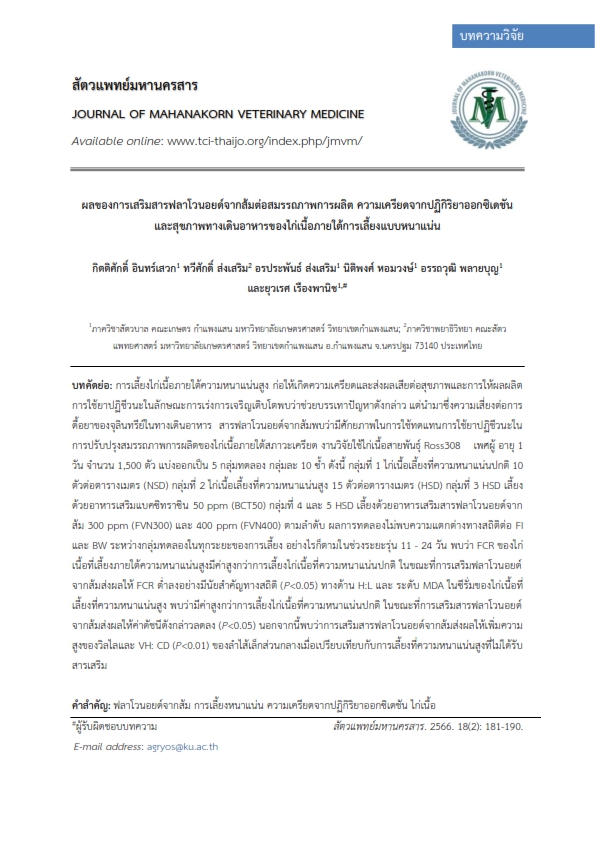
การเลี้ยงไก่เนื้อภายใต้ความหนาแน่นสูง ก่อให้เกิดความเครียดและส่งผลเสียต่อสุขภาพและการให้ผลผลิต การใช้ยาปฏิชีวนะในลักษณะการเร่งการเจริญเติบโตพบว่าช่วยบรรเทาปัญหาดังกล่าว แต่นำมาซึ่งความเสี่ยงต่อการดื้อยาของจุลินทรีย์ในทางเดินอาหาร สารฟลาโวนอยด์จากส้มพบว่ามีศักยภาพในการใช้ทดแทนการใช้ยาปฏิชีวนะในการปรับปรุงสมรรถภาพการผลิตของไก่เนื้อภายใต้สภาวะเครียด งานวิจัยใช้ไก่เนื้อสายพันธุ์ Ross308 เพศผู้ อายุ 1 วัน จำนวน 1,500 ตัว แบ่งออกเป็น 5 กลุ่มทดลอง กลุ่มละ 10 ซ้ำ ดังนี้ กลุ่มที่ 1 ไก่เนื้อเลี้ยงที่ความหนาแน่นปกติ 10 ตัวต่อตารางเมตร (NSD) กลุ่มที่ 2 ไก่เนื้อเลี้ยงที่ความหนาแน่นสูง 15 ตัวต่อตารางเมตร (HSD) กลุ่มที่ 3 HSD เลี้ยงด้วยอาหารเสริมแบคซิทราซิน 50 ppm (BCT50) กลุ่มที่ 4 และ 5 HSD เลี้ยงด้วยอาหารเสริมสารฟลาโวนอยด์จากส้ม 300 ppm (FVN300) และ 400 ppm (FVN400) ตามลำดับ ผลการทดลองไม่พบความแตกต่างทางสถิติต่อ FI และ BW ระหว่างกลุ่มทดลองในทุกระยะของการเลี้ยง อย่างไรก็ตามในช่วงระยะรุ่น 11 - 24 วัน พบว่า FCR ของไก่เนื้อที่เลี้ยงภายใต้ความหนาแน่นสูงมีค่าสูงกว่าการเลี้ยงไก่เนื้อที่ความหนาแน่นปกติ ในขณะที่การเสริมฟลาโวนอยด์จากส้มส่งผลให้ FCR ต่ำลงอย่างมีนัยสำคัญทางสถิติ (P<0.05) ทางด้าน H:L และ ระดับ MDA ในซีรั่มของไก่เนื้อที่เลี้ยงที่ความหนาแน่นสูง พบว่ามีค่าสูงกว่าการเลี้ยงไก่เนื้อที่ความหนาแน่นปกติ ในขณะที่การเสริมสารฟลาโวนอยด์จากส้มส่งผลให้ค่าดัชนีดังกล่าวลดลง (P<0.05) นอกจากนี้พบว่าการเสริมสารฟลาโวนอยด์จากส้มส่งผลให้เพิ่มความสูงของวิลไลและ VH: CD (P<0.01) ของลำไส้เล็กส่วนกลางเมื่อเปรียบเทียบกับการเลี้ยงที่ความหนาแน่นสูงที่ไม่ได้รับสารเสริม
Article Details

อนุญาตภายใต้เงื่อนไข Creative Commons Attribution-NonCommercial-NoDerivatives 4.0 International License.
เอกสารอ้างอิง
Abudabos, A.M., Samara, E.M., Hussein, E.O.S., Al-Ghadi, M.Q. and AlAtiyat, R. M. 2013. Impacts of stocking density on the performance and welfare of broiler chickens. Ital. J. Anim. Sci. 12: e66–e71.
Brunnsgaard, G. 1998. Effects of cereal type and feed particle size on morphological characteristics epithelial cell proliferation and lectin binding patterns in the large intestine of pig. J. Anim. 76: 2786-2798.
Guardia S. 2011. Effects of stocking density on the growth performance and digestive microbiota of broiler chickens. Poult. Sci. 90: 1878-1889.
Gomes, A.V.S., Quinteiro-Filho, W.M., Ribeiro, A., Ferraz-de-Paula, V., Pinheiro, M.L., Baskeville, E., Akamine, A.T., Astolfi-Ferreira, C.S., Ferreira, A.J.P., Palermo-Neto, J. 2014. Overcrowding stress decreases macrophage activity and increases Salmonella enteritidis invasion in broiler chickens. Avian. Pathol. 43: 82–90.
Grotto, D., Santa Maria, L.D., Boeira, S., Valentini, J., Charão, M.F., Moro, A.M., Nascimento, P.C., Pomblum, V.J. and Garcia, S.C. 2007. Rapid quantification of malondialdehyde in plasma by high performance liquid chromatography-visible detection. J. Pharm. Biomed. Anal. 43: 619–624.
Kabploy, K., Bunyapraphatsara, N., Morales, N.P. and Paraksa, N. 2016. Effect of antibiotic growth promoters on anti-oxidative and anti-inflammatory activities in broiler chickens. Thai. J. Vet. Med. 46(1): 89-95.
Kamboh, A.A., Hang, S.Q., Bakhetgul, M. and Zhu, W-Y. 2013. Effects of genistein and hesperidin on biomarkers of heat stress in broilers under persistent summer stress. Poult. Sci. 92: 2411-2418.
Kim, H.P., Kun, H.S., Hyeun, W.C. and Sam, S.K. 2004. Anti-inflammatory plant flavonoids and cellular action mechanisms. J. Pharmacol. Sci. 96: 229-245.
Li, W., Wei, F., Xu, B., Sun, Q., Deng, W., Ma, H., Bai, J. and Li, S. 2019. Effect of stocking density and alpha-lipoic acid on the growth performance, physiological and oxidative stress and immune response of broilers. Asian Austral. J. Anim. 32(12): 1914-1922.
Niewold, T.A. 2007. The nonantibiotic anti-inflammatory effect of antimicrobial growth promoters, the real mode of action? A hypothesis. Poult. Sci. 86: 605–609.
Nimse, S.B. and Pal, D. 2015. Free radicals, natural antioxidants, and their reaction mechanisms. RSC Adv. 5(35): 27986-8006.
Panche, A.N, Diwan, A.D. and Chandra, S.R. 2016. Flavonoids: an overview. J. of Nutri. Sci. 5(47): 1-15.
Prevatto, J.P., Torres, R.C., Diaz, B.L., Silva, P.M.R., Martins, M.A., and Carvalho, V.F. 2017. Antioxidant Treatment Induces Hyperactivation of the HPA Axis by Upregulating ACTH Receptor in the Adrenal and Downregulating Glucocorticoid Receptors in the Pituitary. Oxid. Med. Cell Longev. 2017: 4156361.
Turan, A. and Mahmood, A. 2007. The profile of antioxidant systems and lipid peroxidation across the crypt-villus axis in rat intestine. Dig. Dis. Sci. 52: 1840-1844.
Zhou, Y., Mao, S. and Zhou, M. 2019. Effect of the flavonoid baicalein as a feed additive on the growth performance, immunity, and antioxidant capacity of broiler chickens. Poult. Sci. 98 (7): 2790-2799.
Zhu, A.N., Zhang, K.Y., Wang, J.P., Bai, S.P., Zeng, Q.F., Peng, H.W. and Ding, X.M. 2021. Effect of different concentrations of neohesperidin dihydrochalcone on performance, egg quality, serum biochemistry and intestinal morphology in laying hens. Poult. Sci. 100: 101387.
