The art and sciences of Tuina: From past to present
Keywords:
Tuina, Traditional Chinese medicine, Chinese Tuina massage, Tuina therapyAbstract
Recently, alternative medicine was interested in its sciences, one of alternative therapy using the concept of patient center, and it was also holistic care. Chinese Tuina Massage has been one of the sciences on traditional Chinese medicine since the ancient era. The explicit knowledge of Chinese Tuina Massage has been developed continually has been around for a very long time, as evidenced by the scriptures “Huangdi Neijing”, the first traditional Chinese medicine textbook completely edited in Qin and Han Dynasty. Chinese Tuina Massage has been used to heal the disease in Ayurveda, Obstetrics & Gynecology, Pediatrics, Orthopedics etc. Additionally, there were investigations to apply Tui Na massage used in other areas of medicine including textbook of Chinese Tuina Massage was edited as considering the new information generated by treating various illnesses. The advantages were safety and disappearing of any side effects. Currently, Tuina is a popular alternative treatment as it restores balance to the body. It helps regulate the circulatory, nervous and muscular systems, relieves pain and promotes general health. It is also recognized by the World Health Organization for its effectiveness in treating disease.
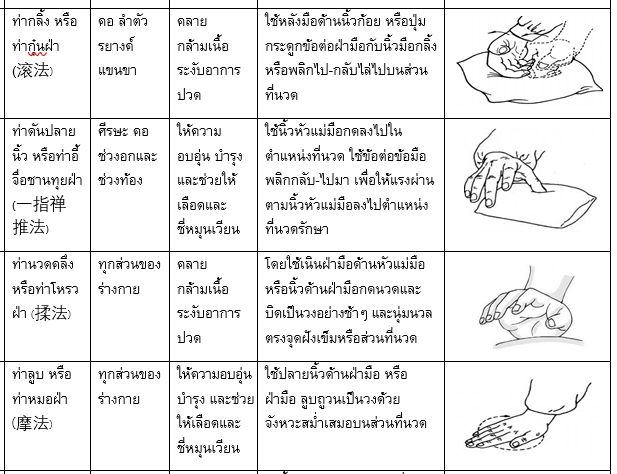
This article aims to provide a comprehensive analysis of the knowledge surrounding Tuina. Five key areas are covered: its history and development, underlying principles and practices, relevant theoretical frameworks, preparation for massage, and fundamental Tuina techniques. The discussion highlights the historical context, the theoretical foundations, and the systematic application of Tuina therapy in clinical practice.
References
Buddharat U, Sen-Ngam K, Khamchan P. Using eastern wisdoms in nursing care for patients of registered nurse in the South of Thailand. J Res Nurs Midwifery Health Sci. 2015;35(2):1–20. (In Thai)
Bullock RR. Essential traditional Chinese medicine. London: Caxton Editions; 2002.
Ilić D, Đurović A, Brdareski Z, Vukomanović A, Pejović V, Grajić M. The position of the Chinese massage (Tuina) in clinical medicine. Vojnosanit Pregl. 2012;69(11):999–1004.
Mihajlovic V. Physiotherapy Rijeka Crnojevi. Obodsko slovo; 2002.
McCarthy M. Palpatory literacy, Chinese therapeutic bodywork (Tui Na) and the remediation of head, neck and shoulder pain. J Bodyw Mov Ther. 2003;7(4):262–77.
Hoisung N, Saiwadi S, Kruewan S. Study of differences between massage therapy for low back pain with traditional Chinese medicine and Thai traditional medicine. In: The 6th National Academic Conference; 30 Mar 2019; Nakhon Ratchasima, Thailand. Nakhon Ratchasima: Nakhon Ratchasima College; 2019.
Huachiew Traditional Chinese Medicine Clinic. Tuina massage therapy in Chinese medicine [Internet]. [cited 2024 Aug 11]. Available from: https://www.huachiewtcm.com/content/6276/ .(In Thai)
Ding Q, Yan M, Zhou J, Yang L, Guo J, Wang J, et al. Clinical effects of innovative tuina manipulations on treating cervical spondylosis of vertebral artery type and changes in cerebral blood flow. J Tradit Chin Med. 2012;32(3):388–92.
World Health Organization. WHO benchmark for practice of Tuina. Geneva: World Health Organization.
Jueangprasert W, et al. Chinese–Thai–English dictionary of traditional Chinese medicine terms. Bangkok: Phumthong Publishing; 2021. (In Thai)
Wanarat L, et al. Basic traditional Chinese medicine. Nonthaburi: Department for Development of Thai Traditional and Alternative Medicine, Ministry of Public Health; 2008. (In Thai)
Beijing College of Traditional Chinese Medicine. Essentials of Chinese acupuncture. Shanghai: Shanghai Scientific and Technical Publishers; 2002.
Melzack R, Wall PD. Gate control theory: on the evolution of pain concepts. Forum. 1996 Summer;128–38.
Xu Massage. Ordinary higher education (Version 15). Beijing: China Press of Traditional Chinese Medicine Publishing Co.; 2008.
Yuan JT. Tui Na textbook. Beijing: China of Traditional Chinese Medicine Publishing Co., Ltd.; 2003.
Yuan Y, Ma H, Li S, Zou H, Tong X, Zhang G, et al. Optimization of Tuina rolling manipulation parameters to promote blood circulation using a circulatory orthogonal experiment. J Phys Ther Sci. 2024;36(5):294–302.
Xiao Y, Yang D, Huang CH, et al. Metrological analysis of Tuina on experimental animal models. Chin J Basic Med Tradit Chin Med. 2021;27:1160–4.
Kang SH, Kim IK, Choi EJ, So WY. Effects of the Tui-na and Thai massage techniques on vascular arterial compliance in middle-aged Korean men. Iran J Public Health. 2018;47(2):292.
Seifert G, Kanitz JL, Rihs C, et al.: Rhythmical massage improves autonomic nervous system function: a single-blind randomised controlled trial. J Integr Med, 2018, 16: 172–177.
Aree T, Kritpet T, Maphong R. The acute effects of different tuina time massage on work-related muscle pain from office syndrome in office workers. J Sports Sci Health. 2023;25(2):118–33. (In Thai)
Chen M. Analysis of the therapeutic effect of traditional Chinese massage combined with acupuncture and moxibustion in the treatment of cervical spondylopathy of vertebral artery type. China Acad J Electron Publ House. 2021;28(36):145–9.
Kou ZW. Clinical study on 90 cases of cervical spondylosis of Qi and blood stagnation type treated with acupuncture combined Tuina massage. Stud Trace Elem Health. 2022 [Internet]. [cited 2024 Aug 14]. Available from: https://kns.cnki.net/kcms/detail/52.1081.R.20220120.1739.072.html.
Yu BP. Clinical study on tuina for acute cervical radiculopathy. China Pract Med. 2021;16(2):163–5.
Cheng ZJ, Zhang SP, Gu YJ, Chen ZY, Xie FF, Guan C, et al. Effectiveness of Tuina therapy combined with Yijinjing exercise in the treatment of nonspecific chronic neck pain: a randomized clinical trial. JAMA Netw Open. 2022;5(12):e2246538-e2246538.
Liu L, Huang J, Li T, Qiu M, Huang Y, Fan Z, et al. Efficacy and safety of Tuina (Chinese Therapeutic Massage) for chronic ankle instability: a systematic review and meta-analysis of randomized controlled trials. PLoS One. 2025;20(6):e0321771.
Downloads
Published
How to Cite
Issue
Section
License
Copyright (c) 2025 University of Phayao

This work is licensed under a Creative Commons Attribution-NonCommercial-NoDerivatives 4.0 International License.
ผู้นิพนธ์ต้องรับผิดชอบข้อความในบทนิพนธ์ของตน มหาวิทยาลัยพะเยาไม่จำเป็นต้องเห็นด้วยกับบทความที่ตีพิมพ์เสมอไป ผู้สนใจสามารถคัดลอก และนำไปใช้ได้ แต่จะต้องขออนุมัติเจ้าของ และได้รับการอนุมัติเป็นลายลักษณ์อักษรก่อน พร้อมกับมีการอ้างอิงและกล่าวคำขอบคุณให้ถูกต้องด้วย
The authors are themselves responsible for their contents. Signed articles may not always reflect the opinion of University of Phayao. The articles can be reproduced and reprinted, provided that permission is given by the authors and acknowledgement must be given.