Role of probiotics and alteration of the gut microbiota in alzheimer’s disease
Keywords:
Probiotics, Gut Microbiota, Alzheimer’s DiseaseAbstract
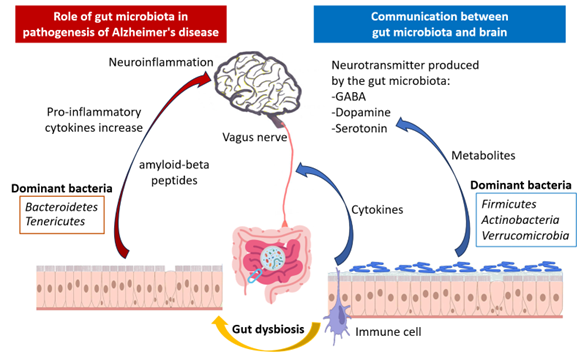
Alzheimer’s disease is the most prevalent form of neurodegenerative disorder, primarily affecting the elderly population. This chronic condition is characterized by the progressive destruction of various components of the nervous system. The hallmark pathological features commonly observed in patients include the accumulation of amyloid-beta (Aβ) plaques, the formation of neurofibrillary tangles, and chronic neuroinflammation within the brain. In recent years, there has been growing interest in the use of probiotic supplementation due to its potential health benefits. Probiotics have been shown to support intestinal barrier integrity, enhance immune function, and promote the diversity of gut microbiota. A balanced gut microbiota plays a critical role in maintaining central nervous system homeostasis and modulating neurotransmitter signaling, thereby contributing to improved prognosis in Alzheimer’s disease. Therefore, the present article aims to elucidate the role of probiotics and gut microbiota in modulating neuroinflammation and the pathogenesis of Alzheimer’s disease.
References
Long JM, Holtzman DM. Alzheimer Disease: An Update on pathobiology and treatment strategies. Cell. 2019;179(2):312-39.
Naomi R, Embong H, Othman F, Ghazi HF, Maruthey N, Bahari H. Probiotics for Alzheimer's disease: a systematic review. Nutrients. 2021;14(1):20. doi:10.3390/nu14010020.
Yang J, Liang J, Hu N, He N, Liu B, Liu G, et al. The gut microbiota modulates neuroinflammation in Alzheimer's disease: Elucidating Crucial Factors and Mechanistic Underpinnings. CNS Neurosci Ther. 2024;30(10):e70091.
Lee JH, Jia J, Ji Y, Kandiah N, Kim S, Mok V, et al. A Framework for best practices and readiness in the advent of anti-amyloid therapy for early Alzheimer's disease in Asia. J Alzheimers Dis. 2024;101(1):1-12.
Zheng Q, Wang X. Alzheimer's disease: insights into pathology, molecular mechanisms, and therapy. Protein Cell. 2025;16(2):83-120.
Sheikhi K, Momenabadi V, Khosravi S, Souri A, Goodarzi E. Burden of risk factors attributable to Alzheimer's disease and other dementia and its relationship with the Socio-Demographic index in Asia. BMC Neurol. 2025;25(1):247.
Wangtongkum S, Sucharitkul P, Silprasert N, Inthrachak R. Prevalence of dementia among population age over 45 years in Chiang Mai, Thailand. J Med Assoc Thai. 2008;91(11):1685-90.
Jitapunkul S, Kunanusont C, Phoolcharoen W, Suriyawongpaisal P. Prevalence estimation of dementia among Thai elderly: a national survey. J Med Assoc Thai. 2001;84(4):461-7.
Kamatham PT, Shukla R, Khatri DK, Vora LK. Pathogenesis, diagnostics, and therapeutics for Alzheimer's disease: Breaking the memory barrier. Ageing Res Rev. 2024;101:102481.
Hardy J, Selkoe DJ. The amyloid hypothesis of Alzheimer's disease: progress and problems on the road to therapeutics. Science. 2002;297(5580):353-6. doi: 10.1126/science.1072994.
Al-Ghraiybah NF, Wang J, Alkhalifa AE, Roberts AB, Raj R, Yang E, et al. Glial cell-mediated neuroinflammation in Alzheimer's disease. Int J Mol Sci. 2022;23(18):10572.
Dominguez-Bello MG, Costello EK, Contreras M, Magris M, Hidalgo G, Fierer N, et al. Delivery mode shapes the acquisition and structure of the initial microbiota across multiple body habitats in newborns. Proc Natl Acad Sci U S A. 2010;107(26):11971-5.
Chandrasekaran P, Weiskirchen S, Weiskirchen R. Effects of probiotics on gut microbiota: an overview. Int J Mol Sci. 2024;25(11):6022. doi: 10.3390/ijms25116022.
Koh A, De Vadder F, Kovatcheva-Datchary P, Backhed F. From dietary fiber to host physiology: short-chain fatty acids as key bacterial metabolites. Cell. 2016;165(6):1332-45.
Buffie CG, Pamer EG. Microbiota-mediated colonization resistance against intestinal pathogens. Nat Rev Immunol. 2013;13(11):790-801.
Cryan JF, O'Riordan KJ, Cowan CSM, Sandhu KV, Bastiaanssen TFS, Boehme M, et al. The microbiota-gut-brain axis. Physiol Rev. 2019;99(4):1877-2013.
Hill C, Guarner F, Reid G, Gibson GR, Merenstein DJ, Pot B, et al. Expert consensus document. The International Scientific Association for Probiotics and Prebiotics consensus statement on the scope and appropriate use of the term probiotic. Nat Rev Gastroenterol Hepatol. 2014;11(8):506-14.
Liu Q, Yu Z, Tian F, Zhao J, Zhang H, Zhai Q, et al. Surface components and metabolites of probiotics for regulation of intestinal epithelial barrier. Microb Cell Fact. 2020;19(1):23.
Wang H, Lee IS, Braun C, Enck P. Effect of probiotics on central nervous system functions in animals and humans: a systematic review. J Neurogastroenterol Motil. 2016;22(4):589-605.
Ministry of Public Health. Notification of the Ministry of Public Health (No. 311) B.E. 2554 (2011) Re: Use of Probiotic Microorganisms in Foods. Government Gazette Vol. 128, Special Part 80 Ngor (June 1, 2011).
Pant A, Maiti TK, Mahajan D, Das B. Human gut microbiota and drug metabolism. Microb Ecol. 2023;86(1):97-111.
Lee BJ, Bak YT. Irritable bowel syndrome, gut microbiota and probiotics. J Neurogastroenterol Motil. 2011;17(3):252-66.
Zhao S, Liang S, Tao J, Peng Y, Chen S, Wai HKF, et al. Probiotics for adults with major depressive disorder compared with antidepressants: a systematic review and network meta-analysis. Nutr Rev. 2025;83(1):72-82.
Bonfili L, Cecarini V, Cuccioloni M, Angeletti M, Berardi S, Scarpona S, et al. SLAB51 probiotic formulation activates SIRT1 pathway promoting antioxidant and neuroprotective effects in an AD mouse model. Mol Neurobiol. 2018;55(10):7987-8000.
Wang C, Zheng D, Weng F, Jin Y, He L. Sodium butyrate ameliorates the cognitive impairment of Alzheimer's disease by regulating the metabolism of astrocytes. Psychopharmacology (Berl). 2022;239(1):215-27.
Kowalski K, Mulak A. Brain-gut-microbiota axis in Alzheimer's disease. J Neurogastroenterol Motil. 2019;25(1):48-60.
Rinninella E, Raoul P, Cintoni M, Franceschi F, Miggiano GAD, Gasbarrini A, et al. What is the healthy gut microbiota composition? a changing ecosystem across age, environment, diet, and diseases. Microorganisms. 2019;7(1).
Akbari E, Asemi Z, Daneshvar Kakhaki R, Bahmani F, Kouchaki E, Tamtaji OR, et al. Effect of probiotic supplementation on cognitive function and metabolic status in Alzheimer's disease: a randomized, double-blind and controlled trial. Front Aging Neurosci. 2016;8:256.
Kobayashi Y, Kinoshita T, Matsumoto A, Yoshino K, Saito I, Xiao JZ. Bifidobacterium breve A1 supplementation improved cognitive decline in older adults with mild cognitive impairment: an open-label, single-arm study. J Prev Alzheimers Dis. 2019;6(1):70-5.
Li X, Hu S, Yin J, Peng X, King L, Li L, et al. Effect of synbiotic supplementation on immune parameters and gut microbiota in healthy adults: a double-blind randomized controlled trial. Gut Microbes. 2023;15(2):2247025.
Liu W, Guo J, Dong Y, Li J, Wang Y. Efficacy of probiotic supplementation in influencing cognitive function in Alzheimer's disease: a systematic review and meta-analysis. J Food Sci. 2025;90(7):e70037.
Lan X, Li B, Zhao J, Stanton C, Ross RP, Chen W, et al. Probiotic intervention improves metabolic outcomes in gestational diabetes mellitus: a meta-analysis of randomized controlled trials. Clin Nutr. 2024;43(7):1683-95.
Dudek-Wicher R, Junka A, Paleczny J, Bartoszewicz M. Clinical trials of probiotic strains in selected disease entities. Int J Microbiol. 2020;2020:8854119.
Downloads
Published
How to Cite
Issue
Section
License
Copyright (c) 2025 University of Phayao

This work is licensed under a Creative Commons Attribution-NonCommercial-NoDerivatives 4.0 International License.
ผู้นิพนธ์ต้องรับผิดชอบข้อความในบทนิพนธ์ของตน มหาวิทยาลัยพะเยาไม่จำเป็นต้องเห็นด้วยกับบทความที่ตีพิมพ์เสมอไป ผู้สนใจสามารถคัดลอก และนำไปใช้ได้ แต่จะต้องขออนุมัติเจ้าของ และได้รับการอนุมัติเป็นลายลักษณ์อักษรก่อน พร้อมกับมีการอ้างอิงและกล่าวคำขอบคุณให้ถูกต้องด้วย
The authors are themselves responsible for their contents. Signed articles may not always reflect the opinion of University of Phayao. The articles can be reproduced and reprinted, provided that permission is given by the authors and acknowledgement must be given.