Factors predicting two-step test performance: Balance, gait speed, and fear of falling in community-dwelling older adults
Keywords:
Physical performance, Two-step test score, Elderly, Timed up and go testAbstract
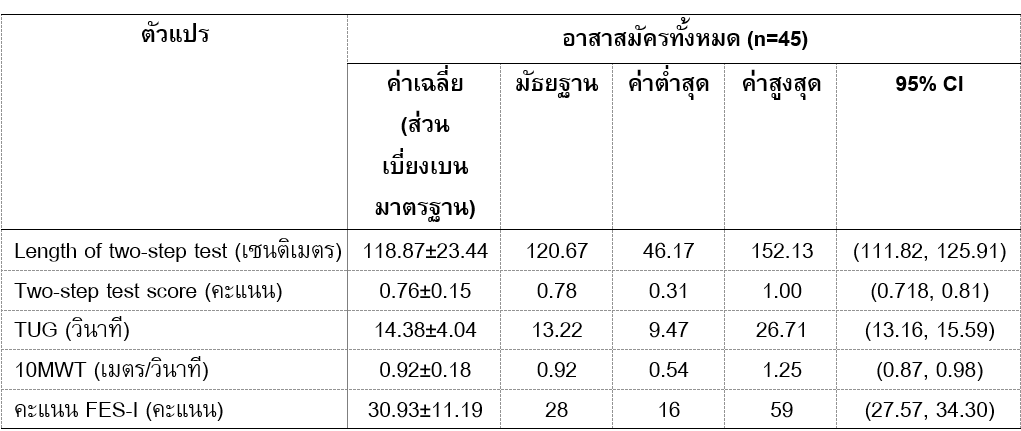
A walking cycle consists of two consecutive steps, which requires balance control and influences gait speed. The Two-Step Test is used to assess maximum stride, which may reflect balance ability, gait speed, and fear of falling. Therefore, this study aimed to investigate the correlation between Two-Step Test and dynamic balance, gait speed, and fear of falling, as well as to identify factors predicting Two-Step Test in community-dwelling older adults. A total of 45 participants with an average aged 66.80 ± 6.52 years were assessed using the Two-Step Test, Timed Up and Go (TUG), 10-Meter Walk Test (10MWT), and the Fall Efficacy Scale-International (FES-I). Correlation analyses were conducted between Two-Step Test outcomes (length of two-step and two-step test score) and TUG, 10MWT, and FES-I scores. Multiple linear regression analysis was performed to identify predictors of Two-Step Test using TUG, 10MWT, and FES-I as independent variables. The results showed that both length of two-step and two-step test score were significantly correlated at low to moderate levels with TUG (rs = -0.441, p-value < 0.002), 10MWT (rs = 0.399, p-value < 0.007), and FES-I scores (rs = -0.363, p-value < 0.014). TUG was the only significant predictor of both length of two-step (Beta weight = -2.816) and two-step test score (Beta weight = -0.017). The regression models explained 23.60% (R² = 0.236, p-value < 0.001) and 21.00% (R² = 0.210, p-value < 0.001), respectively. In conclusion, the Two-Step Test can reflect dynamic balance ability in community-dwelling older adults.
References
United Nations Department of Economic and Social Affairs, Population Division. World population prospects 2022: summary of results. 1st edition. New York: United Nations Publication; 2022. p. 1-52.
Department of Older Persons. Situation of the Thai Elderly 2022. 1st ed. Bangkok: Amarin Corporations Public Company Limited; 2023. pp. 9–10. (in Thai)
Brachman A, Hadyk V, Kamieniarz-Olczak A, Nawrat-Szołtysik A. Examining the role of fear of falling on gait parameters and short-term gait adaptation in older adults. J Clin Med. 2025; 14(23):8311.
Osoba MY, Rao AK, Agrawal SK, Lalwani AK. Balance and gait in the elderly: A contemporary review. Laryngoscope Investig Otolaryngol. 2019 ;4(1):143-53.
Pirker W, Katzenschlager R. Gait disorders in adults and the elderly: A clinical guide. Wien Klin Wochenschr. 2017 ;129(3-4):81-95.
Saidani S, Haddad R, Bouallegue R, Shubair R. Fear of falling and risk factors in older adults. Procedia Comput Sci. 2022;203(2022):247–53.
Muramoto A, Imagama S, Ito Z, Hirano K, Ishiguro N, Hasegawa Y. Spinal sagittal balance substantially influences locomotive syndrome and physical performance in community-living middle-aged and elderly women. J Orthop Sci. 2016;21(2):216–21.
Howland J, Lachman ME, Peterson EW, Cote J, Kasten L, Jette A. Covariates of fear of falling and associated activity curtailment. Gerontologist.1998;38(5):549-55.
Makino K, Makizako H, Doi T, Tsutsumimoto K, Hotta R, Nakakubo S, et al. Fear of falling and gait parameters in older adults with and without fall history. Geriatr Gerontol Int. 2017;17(12):2455-9.
Chamberlin ME, Fulwider BD, Sanders SL, Medeiros JM. Does fear of falling influence spatial and temporal gait parameters in elderly persons beyond changes associated with normal aging?. J Gerontol A Biol Sci Med Sci. 2005;60(9):1163–7.
Kojima K, Kamai D, Ishitani S, Watanabe S. Availability of the two-step test to evaluate balance in frail people in a day care service. J Phys Ther Sci. 2017;29(6):1025-8.
Nakamura K, Ogata T. Locomotive syndrome: Definition and management. Clin Rev Bone Miner Metab. 2016;14(2):56-67.
Rakpanich P. Exercise for Hypertensive Patients. Royal Thai Navy Medical Journal. 2014;41(1):35–43. (in Thai)
Riley RD, Ensor J, Snell KI, Harrell FE, Martin GP, Reitsma JB, et al. Calculating the sample size required for developing a clinical prediction model. BMJ. 2020;368:1-12.
Podsiadlo, D.; Richardson, S. The timed “Up & Go”: A test of basic functional mobility for frail elderly persons. J Am Geriatr Soc. 1991;39:142–8.
Beauchet O, Fantino B, Allali G, Muir SW, Montero-Odasso M, Annweiler C. Timed Up and Go test and risk of falls in older adults: a systematic review. J Nutr Health Aging. 2011;15(10):933-8.
Peters DM, Fritz SL, Krotish DE. Assessing the reliability and validity of a shorter walk test compared with the 10-meter walk test for measurements of gait speed in healthy, older adults. J Geriatr Phys Ther. 2013;36(1):24-30.
Amatachaya S, Naewla S, Srisim K, Arrayawichanon P, Siritaratiwat W. Concurrent validity of the 10-meter walk test as compared with the 6-minute walk test in patients with spinal cord injury at various levels of ability. Spinal Cord. 2014;52(4):333-6.
Yardley L, Beyer N, Hauer K, Kempen G, Piot-Ziegler C, Todd C. Development and initial validation of the Falls Efficacy Scale-International (FES-I). Age Ageing. 2005;34(6):614-9.
Thiamwong L. (2011). Testing the properties of a fear of falling assessment tool in Thai older adults. Songklanagarind Medical Journal, 2011:29(6), 277–86. (in Thai)
Medina-Jiménez EA, Acosta-Quiroz CO, García-Flores R. Adaptation and validation of the Falls Efficacy Scale-International (FES-I) in community-dwelling older Mexican adults. Gerontol Geriatr Med. 2023;9:1-9.
Schober P, Boer C, Schwarte LA. Correlation coefficients: Appropriate use and interpretation. Anesth Analg. 2018;126(5):1763-8.
Tesio L, Rota V. The motion of body center of mass during walking: A review oriented to clinical applications. Front Neurol. 2019;10:999.
Lim MR, Huang RC, Wu A, Girardi FP, Cammisa FP. Evaluation of the elderly patient with an abnormal gait. J Am Acad Orthop Surg. 2007;15(2):107-17.
Ziegler J, Gattringer H, Müller A. On the relation between gait speed and gait cycle duration for walking on even ground. J Biomech. 2024;164:1-8.
Maki BE, Holliday PJ, Topper AK. Fear of falling and postural performance in the elderly. J Gerontol. 1991;46(4):M123-31.
Downloads
Published
How to Cite
Issue
Section
License
Copyright (c) 2026 University of Phayao

This work is licensed under a Creative Commons Attribution-NonCommercial-NoDerivatives 4.0 International License.
ผู้นิพนธ์ต้องรับผิดชอบข้อความในบทนิพนธ์ของตน มหาวิทยาลัยพะเยาไม่จำเป็นต้องเห็นด้วยกับบทความที่ตีพิมพ์เสมอไป ผู้สนใจสามารถคัดลอก และนำไปใช้ได้ แต่จะต้องขออนุมัติเจ้าของ และได้รับการอนุมัติเป็นลายลักษณ์อักษรก่อน พร้อมกับมีการอ้างอิงและกล่าวคำขอบคุณให้ถูกต้องด้วย
The authors are themselves responsible for their contents. Signed articles may not always reflect the opinion of University of Phayao. The articles can be reproduced and reprinted, provided that permission is given by the authors and acknowledgement must be given.