Social Media Usage Behavior for Nursing Study after the COVID-19 Outbreak of Nursing Students at Princess of Naradhiwas University
Keywords:
Using social media for learning, After the COVID-19outbreak, Nursing studentsAbstract
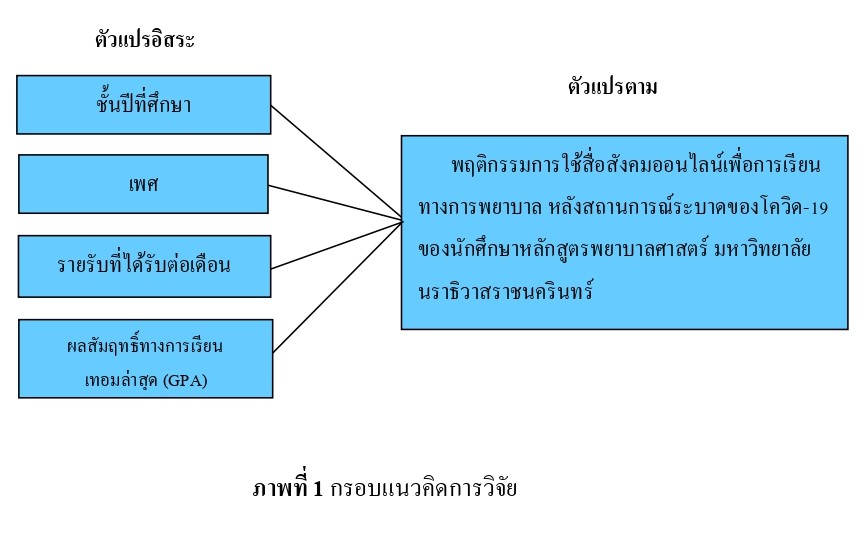
The objective of this research was to examine the factors influencing nursing students' use of social media for their studies after the COVID-19 outbreak at Princess of Naradhiwas University. The study sample was composed of 220 nursing students from Princess of Naradhiwas University. The research tools included a personal information questionnaire, an internet usage pattern questionnaire, and a social media usage behavior of nursing students questionnaire. The reliability of the questionnaire was established at 0.90. Data were analyzed using descriptive statistics, and relationships were assessed using the Chi-Square Test.
The findings revealed that the majority of students were female (89.1%). Students were categorized by year of study as follows: third year (31.4 %), second year (25.5 %), first year (21.8 %), and fourth year (21.3 %). The Grade Point Averages (GPAs) were predominantly good and very good, representing 59.1% and 33.6%, respectively. The highest average monthly income reported among the students was between 3,000 and 5,000 baht. Upon analyzing the relationships, it was found that personal factors such as gender, year of study, and monthly income were not significantly related to social media usage behavior for nursing studies. However, GPA was significantly related to social media usage behavior at a statistical level of 0.05. This indicates that students with good or very good academic performance tend to engage more with social media for their nursing studies compared to other groups. Therefore, it is recommended to provide better access to convenient and quality social media resources to support nursing education.
References
Anderson, T., & Dron, J. (2011). The theory and practice of online learning (2nd ed.). Athabasca University Press. https://www.aupress.ca/app/uploads/120146_99Z_Anderson_2008-Theory _and_Practice_of_Online_Learning.pdf
Bumrungsri, P., Trasuwan, J., Rattanarat, S., Tarakan, A., Chamnankit, N., Pongtongmueang, N., & Srisuk, N. (2021). Behavior of Online Media Use of Students of Faculty of Nursing, Suratthani Rajabhat University. The 13th NPRU National Academic Conference Nakhon Pathom Rajabhat University. https://publication.npru.ac.th/bitstream/123456789/1365 /1/ npru_110.pdf
Cheung, C., Chiu, P., & Lee, M. (2011). Online social network: Why do students use facebook?. Computers in Human Behavior; 27(4), 1337 - 1343. https://doi.org/10.1016/j.chb.2010.07.028
Chuayphen, P., Kongprapun, N., & Pheukfak, S. (2020). Internet usage behavior of students of Rajamangala University of Technology Suvarnabhumi. Journal of Liberal Art of Rajamangala University of Technology Suvarnabhumi, 2(3), 543 - 556. https://so03.tci-thaijo.org/index.php/art/article/view/248779
Cronbach, L.J. (1990). Essentials of psychological testing (5thed.). Harper & Row.
EDTA. (2022). Thailand Internet User Behavior. https://www.etda.or.th/getattachment/ 78750426-4a58-4c36-85d3-d1c11c3db1f3/IUB-65-Final.pdf.aspx
Jarintanan, P., Waloh, W., & Nimu, N. (2025). Factors related to Internet usage behavior after online learning in Nursing students of Princess of Naradhiwas University (Research Report). Faculty of Nursing, Princess of Naradhiwas University.
Jerasopon, P. (1998). Principles and theories of communication. Sukhothai Thammathirat Open University.
Leelathakul, N., & Chaipah, K. (2013). Quantitative Effects of using Facebook as a Learning Tool on Students’ Performance. In Proceeding of The 10th International Joint Conference on Computer Sciences and Software Engineering (pp. 99-104). Khon Kaen University. https://doi.org/10.1109/JCSSE.2013.6567325
Mayer, R. E. (2002). Cognitive Theory and the Design of Multimedia Instruction: An example of the two‐way street between cognition and instruction. New Directions for Teaching and Learning, 2002(89), 55 - 71. https://doi.org/10.1002/tl.47
McCombs, M. E., & Becker, L. B. (1979). Using Mass Communication Theory. Public Opinion Quarterly; 36(2), 176 - 187. https://doi.org/10.1086/267990
Mettathamrong, J., Pakpian, T., & Prajudtasri, P. (2020). A Confirmatory Factor Analysis Model of Internet Using Behavior in Daily Life of Thai Youth in the Social Media. KKU Research Journal (Graduate Studies) Humanities and Social Sciences, 8(3), 73 – 86. https://so04.tcithaijo.org/index.php/gskkuhs/article/view/247813
Ministry of labour (2024). Notification of the Wage Committee on Minimum Wage Rate (No.13). https://www.mol.go.th/wp-content/uploads/sites/2/2025/01/ประกาศค่าจ้าง-ฉ.13-Eng2025.pdf
Santhuenkaew, T., Athikiate, K., & Namwong, T. (2024). Using Social Media to Promote Students' Learning Skills in The Digital Age. Journal of Applied Education, 2(5), 37 – 44. https://so16.tci-thaijo.org/index.php/JAE/article/view/963
Wannathai, P., Paojinda, A., Maneemorakot, T., Ruayrung, J., & Jaion, A. (2023). Effects of Using Online Instructions on Students’ Learning Achievement and Learning Progression in the Small-Sized Secondary Schools in Phetchaburi Province. Journal of teacher professional development, 4(1), 76 - 86. https://ph02.tci-thaijo.org/ index.php/withayajarnjournal/article/ view/247427
Yamane, T. (1973). Statistics: An Introductory Analysis (2rd ed.). Harper and Row.
Downloads
Published
How to Cite
Issue
Section
License
Copyright (c) 2025 Princess of Naradhiwas University Journal

This work is licensed under a Creative Commons Attribution-NonCommercial-NoDerivatives 4.0 International License.