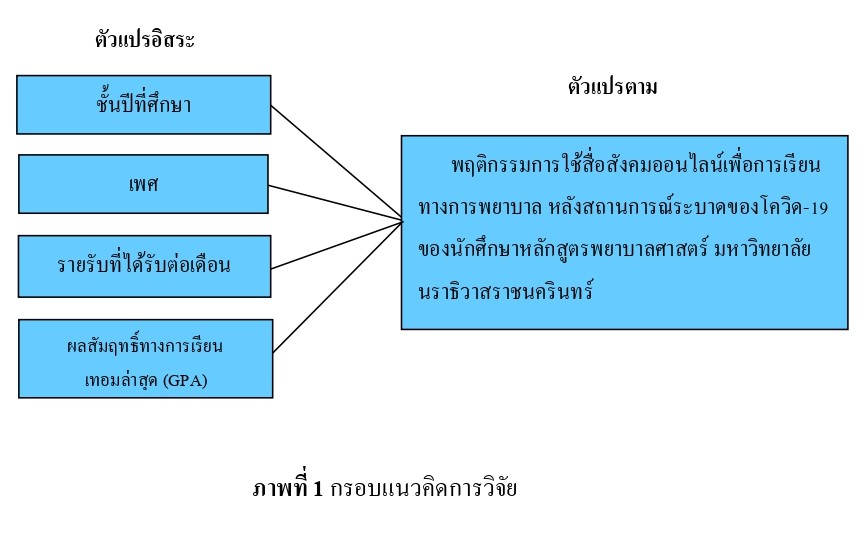
พฤติกรรมการใช้สื่อสังคมออนไลน์เพื่อการเรียนทางการพยาบาล หลังสถานการณ์ระบาด ของโควิด-19 ของนักศึกษาหลักสูตรพยาบาลศาสตร์ มหาวิทยาลัยนราธิวาสราชนครินทร์
คำสำคัญ:
การใช้สื่อสังคมออนไลน์เพื่อการเรียน, หลังสถานการณ์ระบาดของโควิด-19, ระดับพฤติกรรมการดูแลเอื้ออาทร นักศึกษาพยาบาล ผู้คลอดบทคัดย่อ
การวิจัยนี้มีวัตถุประสงค์ เพื่อศึกษาปัจจัยที่มีความสัมพันธ์กับพฤติกรรมการใช้สื่อสังคมออนไลน์เพื่อการเรียนทางการพยาบาล หลังสถานการณ์ระบาดของโควิด-19 ของนักศึกษาหลักสูตรพยาบาลศาสตร์ มหาวิทยาลัยนราธิวาสราชนครินทร์ กลุ่มตัวอย่างคือ นักศึกษาพยาบาลจำนวน 220 คน เครื่องมือที่ใช้ในการวิจัย ประกอบด้วย แบบสอบถามข้อมูลส่วนบุคคล แบบสอบถามรูปแบบการใช้งานอินเทอร์เน็ตและแบบสอบถามพฤติกรรมการใช้สื่อสังคมออนไลน์ของนักศึกษาพยาบาล โดยแบบสอบถามมีค่าความเชื่อมั่นเท่ากับ 0.90 วิเคราะห์ข้อมูลโดยใช้สถิติเชิงพรรณนา (Descriptive statistics) และวิเคราะห์ความสัมพันธ์ด้วยวิธีการทดสอบไคสแควร์ (Chi-Square Test)
ผลการวิจัยพบว่า นักศึกษาส่วนใหญ่เป็นเพศหญิง (ร้อยละ 89.1) โดยเป็นนักศึกษาชั้นปีที่ 3, 2, 1 และ 4 คิดเป็นร้อยละ 31.4, 25.5, 21.8 และ 21.3 ตามลำดับ ผลสัมฤทธิ์ทางการเรียนเทอมล่าสุด (GPA) มากที่สุดคือ ระดับดีและระดับดีมาก คิดเป็นร้อยละ 59.1 และ 33.6 มีรายรับที่ได้ต่อเดือนเฉลี่ยสูงสุดอยู่ที่ 3,000 - 5,000 บาทต่อเดือน เมื่อวิเคราะห์ความสัมพันธ์ พบว่า ปัจจัยด้านเพศ ชั้นปีที่ศึกษา และรายรับที่ได้รับต่อเดือน ไม่มีความสัมพันธ์กับพฤติกรรมการใช้สื่อสังคมออนไลน์เพื่อการเรียนทางการพยาบาลอย่างมีนัยสำคัญทางสถิติ ส่วนผลสัมฤทธิ์ทางการเรียนเทอมล่าสุด (GPA) มีความสัมพันธ์กับพฤติกรรมการใช้สื่อสังคมออนไลน์เพื่อการเรียนทางการพยาบาลอย่างมีนัยสำคัญทางสถิติที่ระดับ 0.05 (χ 2 = 5.992, p = .05) แสดงให้เห็นว่า นักศึกษาที่มีผลการเรียนในระดับดีขึ้นไปมีพฤติกรรมการใช้สื่อสังคมออนไลน์เพื่อการเรียนทางการพยาบาลหลังสถานการณ์ระบาดของโควิด-19 ที่สูงกว่ากลุ่มอื่น ดังนั้น ควรมีการสนับสนุนการเข้าถึงสื่อสังคมออนไลน์ที่สะดวกและมีคุณภาพ เพื่อเพิ่มการเรียนรู้ทางการพยาบาล
เอกสารอ้างอิง
Anderson, T., & Dron, J. (2011). The theory and practice of online learning (2nd ed.). Athabasca University Press. https://www.aupress.ca/app/uploads/120146_99Z_Anderson_2008-Theory _and_Practice_of_Online_Learning.pdf
Bumrungsri, P., Trasuwan, J., Rattanarat, S., Tarakan, A., Chamnankit, N., Pongtongmueang, N., & Srisuk, N. (2021). Behavior of Online Media Use of Students of Faculty of Nursing, Suratthani Rajabhat University. The 13th NPRU National Academic Conference Nakhon Pathom Rajabhat University. https://publication.npru.ac.th/bitstream/123456789/1365 /1/ npru_110.pdf
Cheung, C., Chiu, P., & Lee, M. (2011). Online social network: Why do students use facebook?. Computers in Human Behavior; 27(4), 1337 - 1343. https://doi.org/10.1016/j.chb.2010.07.028
Chuayphen, P., Kongprapun, N., & Pheukfak, S. (2020). Internet usage behavior of students of Rajamangala University of Technology Suvarnabhumi. Journal of Liberal Art of Rajamangala University of Technology Suvarnabhumi, 2(3), 543 - 556. https://so03.tci-thaijo.org/index.php/art/article/view/248779
Cronbach, L.J. (1990). Essentials of psychological testing (5thed.). Harper & Row.
EDTA. (2022). Thailand Internet User Behavior. https://www.etda.or.th/getattachment/ 78750426-4a58-4c36-85d3-d1c11c3db1f3/IUB-65-Final.pdf.aspx
Jarintanan, P., Waloh, W., & Nimu, N. (2025). Factors related to Internet usage behavior after online learning in Nursing students of Princess of Naradhiwas University (Research Report). Faculty of Nursing, Princess of Naradhiwas University.
Jerasopon, P. (1998). Principles and theories of communication. Sukhothai Thammathirat Open University.
Leelathakul, N., & Chaipah, K. (2013). Quantitative Effects of using Facebook as a Learning Tool on Students’ Performance. In Proceeding of The 10th International Joint Conference on Computer Sciences and Software Engineering (pp. 99-104). Khon Kaen University. https://doi.org/10.1109/JCSSE.2013.6567325
Mayer, R. E. (2002). Cognitive Theory and the Design of Multimedia Instruction: An example of the two‐way street between cognition and instruction. New Directions for Teaching and Learning, 2002(89), 55 - 71. https://doi.org/10.1002/tl.47
McCombs, M. E., & Becker, L. B. (1979). Using Mass Communication Theory. Public Opinion Quarterly; 36(2), 176 - 187. https://doi.org/10.1086/267990
Mettathamrong, J., Pakpian, T., & Prajudtasri, P. (2020). A Confirmatory Factor Analysis Model of Internet Using Behavior in Daily Life of Thai Youth in the Social Media. KKU Research Journal (Graduate Studies) Humanities and Social Sciences, 8(3), 73 – 86. https://so04.tcithaijo.org/index.php/gskkuhs/article/view/247813
Ministry of labour (2024). Notification of the Wage Committee on Minimum Wage Rate (No.13). https://www.mol.go.th/wp-content/uploads/sites/2/2025/01/ประกาศค่าจ้าง-ฉ.13-Eng2025.pdf
Santhuenkaew, T., Athikiate, K., & Namwong, T. (2024). Using Social Media to Promote Students' Learning Skills in The Digital Age. Journal of Applied Education, 2(5), 37 – 44. https://so16.tci-thaijo.org/index.php/JAE/article/view/963
Wannathai, P., Paojinda, A., Maneemorakot, T., Ruayrung, J., & Jaion, A. (2023). Effects of Using Online Instructions on Students’ Learning Achievement and Learning Progression in the Small-Sized Secondary Schools in Phetchaburi Province. Journal of teacher professional development, 4(1), 76 - 86. https://ph02.tci-thaijo.org/ index.php/withayajarnjournal/article/ view/247427
Yamane, T. (1973). Statistics: An Introductory Analysis (2rd ed.). Harper and Row.
ดาวน์โหลด
เผยแพร่แล้ว
รูปแบบการอ้างอิง
ฉบับ
ประเภทบทความ
สัญญาอนุญาต
ลิขสิทธิ์ (c) 2025 วารสารมหาวิทยาลัยนราธิวาสราชนครินทร์

อนุญาตภายใต้เงื่อนไข Creative Commons Attribution-NonCommercial-NoDerivatives 4.0 International License.