
The Developing of a Diabetic Retinopathy Screening Program (Eye 3 MUST), Narathiwas Rajanagarindra Hospital
Keywords:
Eyes screening, Diabetic retinopathy, Eyes 3 mustAbstract
The objectives of this research and development were to assess screening prevalence of diabetic retinopathy, and create and evaluate the diabetic retinopathy screening model (eyes 3 must). The processes of this study were conducted in 3 phases: 1) examine the diabetic retinopathy screening status of thirty patients with diabetes mellitus and seven medical professionals, including physicians and nurses. The data was gathered through focus group discussions. Content analysis was used to analyze the data; 2) three experts reviewed the draft of the diabetic retinopathy screening model and 27 registered nurses evaluated its appropriateness, feasibility, and benefits for service clients; and 3) a quasi-experimental methodology of a one-group prepost test with 99 patients with diabetes mellitus was used to assess the model's efficacy. The instruments used in this study were developed diabetic retinopathy screening model and screening record form. Data was analyzed by using frequency, percentage, and one sample t-test.
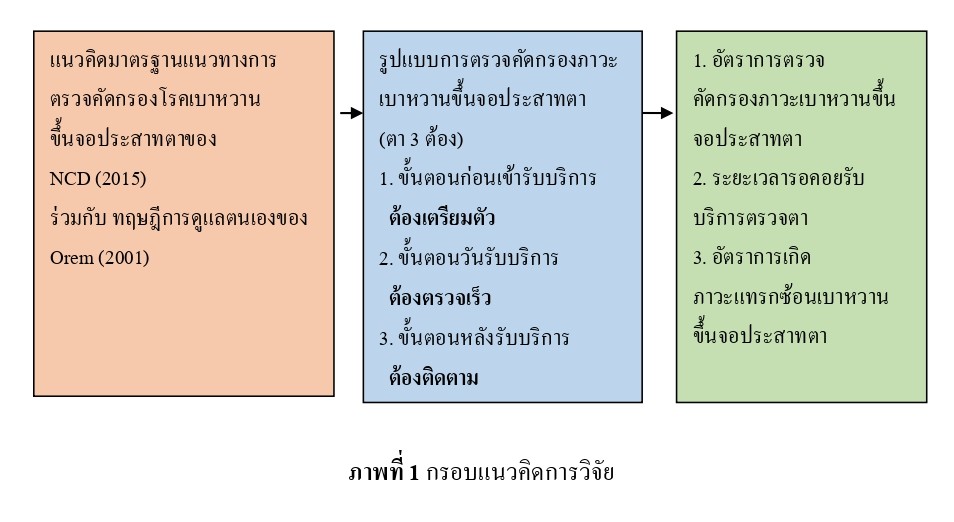
According to the study's findings, the referral process for eye screenings was confusing, there were not enough nurses to handle every case, and patients denied eye examination because of lengthy wait times. The diabetic retinopathy screening model (eyes 3 must) consisted of: 1) preparation before the procedure (must prepare); 2) prompt examination on the day of the procedure (must examine quickly; and 3) follow-up after the procedure (must follow up). According to the results after using the diabetic retinopathy screening model, the screening rate increased from 54.17 percent in 2022 to 71.36 percent in 2023 and 63.03 percent in 2024, respectively. Following the implementation of the diabetic retinopathy screening model, the rate of complications from diabetic retinopathy dropped from 7.37 percent in 2023 to 7.25 percent in 2024. Following the model's implementation, the waiting time for eye examination decreased from 28 minutes to 15.36 minutes (S.D. = 0.63), which was statistically substantially less than the hospital's usual time setting of 20 minutes at the.001 level
(t = 73.21).
References
Alisa, R. (2020). Development of a screening model for diabetic retinopathy. Journal of Enviromental and Community Health, 5(2), 86 - 94. https://he03.tcithaijo.org/index.php/ech/article/download/802/410
Arunee, C., & Wimol, J. (2020). Significant Roles of Nurse Case Manager to Improve Quality of Care for Chronically Ill Patients: Diabetes and Hypertensive Patients. Nursing Journal, 44(4), 195 - 205. https://he02.tci-thaijo.org/index.php/cmunursing/article/view/135865
Atcharawan, S. (2021). The Effect of the practice guideline of waiting time survice of Outpatient Department, King Narai Hospital. Journal of Health and Environmental Education, 6(4), 181 - 189. https://so06.tci-thaijo.org/index.php/hej/article/view/253490
Bureau of Non Communicable Disease [NCD]. (2015). Clinical Practice Guideline Diabetic Retinopathy Screening. The Acricultural Co-Operative Federation of Thailand LTD. (ACFT).
Chanpen, P., Pitsamai, C., & Darunee, M. (2020). Development of Care Model for Patients with Chronic Disease by Community Participation in Lamphun Province. Journal of Health Science 2020, 29(5), 803 - 812. https://thaidj.org/index.php/JHS/article/view/9471
Chayapa, Y. (2020). The Development of a Diabetic Clinic Service by Applying Lean Conceptat Phayakkaphumphisai Hospital, Mahasarakham Province. Mahasarakham Hospital Journal, 17(3), 54 - 63. https://he02.tcithaijo.org/index.php/MKHJ/article/download/247825/169582
Chunthawanich, S. (2010). Qualitative Research Methodology (17th ed). Chulalongkorn University.
Cohen, J. (1988). Statistical power analysis for the behavioral sciences. Hillsdale, Lawrence Erlbaum Associates.
Department of Disease Control Division of Non-Communicable diseases. (2021, January 20). Annual report http://www.thaincd.com/document/file/download/paper-manual/NCDAnnual_Report 2564.pdf
Diabetes Association of Thailand under The Patronage of Her Royal Highness Princess Maha Chakri Sirindhor. (2023). Clinical Practice Guideline for Diabetes. Srimuang Printing.
Faul, F., Erdfelder, E., Lang, A.-G., & Buchner, A. (2007). G*Power 3: A flexible statistical power analysis program for the social, behavioral, and biomedical sciences. Behavior Research Methods, 39, 175 - 191. https://link.springer.com/article/10.3758/BF03193146
Jaroon, B. (2022). Prevalence and factor associated with diabetic retinopathy in type-2 diabetes mellitus in primary care unit at kasetsomboon hospital. Medical Journal of Srisaket Burirum Hospital, 37(2), 341 - 351. https://he02.tcithaijo.org/index.php/MJSSBH/article/view/258908
Kornkan, J. (2023). Prevalence of diabetic retinopathy and relation of Hemoglobin A1c level with occurrence of diabetic retinopathy in diabetic patients at Sanpatong hospital, Chiangmai province. Journal of Disease Prevention and Control 2, Phitsanulok, 10(2), 15 - 25. https://he01.tci-thaijo.org/index.php/dpcphs/article/view/262223/177981
Krippendorff, K. (2013). Content Analysis: An Introduction to Its Methodology. (3rd ed.). SAGE Publication.
Medical record male internal medicine. (2022). Incident medical record effective diabetes retinopathy screening in Naradhiwas rajanagarindra Hospital. Author.
Orem, D.E. (2001). Nursing: Concept of Practice (6th ed.) Mosby.
Siriwan, W., Mukda, D., & Prut, H. (2020). Effect of Educational and Promoting Self-care Behaviors Program for Diabetic Retinopathy Prevention on Clinical Outcomes in Diabetic Patients. Thai Journal of Nursing and Midwifery Practice, 7(2), 57 - 75. https://he02.tcithaijo.org/index. php/apnj/article/view/241479
Supawadee, P., Vorapoj P., & Phadoongsit, C. (2020). Development of Care for Patients with Type 2 Diabetes under the Chronic Disease Management Model (Chronic Care Model) in Diabetes Clinic Khunhan Hospital, Khunhan District, Sisaket Province. Academic Journal of Community Public Health, 6(2), 1 - 15. http://202.28.34.124/dspace/handle/123456789/689
Usanee, R. (2024). Results of the Development of a Nursing Model for Case Management and Self-regulation of Patients with Type 2 Diabetes into Remission of Diabetes. The Office of Disease Prevention and Control 8 Udon Thani Journal, 2(3), 27 - 41. https://he03.tcithaijo.org/index. php/JODPC8/article/view/1833
World Health Organization. (2021, May 26). The top 10 causes of death. https://www.who.int/news-room/fact-sheets/detail/the-top-10-causes-of-death
Downloads
Published
How to Cite
Issue
Section
License
Copyright (c) 2025 Princess of Naradhiwas University Journal

This work is licensed under a Creative Commons Attribution-NonCommercial-NoDerivatives 4.0 International License.