
Development of Practice Guidelines for the Prevention and Treatment of Postpartum Hemorrhage in Mothers with Normal Labor at Narathiwas Rajanagarindra Hospital
Keywords:
Postpartum hemorrhage, Prevention and treatment of PPH in mothers with normal labor, Satisfaction, Effectiveness of obstetric practice guidelineAbstract
This research and development aimed to develop practice guidelines for the prevention and treatment of postpartum hemorrhage (PT-PPH) in mothers with normal labor and evaluate the effectiveness and satisfaction with the use of PT-PPH. The sample group consisted of 74 multidisciplinary obstetrics team members and 300 mothers with normal labor at Narathiwas Rajanagarindra Hospital. Research instruments included 1) a postpartum Hemorrhage (PPH) situation analysis form; 2) maternal data; 3) an AGREE II 2017 assessment form; 4) a PT-PPH usage checklist; and 5) satisfaction with the use of the PT-PPH practice guideline using the Likert Scale and Visual Analog Scale (VAS). Content validity of instrument number 3, 4, and 5 was tested by experts. Reliability of set 3 was .983, set 4 was .75, and set 5 of satisfaction with the Likert Scale = .915; VAS = .998. Situation data was analyzed by using the Colaizzi Technique. Other data were analyzed by using descriptive statistics and an F-test.
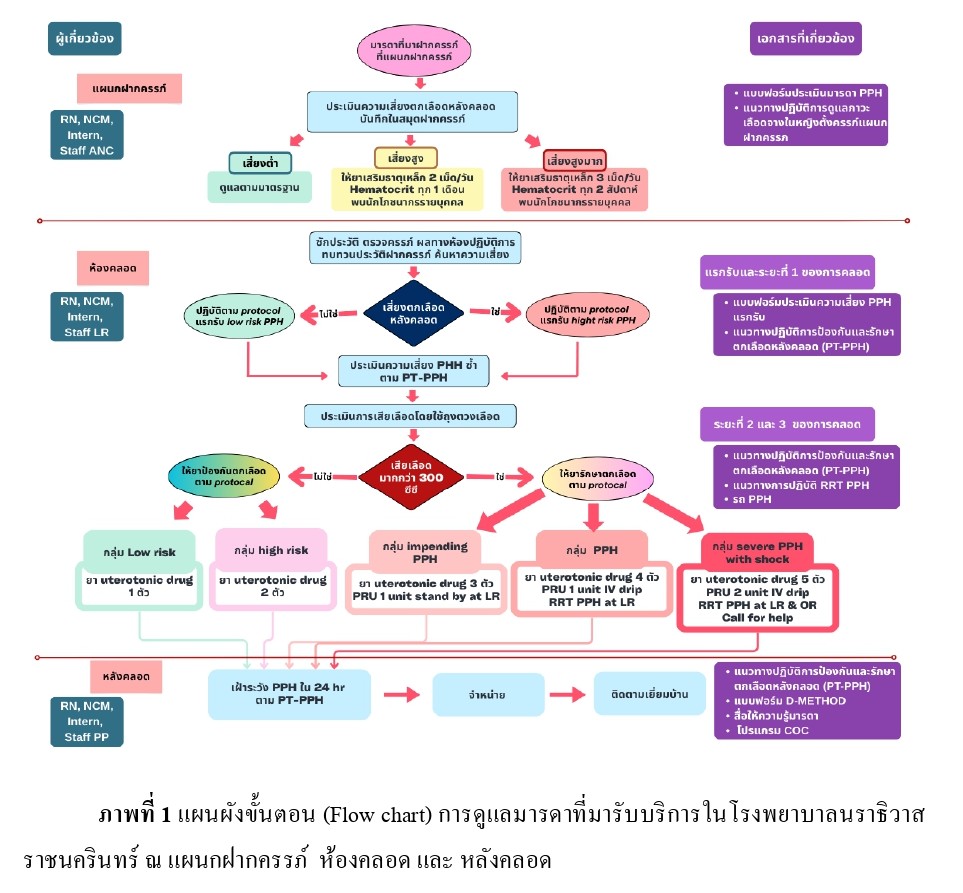
Results revealed that the interdisciplinary team jointly developed and designed the PT-PPH draft, dividing it into prevention groups: low-risk PPH and high-risk PPH. The treatment group included impending PPH, PPH, and severe PPH with shock. The researchers designed the PT-PPH form with 3 columns on a single sheet that included 1) "condition" characteristics of the risk group; 2) “order for one day”; 3) “order for continuation” that clearly separate the treatment plans for each group. The treatment results according to PT-PPH in the first 150 cases showed 2 instances of postpartum hemorrhage due to non-compliance with PT-PPH. The researchers adjusted PT-PPH to make it more user-friendly. In the subsequent 150 cases, no instances of postpartum hemorrhage were observed. The average satisfaction scores for the use of PT-PPH in all groups were at a high level. The results of this study will serve as data for the further development of the PPH prevention and treatment system.
References
Angarita, A. M., Cochrane, E., Bianco, A., & Berghella, V. (2022). Prevention of postpartum hemorrhage in vaginal deliveries. European Journal of Obstetrics & Gynecology and Reproductive Biology, 278, 56 – 63. https://doi.org/10.1016/j.ejogrb.2022.11.021
Colaizzi, P.F. (1978). Psychological research as the phenomenologist views it. In R. S. Valle & M. King (Eds.), Existential-phenomenological alternatives for psychology (pp. 48 – 71). Oxford University Press.
Department of Health, Ministry of Public Health. (2022, May 24). Mortality statistics and causes of maternal death throughout Thailand. http://dashboard.anamai.moph.go.th
Faul, F., Erdfelder, E., Lang, A.-G., & Buchner, A. (2007). G*Power 3: A flexible statistical power analysis program for the social, behavioral, and biomedical sciences. Behavior Research Methods, 39(2), 175 – 191. https://doi.org/10.3758/BF03193146
Giouleka, S., Tsakiridis, I., Kalogiannidis, I., Mamopoulos, A., Tentas, I., Athanasiadis, A., & Dagklis, T. (2022). Postpartum hemorrhage: A comprehensive review of guidelines. Obstetrical & Gynecological Survey, 77(11), 631 – 642. https://doi.org/10.1097/OGX. 0000000000001061
Healthcare Quality Accreditation Institute (Public Organization). (2022). Standard patient care process: Hospitals and health services. Author.
Institute for Medical Technology Research and Evaluation, Department of Medical Services, Ministry of Public Health. (2017). Guideline quality assessment tool for research and evaluation (Appraisal of Guideline for Research and Evaluation II: AGREE II). Author.
Jinakul, D. (2022). Research and development training. Suranaree University of Technology.
Jones, A.J., Federspiel, J.J., & Eke, A C. (2023). Preventing postpartum hemorrhage with combined therapy rather than oxytocin alone. American Journal of Obstetrics & Gynecology: Maternal–Fetal Medicine, 5(2S), 100731. https://doi.org/10.1016/j.ajogmf.2022.100731
Kaewpoung, S., Deoisres, W., & Chinsoi, C. (2021). Factors influencing folic acid intakes among pregnant mothers. Journal of Health and Nursing Research, 37(2), 192 – 202. https://ejournals.swu.ac.th/index.php/pharm/article/view/15396
Krista, S.C., Yan, P.Q., Lorraine, F.Y., Cara, T.M., Lauren, H Z., Arick, W., Kelicia, D., & Jennifer, L.W. (2022). Folic acid and the prevention of birth defects: 30 years of opportunity and controversies. Annual Review of Nutrition, 42, 423 – 452. https://doi.org/10.1146/annurev-nutr- 043020-091647
McCormack, H. M., & Horne, D. J. (1988). Clinical applications of visual analogue scales: A critical review. Psychological Medicine, 18, 1007 – 1019. https://doi.org/10.1017/S0033291700009934
Narathiwat Provincial Public Health Office. (2023, April 23). Narathiwat public health annual performance report 2023. Ministry of Public Health. https://ntwo.moph.go.th/moph-nwt/
Peeyananjarassri, K., Ratipann, N., Suwanrath, C., Pinjaroen, S., Chainarong, N., & Choobun, T. (2023). An in‐depth analysis of maternal mortality in a quaternary university hospital in Southern Thailand: A 16‐year experience. International Journal of Gynecology & Obstetrics, 163(2), 579 – 585. https://doi.org/10.1002/ijgo.14856
Robert, I., Brenner, A., & Shakur-Still, H. (2023). Tranexamic acid for bleeding: Much more than a treatment for postpartum hemorrhage. American Journal of Obstetrics & Gynecology: Maternal–Fetal Medicine, 5(2S), 100722.
https://doi.org/10.1016/j.ajogmf.2022.100722
Royal College of Obstetricians and Gynecologists of Thailand. (2020, June 9). Medical practice guidelines on prevention and treatment of postpartum hemorrhage. Royal Thai College of Obstetricians and Gynecologists. https://www.rtcog.or.th/home/wp-content/uploads/2020/09/ OB-63-020-Prevention-and-Management-of-Postpartum-Hemorrhage.pdf
Ushida, T., Kotani, T., Imai, K., Nakano-Kobayashi, T., Nakamura, N., Moriyana, Y., Yoshida, S., Yamashita, M., Kajiyama, H., & Kikkawa, F. (2021). Shock index and postpartum hemorrhage in vaginal deliveries: A multicenter retrospective study. Shock, 55(3), 332 – 337. https://doi.org/10.1097/SHK.0000000000001634
Vogel, J. P., Nguyen, P. Y., Ramson, J., De Silva, M. S., Pham, M. D., Sultana, S., McDonald, S., Adu-Bonsaffoh, K., & McDougall, A. R. (2024). Effectiveness of care bundles for prevention and treatment of postpartum hemorrhage: A systematic review. American Journal of Obstetrics and Gynecology, 231(1), 67 – 91. https://doi.org/10.1016/j.ajog.2024.01.012
World Health Organization. (2023). A roadmap to combat postpartum haemorrhage between 2023 and 2030. https://www.who.int/publications/i/item/9789240081802
Downloads
Published
How to Cite
Issue
Section
License
Copyright (c) 2025 Princess of Naradhiwas University Journal

This work is licensed under a Creative Commons Attribution-NonCommercial-NoDerivatives 4.0 International License.