
การพัฒนาแนวปฏิบัติการป้องกันและการรักษาภาวะตกเลือดหลังคลอดในมารดา ที่มีการคลอดบุตรปกติ ในโรงพยาบาลนราธิวาสราชนครินทร์
คำสำคัญ:
ภาวะตกเลือดหลังคลอด, การป้องกันและรักษาภาวะ PPH ในมารดาคลอดปกติ, ความพึงพอใจ, ประสิทธิภาพการใช้แนวปฏิบัติทางสูติกรรมบทคัดย่อ
การวิจัยและพัฒนานี้ มีวัตถุประสงค์เพื่อพัฒนาแนวปฏิบัติการป้องกันและรักษาภาวะตกเลือดหลังคลอด (PT-PPH)ในมารดาที่มีการคลอดปกติและศึกษาประสิทธิภาพและความพึงพอใจต่อการใช้ PT-PPH นี้ กลุ่มตัวอย่างคือทีมสหวิชาชีพงานสูติกรรมจำนวน 74 คนและมารดาที่มีการคลอดบุตรปกติ 300 รายในโรงพยาบาลนราธิวาสราชนครินทร์ เครื่องมือวิจัย 1) แบบวิเคราะห์สถานการณ์ตกเลือดหลังคลอด (PPH) 2) ข้อมูลของมารดา 3) แบบประเมิน AGREE II 2017 4) รายการตรวจสอบการใช้ PT-PPH 5) ความพึงพอใจต่อการใช้ PT-PPH ปฏิบัติฯ แบบ Likert Scale และ Visual analog Scale (VAS) ตรวจสอบความตรงเชิงเนื้อหาจากผู้ทรงคุณวุฒิ ความเที่ยงชุดที่ 3 =.983 ชุดที่ 4 =.75 และชุดที่ 5 ความพึงพอใจ Likert Scale = .915; VAS = .998 วิเคราะห์ข้อมูลสถานการณ์ด้วย Colaizzi Technique ข้อมูลอื่น ๆวิเคราะห์ด้วยสถิติเชิงพรรณนา และ F-test
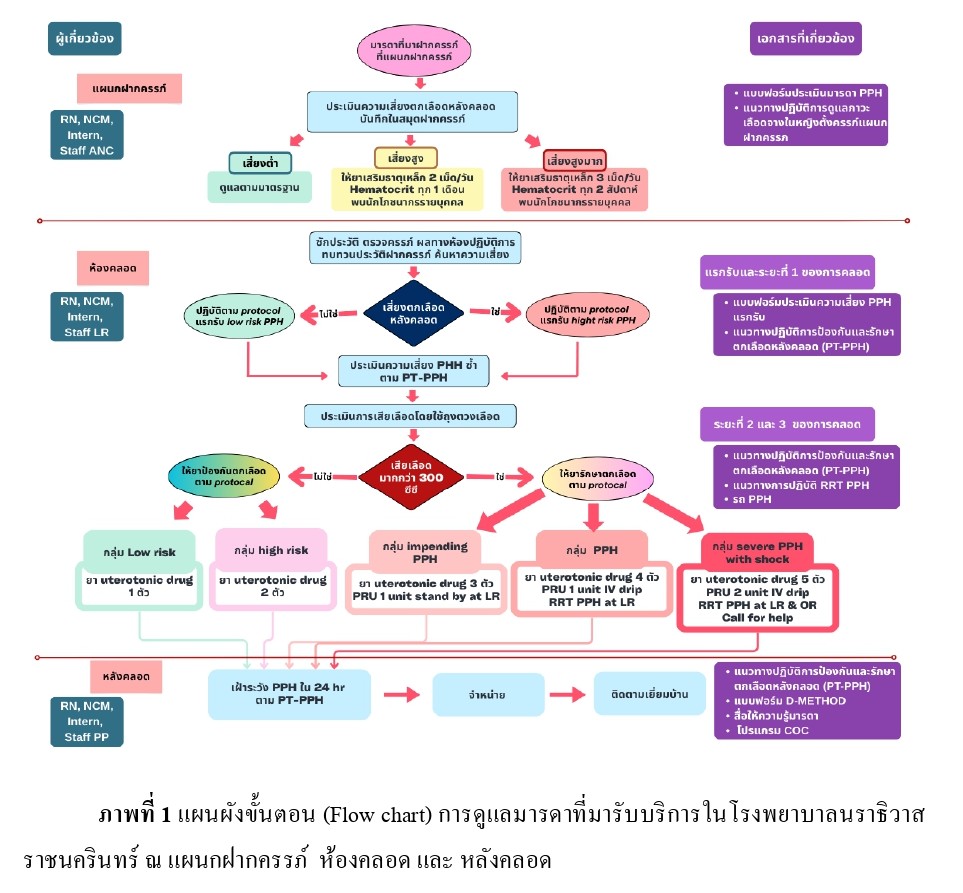
ผลการวิจัยพบว่า สหวิชาชีพร่วมกันพัฒนาและออกแบบร่าง PT-PPH โดยแบ่งเป็น กลุ่มป้องกันคือ low risk PPH และ high risk PPH กลุ่มรักษา คือ impending PPH, PPH และ severe PPH with shock ผู้วิจัยออกแบบฟอร์ม PT-PPH เป็น 3 คอลัมน์ในแผ่นเดียว 1) “condition” คุณลักษณะกลุ่มเสี่ยง 2) “order for one day” 3) “order for continuation” แยกแผนการรักษาแต่ละกลุ่มอย่างชัดเจน ผลการรักษาตาม PT-PPH นี้ใน 150 รายแรก มีภาวะตกเลือด 2 ราย จากการไม่ปฏิบัติตาม PT-PPH ผู้วิจัยปรับ PT-PPH ให้ใช้สะดวกขึ้น ใน 150 รายหลัง พบว่าไม่มีภาวะตกเลือด คะแนนเฉลี่ยความพึงพอใจต่อการใช้ PT-PPH ทุกกลุ่มอยู่ในระดับสูง ผลการศึกษานี้จะเป็นข้อมูลในการพัฒนาระบบป้องกันและรักษา PPH ต่อไป
เอกสารอ้างอิง
Angarita, A. M., Cochrane, E., Bianco, A., & Berghella, V. (2022). Prevention of postpartum hemorrhage in vaginal deliveries. European Journal of Obstetrics & Gynecology and Reproductive Biology, 278, 56 – 63. https://doi.org/10.1016/j.ejogrb.2022.11.021
Colaizzi, P.F. (1978). Psychological research as the phenomenologist views it. In R. S. Valle & M. King (Eds.), Existential-phenomenological alternatives for psychology (pp. 48 – 71). Oxford University Press.
Department of Health, Ministry of Public Health. (2022, May 24). Mortality statistics and causes of maternal death throughout Thailand. http://dashboard.anamai.moph.go.th
Faul, F., Erdfelder, E., Lang, A.-G., & Buchner, A. (2007). G*Power 3: A flexible statistical power analysis program for the social, behavioral, and biomedical sciences. Behavior Research Methods, 39(2), 175 – 191. https://doi.org/10.3758/BF03193146
Giouleka, S., Tsakiridis, I., Kalogiannidis, I., Mamopoulos, A., Tentas, I., Athanasiadis, A., & Dagklis, T. (2022). Postpartum hemorrhage: A comprehensive review of guidelines. Obstetrical & Gynecological Survey, 77(11), 631 – 642. https://doi.org/10.1097/OGX. 0000000000001061
Healthcare Quality Accreditation Institute (Public Organization). (2022). Standard patient care process: Hospitals and health services. Author.
Institute for Medical Technology Research and Evaluation, Department of Medical Services, Ministry of Public Health. (2017). Guideline quality assessment tool for research and evaluation (Appraisal of Guideline for Research and Evaluation II: AGREE II). Author.
Jinakul, D. (2022). Research and development training. Suranaree University of Technology.
Jones, A.J., Federspiel, J.J., & Eke, A C. (2023). Preventing postpartum hemorrhage with combined therapy rather than oxytocin alone. American Journal of Obstetrics & Gynecology: Maternal–Fetal Medicine, 5(2S), 100731. https://doi.org/10.1016/j.ajogmf.2022.100731
Kaewpoung, S., Deoisres, W., & Chinsoi, C. (2021). Factors influencing folic acid intakes among pregnant mothers. Journal of Health and Nursing Research, 37(2), 192 – 202. https://ejournals.swu.ac.th/index.php/pharm/article/view/15396
Krista, S.C., Yan, P.Q., Lorraine, F.Y., Cara, T.M., Lauren, H Z., Arick, W., Kelicia, D., & Jennifer, L.W. (2022). Folic acid and the prevention of birth defects: 30 years of opportunity and controversies. Annual Review of Nutrition, 42, 423 – 452. https://doi.org/10.1146/annurev-nutr- 043020-091647
McCormack, H. M., & Horne, D. J. (1988). Clinical applications of visual analogue scales: A critical review. Psychological Medicine, 18, 1007 – 1019. https://doi.org/10.1017/S0033291700009934
Narathiwat Provincial Public Health Office. (2023, April 23). Narathiwat public health annual performance report 2023. Ministry of Public Health. https://ntwo.moph.go.th/moph-nwt/
Peeyananjarassri, K., Ratipann, N., Suwanrath, C., Pinjaroen, S., Chainarong, N., & Choobun, T. (2023). An in‐depth analysis of maternal mortality in a quaternary university hospital in Southern Thailand: A 16‐year experience. International Journal of Gynecology & Obstetrics, 163(2), 579 – 585. https://doi.org/10.1002/ijgo.14856
Robert, I., Brenner, A., & Shakur-Still, H. (2023). Tranexamic acid for bleeding: Much more than a treatment for postpartum hemorrhage. American Journal of Obstetrics & Gynecology: Maternal–Fetal Medicine, 5(2S), 100722.
https://doi.org/10.1016/j.ajogmf.2022.100722
Royal College of Obstetricians and Gynecologists of Thailand. (2020, June 9). Medical practice guidelines on prevention and treatment of postpartum hemorrhage. Royal Thai College of Obstetricians and Gynecologists. https://www.rtcog.or.th/home/wp-content/uploads/2020/09/ OB-63-020-Prevention-and-Management-of-Postpartum-Hemorrhage.pdf
Ushida, T., Kotani, T., Imai, K., Nakano-Kobayashi, T., Nakamura, N., Moriyana, Y., Yoshida, S., Yamashita, M., Kajiyama, H., & Kikkawa, F. (2021). Shock index and postpartum hemorrhage in vaginal deliveries: A multicenter retrospective study. Shock, 55(3), 332 – 337. https://doi.org/10.1097/SHK.0000000000001634
Vogel, J. P., Nguyen, P. Y., Ramson, J., De Silva, M. S., Pham, M. D., Sultana, S., McDonald, S., Adu-Bonsaffoh, K., & McDougall, A. R. (2024). Effectiveness of care bundles for prevention and treatment of postpartum hemorrhage: A systematic review. American Journal of Obstetrics and Gynecology, 231(1), 67 – 91. https://doi.org/10.1016/j.ajog.2024.01.012
World Health Organization. (2023). A roadmap to combat postpartum haemorrhage between 2023 and 2030. https://www.who.int/publications/i/item/9789240081802
ดาวน์โหลด
เผยแพร่แล้ว
รูปแบบการอ้างอิง
ฉบับ
ประเภทบทความ
สัญญาอนุญาต
ลิขสิทธิ์ (c) 2025 วารสารมหาวิทยาลัยนราธิวาสราชนครินทร์

อนุญาตภายใต้เงื่อนไข Creative Commons Attribution-NonCommercial-NoDerivatives 4.0 International License.