The Development of an Intramuscular Injection Simulation Pad Innovation
Keywords:
Development of an innovation, Muscle injection simulation pad, Effectiveness of innovationAbstract
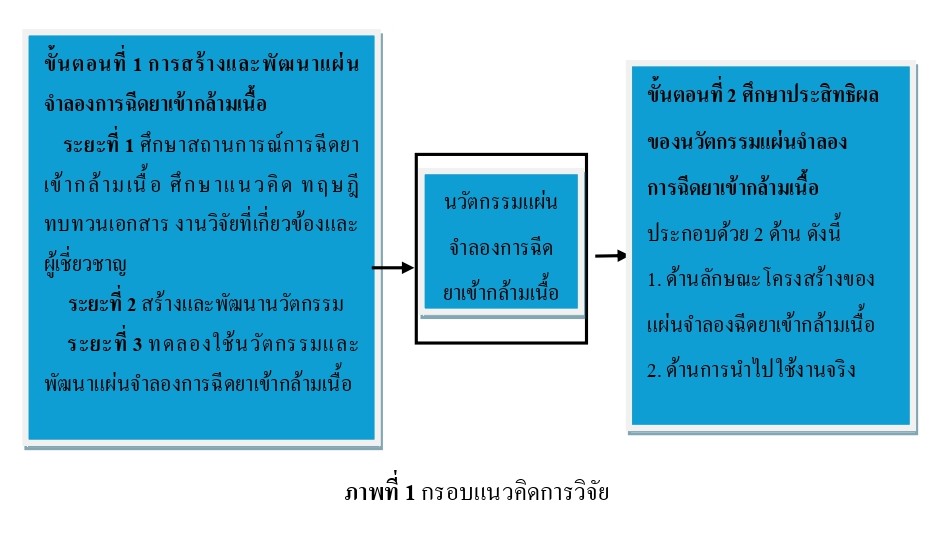
The purposes of this research and development of innovation were to develop a muscle injection simulation pad and study its effectiveness. The research was conducted in two steps: Step 1: Development of the muscle injection simulation pad, which included 1) studying the situation of muscle injections, theoretical concepts, related research, and experts; 2) developing the innovation; and 3) testing the innovation. Step 2: Evaluating the effectiveness of the innovation. The sample group consisted of 27 third-year nursing students, generation 57, Boromarajonani College of Nursing, Songkhla, academic year 2024. The research instruments included 1) the muscle injection simulation pad and 2) the effectiveness assessment form for the muscle injection simulation pad. The content validity index (CVI) was 0.71, and the Cronbach's alpha coefficient was 0.92. Data were analyzed using mean, standard deviation, frequency, and percentage. The research findings were revealed as detailed below.
1. An intramuscular injection simulation pad innovation: The surface texture of the skin layer allowed for easy needle penetration. It was soft. It has clearly defined color separation between the muscle layers. It can inject fluids and extract air realistically. It was reusable, and it had a long lifespan, averaging 100 baht per piece.
2. The overall effectiveness of the intramuscular injection simulation pad innovation was at the highest level (M = 4.46, S.D. = 0.65). Considering the details, it was found that the design of the structure and the practical application aspects were rated the highest (M = 4.37, S.D. = 0.50) and(M = 4.57, S.D. = 0.47), respectively.
Therefore, the intramuscular injection simulation pad innovation can be used in both theoretical and practical nursing education, as the model has realistic characteristics in terms of texture, color, thickness, and skin layer.
References
Anurak, C., Prommul, J., Fuengthin, A., Jitjum, C., Nancha, S., & Maming, H., (2023). Research and Innovation in nursing: An infant heel venipuncture-training manikin. The Southern College Network Journal of Nursing and Public Health, 11(3), e270579. https://he01.tci-thaijo.org/index.php/scnet/article/view/270579/183972
Chaiyasang, P., Machompoo, N., Sakulkhaemaruethai, C., Sridet, R., & Nanudorn, A. (2022). Development of an innovative model from natural rubber for practicing suture skills. Journal of Health Science Research. 16(3), 13 - 25. https://he01.tci-thaijo.org/index.php/JHR/ issue/view/17600
Cohen, J. (1988). Statistical Power Analysis for the Behavioral Sciences (2th ed.). Ni Lawrence Earm Associates.
College of Nursing Boromarajonani Songkhla. (2024). Strategic Plan, Boromarajonani College of Nursing, Songkhla, Fiscal Year 2022-2026. Author.
Faul, F., Erdfelder, E., Lang, A.-G., & Buchner, A. (2007). G*Power 3: A flexible statistical power. analysis program for the social, behavioral, and biomedical sciences. Behavior Research Methods, 39, 175 - 191. https://so04.tci-thaijo.org/index.php/svittj/article/view/181958
Machara, C., Busamongkol, P., Mokharat, P., & Paidee, S. (2019). Development of an Innovative Training Dummy for Injecting Drugs into the Thigh Muscles and Drawing Blood at the Heel of Newborn Infants. Happen Toward the Satisfaction of Nursing Students. In the documents of the national academic conference and presentation of research results. Rajathani Academic Conference No. 4 “Research for Sustainable Development” (pp. 801 – 809). https://nursemis2.ratchathani.ac.th/sub/re_detail.php?id_research=265
Nontaput, T., & Chotiban, P. (2021). Intravenous venipuncture: New development in training on arm manikin. The Southern College Network Journal of Nursing and Public Health, 8(3), 49 - 60. https://he01.tci-thaijo.org/index.php/scnet/article/view/249150
Prommul. J, Nelson. W, Perngyai. C, Damsangsawat. N, Klerlhee. T., & Nawsuwan. K. (2024). Developmental Innovation of neonate model used for orogastric intubation. Praboromarajchanok Institute Office of the Permanent Secretary, Ministry of Public Health. Songkhla.
Rompipat, S. (2020). Developing a model for intradermal injection and its effect upon performance skills and satisfaction levels of third-year nursing students. Journal of Science and Technology (Science Technology), 29(4), 688- 700. https://li01.tci-thaijo.org/index.php/tstj/article/view/242725
Sanongyard, J., Muangchang, Y., & Siratirakul, L. (2022). Effects of Using Simulation-Based Learning of Respiratory System Examination Model on the Ability and Confidence to Perform Children’s Respiratory System Examination of Nursing Students. Journal of Prachomklao College of Nursing, Phetchaburi Province, 5(3), 205 – 217. https://he01.tci-thaijo.org/index.php/pck/article/view/259010/176047
Sinsawad, P., & ChewongJoumal, P. (2022). Innovative development of assisted model for suction skill. Joumal of The Royal Thal Ammy Nurses. 23(3), 409 - 410. https://he01.tci-thaijo.org/index.php/JRTAN/article/view/253823
Sirirakul, L., Panasan, D., & Sanongyard., J. (2020). Effects of using a Suction robot on the ability to suck up sputum of Bachelor of Nursing Science students Boromarajonani College of Nursing, Suphanburi. Journal of Buddhist Social Sciences and Anthropology, 6(5), 386 - 387. https://so04.tci-thaijo.org/index.php/JSBA/article/download/242037/165723
Tansiri, P., Prasertwong, S., Kathikarn, R., Traipak, C., & Insakol, C. (2018, July 12). The Effectiveness of The Teaching Techniques of Injection by Using A Newly Produced Models. Faculty of Nursing Western University. https://www.western.ac.th/pages/nsk-portfolio-teacher-s-workdf.
Watanakit, B., Buriwong, S., Wangpatcharapon, U., & Suksawan, B. (2024). The Development of A simulation for Teaching Medical Procedure: A Model for Practicing Chest Drain. Journal of Social Communication Innovation, 7(2), 88 - 103. https://so04.tci-thaijo.org/index.php/ JRBGS/article/view/270674/184732
Downloads
Published
How to Cite
Issue
Section
License
Copyright (c) 2025 Princess of Naradhiwas University Journal

This work is licensed under a Creative Commons Attribution-NonCommercial-NoDerivatives 4.0 International License.