
Development of the Nursing Service System for End-Stage Renal Disease Received Hemodialysis by One Stop Service Method in Mahasarakham Hospital
Keywords:
Nursing Service System, Hemodialysis, One-Stop ServiceAbstract
This research and development aimed to develop and evaluate a one-stop nursing service system for end-stage renal disease patients receiving hemodialysis. The study consisted of 4 phases: 1) situation and problem analysis, 2) nursing service system development, quality verification, and pilot study, 3) effectiveness evaluation using a quasi-experimental research design with two groups comparing pre-test and post-test results, and 4) evaluation, modification, and quality confirmation of the system. Research instruments included focus group discussion guidelines, patient data recording forms, professional nursing practice recording forms, knowledge assessment tools, nursing practice capability assessment forms, patient satisfaction assessment forms, and nurse satisfaction assessment forms. All instruments were validated by three experts. The research was conducted between February - December 2024. Data were analyzed using descriptive statistics and content analysis.
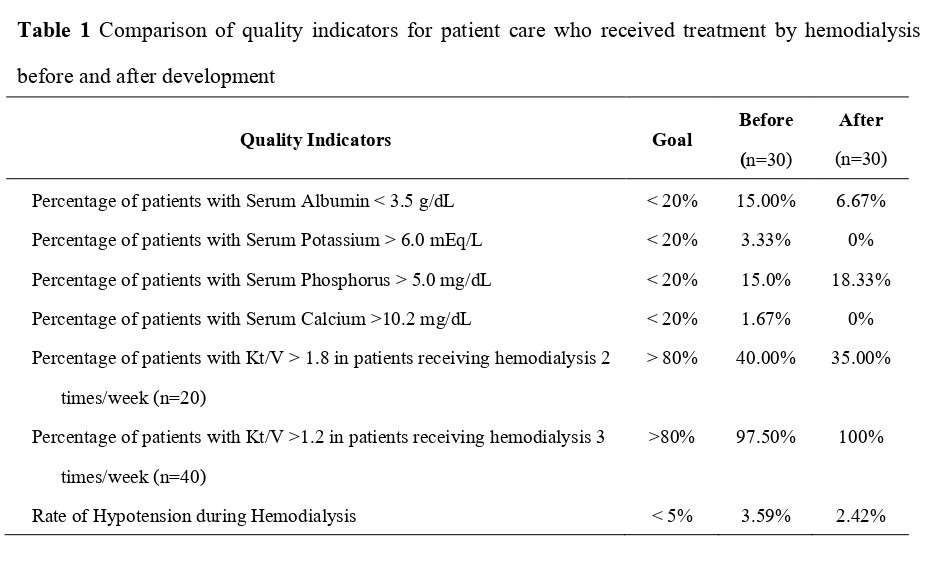
The results revealed that the developed nursing service system was consistent with the patient care context and practitioner needs. It comprised three components: structure, process, and outcome, referred to as the C-K-D model, covering four phases of care. After implementing the developed system, findings showed reduced service steps and waiting times, with patients receiving faster and more convenient services. Professional nurses demonstrated increased knowledge and competency. Both patients and professional nurses reported the highest level of satisfaction. Furthermore, quality of care indicators showed improving trends and met target criteria, indicating that the developed nursing service system could enhance care quality efficiently and effectively. However, continuous monitoring is recommended.
References
Donabedian, A. (2003). An introduction to quality assurance in health care. Oxford University Press.
Drucker, F. P. (1998). Knowledge-worker productivity: The biggest challenge. Harvard Business School Publishing.
Hemodialysis Department, Mahasarakham Hospital. (2023). Service profile 2023. In Nursing service quality report 2023. Mahasarakham Hospital.
Kovesdy, C. P. (2022). Epidemiology of chronic kidney disease: an update 2022. Kidney international supplements, 12(1), 7-11. https://pubmed.ncbi.nlm.nih.gov/35529086/
Srimat, K. (2024). Development of children with thalassemia in receiving a blood transfusion care system on One Stop Service in Kumpawapi Hospital. Journal of Health Innovation Research and Development, 5(1), 139 - 149. https://he01.tcithaijo.org/index.php/jrhi/article/view/ 269428/181373
Michalski, A. (2011). The McKinsey 7-S framework: Invented in the 1980s and still a possibility for success today. GRIN.
Nephrology Society of Thailand. (2020). Information on renal replacement therapy in Thailand 2016-2019. Subcommittee on Registration of Renal Replacement Therapy in Thailand.
Nursing Division. (2016). Special care nursing standards. Department of Medical Services, Ministry of Public Health.
Ophascharoensuk, W. (2014). Criteria and guidelines for certification of hemodialysis treatment standards. Samit Printing and Publishing.
Prachamjun, S. (2017). Student affairs management One Stop Service (OSS). Nakhon Ratchasima Rajabhat University.
Press Ganey. (2019). The impact of patient experience on healthcare quality and outcomes. Press Ganey Associates.
Thaoanont, O., Yodsuban, P., & Amornchai, R. (2023). Development of clinical nursing practice guidelines for patients undergoing hemodialysis. Journal of Nursing Division, 50(3), 185 – 200. https://he01.tci-thaijo.org/index.php/JND/article/view/268074
Downloads
Published
How to Cite
Issue
Section
License
Copyright (c) 2025 Princess of Naradhiwas University Journal

This work is licensed under a Creative Commons Attribution-NonCommercial-NoDerivatives 4.0 International License.