
Research and Development of a Pediatric Patient Triage Model at the Outpatient Department in Nakornping Hospital
Keywords:
Pediatric patient triage, Outpatient department, Satisfaction, Triage accuracyAbstract
Background and Objectives The triage of pediatric patients in the outpatient department is an important process that helps prioritize urgency and reduce treatment risks. However, there are currently several limitations, particularly the lack of a standard model specifically for children, resulting in inaccurate triage and delays in treatment. Nakornping Hospital has seen a continuous increase in pediatric patients. Therefore, this research aimed to analyze the situation, develop a model, and evaluate the effectiveness of the pediatric patient triage model.
Methods The ADDIE Model was applied in three phases. Phase 1 involved analyzing the current situation through focus group discussions with 10 interdisciplinary professionals. Phase 2 focused on developing the model. Phase 3 assessed the effectiveness through a quasi-experimental study with two groups and measured post-intervention, testing with 30 pediatric patients and their parents in each group. The research instruments were validated by five experts, achieving a content validity index of 1.0 and a reliability coefficient of 0.88. Data were analyzed using descriptive statistics, independent t-tests, and chi-square tests.
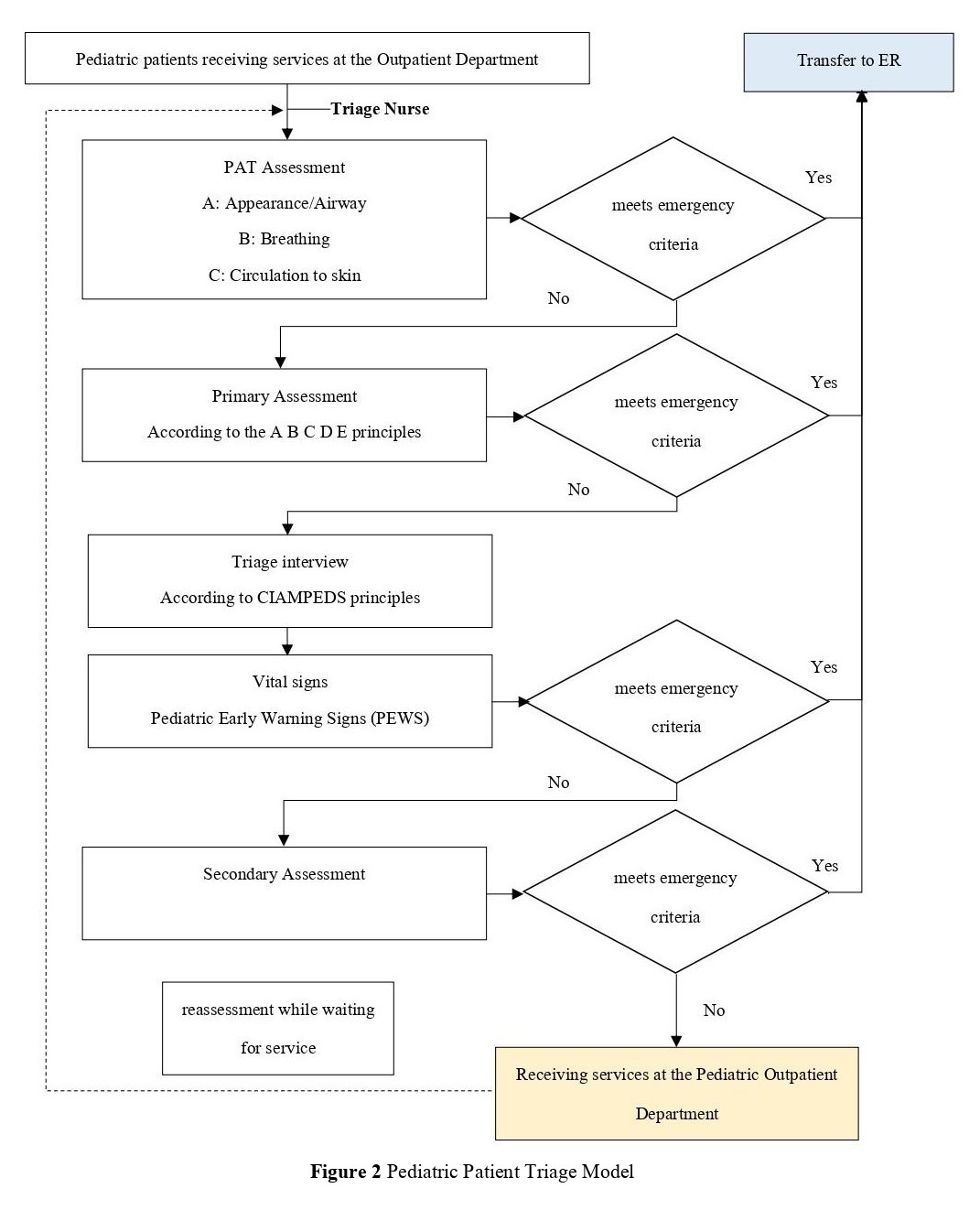
Results The current situation had limitations in staffing, outdated practices, and a lack of specialized experts. The developed model included adjustments to the Emergency Severity Index criteria specifically for children, guidelines for special needs children, a 5-step triage process, a waiting time of no more than 10 minutes, and interdisciplinary teamwork. Parents in the experimental group had a satisfaction level (M = 93.10, S.D. = 10.76) significantly higher than the control group (M = 86.13, S.D. = 15.13) (p < 0.05) and a triage accuracy rate (76.67 %) significantly higher than the control group (36.67 %) (p < 0.01)
Conclusions and Recommendations The developed pediatric patient triage model enhances parental satisfaction and triage accuracy. It can be applied in other tertiary hospitals.
References
Abram, E., Dhaliwal, B., Oketola, B., Badran, H., Gangwani, A., Eleonu, P., Costello, C., Tam, C., Klassen, T.P., Doyle. E., & Aregbesola, A. (2025). Improving patient care experience in the pediatric emergency department: a systematic review. Canadian Journal of Emergency Medicine, 27(6), 476 - 490. https://doi.org/10.1007/s43678-025-00897-3
Alshaibi, S., AlBassri, T., AlQeuflie, S., Philip, W., & Alharthy, N. (2021). Pediatric triage variations among nurses, pediatric and emergency residents using the Canadian triage and acuity scale. BMC Emergency Medicine, 21, 1 - 6. https://doi.org/10.1186/s12873-021-00541-0
Berkowitz, D., Morrison, S., Shaukat, H., Button, K., Stevenson, M., LaViolette, D., & Chamberlain, J. (2022). Under-triage: a new trigger to drive quality improvement in the emergency department. Pediatric Quality & Safety, 7(4), e581.
https://doi.org/10.1097/pq9.0000000 000000581
Branes, H., Solevåg, A. L., & Solberg, M. T. (2021). Pediatric early warning score versus a paediatric triage tool in the emergency department: A reliability study. Nursing Open, 8(2), 702 - 708. https://doi.org/10.1002/nop2.675
Clhinda, C. (2003). Effects of using a patient triage model based on acuity levels on client satisfaction and nurse job satis faction in the Accident and Emergency Department College Medicine, Bangkok Metropolitan and Vajira Hospital [Master’s thesis]. Chulalongkorn University
Clark, D. (2003, October). “Instructional System Design-Analysis Phase”. www.nwlink.com/hrd/sat2.html
Cohen, J. (1988). Statistical Power Analysis for the Behavioral Sciences (2nd ed.). Lawrence Erlbaum Associates.
Gray, J.R., Grove, S.K., & Sutherland, S. (2017) Burns & Grove’s the Practice of Nursing Research: Appraisal, Synthesis, and Generation of Evidence (8th Eds). Elsevier.
Guerrero-Márquez, G., Míguez-Navarro, M. C., del Carmen Ignacio-Cerro, M., & Rivas-García, A. (2022). Analysis of the validity of the five-level TRIPED-GM paediatric triage system. Enfermería Clínica (English Edition), 32, S54 - S63.
https://doi.org/10.1016/j.enfcle.2021.09.005
Gunawan, J., Marzilli, C., & Aungsuroch, Y. (2021). Establishing appropriate sample size for developing and validating a questionnaire in nursing research. Belitung Nursing Journal, 7(5), 356 – 360. https://doi.org/10.33546/bnj.1927
Hennink, M., & Kaiser, B. N. (2022). Sample sizes for saturation in qualitative research: A systematic review of empirical tests. Social Science & Medicine, 292, 114523. https://doi.org/10.1016/j.socscimed.2021.114523
Loflath, V., Hau, E. M., Garcia, D., Berger, S., & Lollgen, R. (2021). Parental satisfaction with waiting time in a Swiss tertiary paediatric emergency department. Emergency Medicine Journal, 38(8), 617 - 623. https://doi.org/10.1136/emermed-2019-208616
Lopez-Hernandez, M., Puig-Llobet, M., Miralles-Sánchez, L., Moreno-Mateos, Y., & Galimany-Masclans, J. (2024). Patient Satisfaction with Nursing Triage Care in Hospital Emergency Departments: Scoping Review. Enfermería Clínica, 34(5), 408-415.
https://doi.org/10.1016/j.enfcle.2024.09.004
Ma, X., Liu, Y., Du, M., Ojo, O., Huang, L., Feng, X., & Wang, X. (2021). The accuracy of the pediatric assessment triangle in assessing triage of critically ill patients in emergency pediatric department. International Emergency Nursing, 58, 101041. https://doi.org/10.1016/j.ienj.2021.101041
Malla, C. (2020). Knowledge Regarding Acute respiratory infection and its management among mothers of under five children attending pediatric OPD of teaching hospital, Birgunj. International Journal of Health Sciences and Research, 10(7), 112 - 115. https://www.ijhsr.org/IJHSR_Vol.10_Issue.7_July2020/19.pdf
Mawji, A., Li, E., Dunsmuir, D., Komugisha, C., Novakowski, S. K., Wiens, M. O., & Ansermino, J. M. (2022). Smart triage: Development of a rapid pediatric triage algorithm for use in low-and-middle income countries. Frontiers in Pediatrics, 10, 976870.
https://doi.org/10.3389/fped.2022.976870
Mejzinolli, A., Lenjani, B., Krasniqi, B., Beqiri, L., Berisha, A., & Makolli, S. (2020). Triage System and Emergency Pediatric Medical Care. Practice of surgery, 5, 2787. https://www.clinicsin surgery.com/open-access/triage-system-and-emergency-pediatric-medical-care-7629.pdf
Montoro-Perez, N., Richart-Martinez, M., & Montejano-Lozoya, R. (2023). Factors associated with the inappropriate use of the pediatric emergency department. A systematic review. Journal of Pediatric Nursing, 69, 38 - 46. https://doi.org/10.1016/j.pedn.2022.12.027
Nakornping Hospital. (2024). Chiang Mai: Strategic and Project Planning Division. Author.
Ruch, D. A., Steelesmith, D. L., Warner, L. A., Bridge, J. A., Campo, J. V., & Fontanella, C. A. (2021). Health services use by children in the welfare system who died by suicide. Pediatrics, 147(4), e2020011585. https://doi.org/10.1542/peds.2020-011585
Sax, D. R., Warton, E. M., Kene, M. V., Ballard, D. W., Vitale, T. J., Timm, J. A., & Di Lena, D. D. (2024). Emergency Severity Index Version 4 and Triage of Pediatric Emergency Department Patients. JAMA Pediatrics, 178(10), 1027-1034.
https://doi.org/10.1001/jamapediatrics.2024.2671
Shrestha, L., Adhikari, B., Bajracharya, M., Aryal, N., Rajbhandari, A., Shrestha, S., & Das, D. (2024). Triage processes in primary, secondary, and tertiary health care facilities in the Kathmandu Valley, Nepal: a mixed-methods study. BMC Emergency Medicine, 24(1), 222. https://doi.org/10.1186/s12873-024-01139-y
Simon Junior, H., Schvartsman, C., Sukys, G. D. A., & Farhat, S. C. L. (2022). Pediatric emergency triage systems. Revista Paulista de Pediatria, 41, e2021038. https://doi.org/10.1590/1984-0462/2023/41/2021038
Tanner, K., Bican, R., Boster, J., Christensen, C., Coffman, C., Fallieras, K., & Marrie, J. (2020). Feasibility and acceptability of clinical pediatric telerehabilitation services. International Journal of Telerehabilitation, 12(2), 43. https://doi.org/10.5195/ijt.2020.6336
Downloads
Published
How to Cite
Issue
Section
License
Copyright (c) 2026 Princess of Naradhiwas University Journal

This work is licensed under a Creative Commons Attribution-NonCommercial-NoDerivatives 4.0 International License.