
การพัฒนาและประสิทธิผลของรูปแบบการคัดแยกผู้ป่วยเด็ก ณ แผนกผู้ป่วยนอก โรงพยาบาลนครพิงค์
คำสำคัญ:
การคัดแยกผู้ป่วยเด็ก, แผนกผู้ป่วยนอก, ความพึงพอใจ, ความแม่นยำในการคัดแยกบทคัดย่อ
ความเป็นมาและวัตถุประสงค์ การคัดแยกผู้ป่วยเด็กในแผนกผู้ป่วยนอกเป็นกระบวนการสำคัญที่ช่วยจัดลำดับความเร่งด่วนและลดความเสี่ยงในการรักษา อย่างไรก็ตาม ปัจจุบันพบข้อจำกัดหลายประการ โดยเฉพาะการขาดรูปแบบมาตรฐานเฉพาะสำหรับเด็ก ส่งผลให้การคัดแยกไม่แม่นยำและเกิดความล่าช้าในการรักษา โรงพยาบาลนครพิงค์มีผู้ป่วยเด็กเข้ารับบริการเพิ่มขึ้นอย่างต่อเนื่อง การวิจัยนี้จึงมีวัตถุประสงค์เพื่อศึกษาสถานการณ์ พัฒนารูปแบบ และประเมินประสิทธิผลของการคัดแยกผู้ป่วยเด็ก
วิธีการวิจัย ดำเนินการประยุกต์ใช้แนวคิด ADDIE Model แบ่งเป็น 3 ระยะ ระยะที่ 1 ศึกษาสถานการณ์ปัจจุบันโดยการสนทนากลุ่มสหสาขาวิชาชีพ 10 ท่าน ระยะที่ 2 พัฒนารูปแบบ ระยะที่ 3 ศึกษาประสิทธิผลด้วยการวิจัยกึ่งทดลองแบบสองกลุ่มวัดหลังการทดลอง โดยทดลองใช้กับผู้ป่วยเด็กและผู้ปกครองกลุ่มละ 30 คน เครื่องมือวิจัยผ่านพิจารณาโดยผู้ทรงคุณวุฒิ 5 ท่าน ได้ค่าความตรงของเนื้อหาเท่ากับ 1.0 และความเชื่อมั่นเท่ากับ 0.88 วิเคราะห์ข้อมูลด้วยสถิติเชิงพรรณนา สถิติทีอิสระ และสถิติไคสแควร์
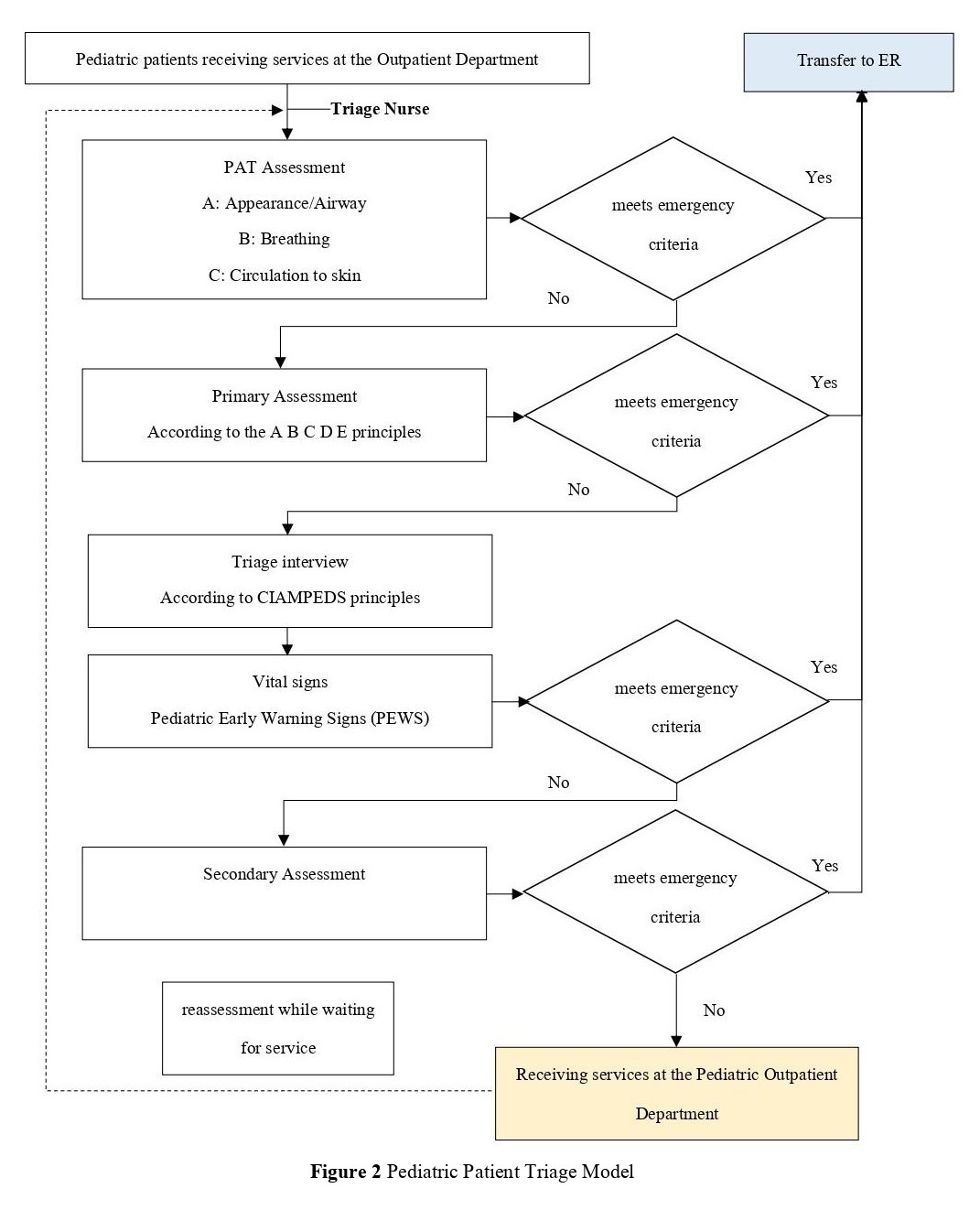
ผลการวิจัย สถานการณ์ปัจจุบันมีข้อจำกัดด้านอัตรากำลัง แนวปฏิบัติไม่ทันสมัย และขาดผู้เชี่ยวชาญเฉพาะด้าน รูปแบบที่พัฒนาขึ้นประกอบด้วย การปรับเกณฑ์ ESI เฉพาะสำหรับเด็ก แนวทางสำหรับเด็กพิเศษ กระบวนการคัดแยก 5 ขั้นตอน ระยะเวลารอคอยไม่เกิน 10 นาที และการทำงานเป็นทีมสหสาขาวิชาชีพ ผู้ปกครองในกลุ่มทดลองมีความพึงพอใจ (M = 93.10, S.D. = 10.76) สูงกว่ากลุ่มควบคุม (M = 86.13, S.D. = 15.13) อย่างมีนัยสำคัญ (p < 0.05) และมีความแม่นยำในการคัดแยก (ร้อยละ 76.67) สูงกว่ากลุ่มควบคุม (ร้อยละ 36.67) อย่างมีนัยสำคัญ (p < 0.01)
สรุปและข้อเสนอแนะ รูปแบบการคัดแยกผู้ป่วยเด็กที่พัฒนาขึ้นช่วยเพิ่มความพึงพอใจของผู้ปกครองและความแม่นยำในการคัดแยก สามารถนำไปประยุกต์ใช้ในโรงพยาบาลระดับตติยภูมิอื่น ๆ ได้
เอกสารอ้างอิง
Abram, E., Dhaliwal, B., Oketola, B., Badran, H., Gangwani, A., Eleonu, P., Costello, C., Tam, C., Klassen, T.P., Doyle. E., & Aregbesola, A. (2025). Improving patient care experience in the pediatric emergency department: a systematic review. Canadian Journal of Emergency Medicine, 27(6), 476 - 490. https://doi.org/10.1007/s43678-025-00897-3
Alshaibi, S., AlBassri, T., AlQeuflie, S., Philip, W., & Alharthy, N. (2021). Pediatric triage variations among nurses, pediatric and emergency residents using the Canadian triage and acuity scale. BMC Emergency Medicine, 21, 1 - 6. https://doi.org/10.1186/s12873-021-00541-0
Berkowitz, D., Morrison, S., Shaukat, H., Button, K., Stevenson, M., LaViolette, D., & Chamberlain, J. (2022). Under-triage: a new trigger to drive quality improvement in the emergency department. Pediatric Quality & Safety, 7(4), e581.
https://doi.org/10.1097/pq9.0000000 000000581
Branes, H., Solevåg, A. L., & Solberg, M. T. (2021). Pediatric early warning score versus a paediatric triage tool in the emergency department: A reliability study. Nursing Open, 8(2), 702 - 708. https://doi.org/10.1002/nop2.675
Clhinda, C. (2003). Effects of using a patient triage model based on acuity levels on client satisfaction and nurse job satis faction in the Accident and Emergency Department College Medicine, Bangkok Metropolitan and Vajira Hospital [Master’s thesis]. Chulalongkorn University
Clark, D. (2003, October). “Instructional System Design-Analysis Phase”. www.nwlink.com/hrd/sat2.html
Cohen, J. (1988). Statistical Power Analysis for the Behavioral Sciences (2nd ed.). Lawrence Erlbaum Associates.
Gray, J.R., Grove, S.K., & Sutherland, S. (2017) Burns & Grove’s the Practice of Nursing Research: Appraisal, Synthesis, and Generation of Evidence (8th Eds). Elsevier.
Guerrero-Márquez, G., Míguez-Navarro, M. C., del Carmen Ignacio-Cerro, M., & Rivas-García, A. (2022). Analysis of the validity of the five-level TRIPED-GM paediatric triage system. Enfermería Clínica (English Edition), 32, S54 - S63.
https://doi.org/10.1016/j.enfcle.2021.09.005
Gunawan, J., Marzilli, C., & Aungsuroch, Y. (2021). Establishing appropriate sample size for developing and validating a questionnaire in nursing research. Belitung Nursing Journal, 7(5), 356 – 360. https://doi.org/10.33546/bnj.1927
Hennink, M., & Kaiser, B. N. (2022). Sample sizes for saturation in qualitative research: A systematic review of empirical tests. Social Science & Medicine, 292, 114523. https://doi.org/10.1016/j.socscimed.2021.114523
Loflath, V., Hau, E. M., Garcia, D., Berger, S., & Lollgen, R. (2021). Parental satisfaction with waiting time in a Swiss tertiary paediatric emergency department. Emergency Medicine Journal, 38(8), 617 - 623. https://doi.org/10.1136/emermed-2019-208616
Lopez-Hernandez, M., Puig-Llobet, M., Miralles-Sánchez, L., Moreno-Mateos, Y., & Galimany-Masclans, J. (2024). Patient Satisfaction with Nursing Triage Care in Hospital Emergency Departments: Scoping Review. Enfermería Clínica, 34(5), 408-415.
https://doi.org/10.1016/j.enfcle.2024.09.004
Ma, X., Liu, Y., Du, M., Ojo, O., Huang, L., Feng, X., & Wang, X. (2021). The accuracy of the pediatric assessment triangle in assessing triage of critically ill patients in emergency pediatric department. International Emergency Nursing, 58, 101041. https://doi.org/10.1016/j.ienj.2021.101041
Malla, C. (2020). Knowledge Regarding Acute respiratory infection and its management among mothers of under five children attending pediatric OPD of teaching hospital, Birgunj. International Journal of Health Sciences and Research, 10(7), 112 - 115. https://www.ijhsr.org/IJHSR_Vol.10_Issue.7_July2020/19.pdf
Mawji, A., Li, E., Dunsmuir, D., Komugisha, C., Novakowski, S. K., Wiens, M. O., & Ansermino, J. M. (2022). Smart triage: Development of a rapid pediatric triage algorithm for use in low-and-middle income countries. Frontiers in Pediatrics, 10, 976870.
https://doi.org/10.3389/fped.2022.976870
Mejzinolli, A., Lenjani, B., Krasniqi, B., Beqiri, L., Berisha, A., & Makolli, S. (2020). Triage System and Emergency Pediatric Medical Care. Practice of surgery, 5, 2787. https://www.clinicsin surgery.com/open-access/triage-system-and-emergency-pediatric-medical-care-7629.pdf
Montoro-Perez, N., Richart-Martinez, M., & Montejano-Lozoya, R. (2023). Factors associated with the inappropriate use of the pediatric emergency department. A systematic review. Journal of Pediatric Nursing, 69, 38 - 46. https://doi.org/10.1016/j.pedn.2022.12.027
Nakornping Hospital. (2024). Chiang Mai: Strategic and Project Planning Division. Author.
Ruch, D. A., Steelesmith, D. L., Warner, L. A., Bridge, J. A., Campo, J. V., & Fontanella, C. A. (2021). Health services use by children in the welfare system who died by suicide. Pediatrics, 147(4), e2020011585. https://doi.org/10.1542/peds.2020-011585
Sax, D. R., Warton, E. M., Kene, M. V., Ballard, D. W., Vitale, T. J., Timm, J. A., & Di Lena, D. D. (2024). Emergency Severity Index Version 4 and Triage of Pediatric Emergency Department Patients. JAMA Pediatrics, 178(10), 1027-1034.
https://doi.org/10.1001/jamapediatrics.2024.2671
Shrestha, L., Adhikari, B., Bajracharya, M., Aryal, N., Rajbhandari, A., Shrestha, S., & Das, D. (2024). Triage processes in primary, secondary, and tertiary health care facilities in the Kathmandu Valley, Nepal: a mixed-methods study. BMC Emergency Medicine, 24(1), 222. https://doi.org/10.1186/s12873-024-01139-y
Simon Junior, H., Schvartsman, C., Sukys, G. D. A., & Farhat, S. C. L. (2022). Pediatric emergency triage systems. Revista Paulista de Pediatria, 41, e2021038. https://doi.org/10.1590/1984-0462/2023/41/2021038
Tanner, K., Bican, R., Boster, J., Christensen, C., Coffman, C., Fallieras, K., & Marrie, J. (2020). Feasibility and acceptability of clinical pediatric telerehabilitation services. International Journal of Telerehabilitation, 12(2), 43. https://doi.org/10.5195/ijt.2020.6336
ดาวน์โหลด
เผยแพร่แล้ว
รูปแบบการอ้างอิง
ฉบับ
ประเภทบทความ
สัญญาอนุญาต
ลิขสิทธิ์ (c) 2026 วารสารมหาวิทยาลัยนราธิวาสราชนครินทร์

อนุญาตภายใต้เงื่อนไข Creative Commons Attribution-NonCommercial-NoDerivatives 4.0 International License.