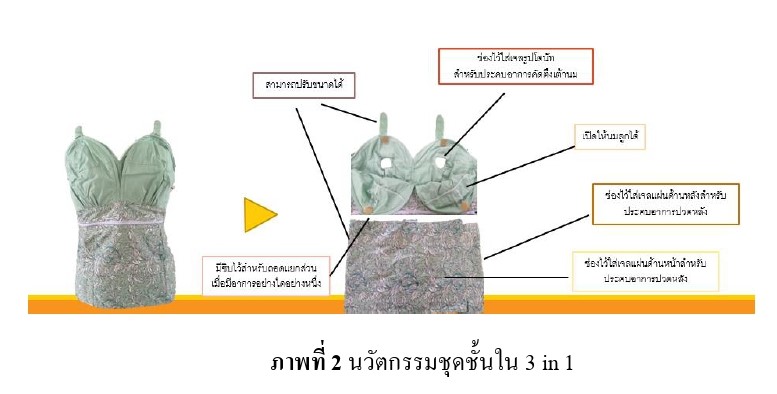
Effectiveness of the San Yai Rak 3-in-1 lingerie Innovation in Reducing Breast Engorgement, Back Pain, and Afterpain in Postpartum Mothers
Keywords:
Breast engorgement, Back pain, Afterpain, Postpartum Mothers, San Yai Rak 3-in-1 lingerie innovation.Abstract
Background and Objectives Normal labor postpartum mothers at Narathiwat Rajanagarindra Hospital experience breast engorgement, back pain, and afterpain, and they desire relief from these symptoms. Therefore, the researcher implemented the San Yai Rak 3-in-1 lingerie innovation in this study. This research was a quasi-experimental study measuring before and after the use of the San Yai Rak 3-in-1 lingerie innovation. The objectives were to: 1) study breast engorgement, back pain, and afterpain in postpartum mothers; 2) compare breast engorgement, back pain, and afterpain in postpartum mothers before and after using the San Yai Rak 3-in-1 lingerie innovation; and 3) study satisfaction with the use of the San Yai Rak 3-in-1 lingerie innovation.
Methods The sample group consisted of 60 postpartum mothers. Data was collected using a personal information questionnaire, a breast engorgement questionnaire, a back pain questionnaire, an afterpain questionnaire, and a satisfaction assessment questionnaire for the use of the San Yai Rak 3-in-1 lingerie innovation for breast engorgement, back pain, and afterpain. The Cronbach's alpha coefficient reliabilities of the breast engorgement, back pain, and afterpain questionnaires and the satisfaction assessment questionnaire for the use of the San Yai Rak 3-in-1 lingerie innovation were 0.91 and 0.86, respectively. Data were analyzed using descriptive statistics and the paired t-test.
Results The research findings indicated that postpartum mothers before using the San Yai Rak 3-in-1 lingerie innovation had a mild degree of breast engorgement symptoms (45%) and a moderate degree (45%). They reported mild back pain (95%). They reported mild afterpain (45%) and a moderate degree of afterpain (45%). Postpartum mothers after using the San Yai Rak 3-in-1 lingerie innovation had significantly lower average scores for breast engorgement, back pain, and afterpain compared to before using the lingerie innovation, with statistical significance at the .05 level (t = 2.15, 2.65, 2.85, p < .05). The satisfaction of postpartum mothers after using the San Yai Rak 3-in-1 lingerie innovation to reduce breast engorgement, back pain, and afterpain was at a high level (M = 2.65, S.D. = 0.36).
Conclusion and Recommendations The San Yai Rak 3-in-1 lingerie innovation can be used to reduce breast engorgement, back pain, and afterpain in mothers after normal childbirth. This provides drug-free pain relief, and in future research, this innovation can be adapted by replacing the gel with local herbs from the three southern border provinces that have properties to relieve breast engorgement, back pain, and afterpain.
References
Amudha, N., & Prakash, D. (2023). Gua-sha therapy on breast engorgement among Indian postnatal mothers. Bioinformation, 19(8), 853 - 859. https://pmc.ncbi.nlm.nih.gov/articles/PMC106 13815/pdf/97320630019853.pdf
Butdapan, P., Saeheng, P., Pongpanich, P., Maneechai, K., Duangdee, T., Suwannatrai, U., Akaraseenont, P., & Tachaviriya, O. (2024). Relieving breast engorgement in postpartum women with Thai traditional massage and hot herbal compression. Siriraj Medical Bulletin, 17(3), 339-345. https://he02.tci-thaijo.org/index.php/simedbull/article/view/269752/184781
Chan, J., Sultana, R., Mathur, D., Tan, C., & Sng, B. (2025). The association of pain and psychological vulnerabilities with postpartum pain catastrophizing: A secondary analysis of a randomized controlled trial association de la douleur et des vulne´rabilite´s psychologiques avec la catastrophisation de la douleur en post-partum: une analyse secondaire d’une e´tude randomise´e controˆle´e. Canadian Journal of Anesthesia-Journal canadien d anesthesie, 72, 603 - 614. https://doi.org/10.1007/s12630-025-02920-8
Coad, J., & Dunstall, M. (2011). Anatomy and physiology for midwives (3rded.). ChurchillLivingstone. https://www.scirp.org/reference/referencespapers?referenceid=2873841
Ekthamasuth, C., & Suvithayasiri, K. (2017). Nursing during childbirth. Pimdeekarnpin.
Faul, F., Erdfelder, E., Lang, A., & Buchner, A. (2007). G*Power 3: A flexible statistical power analysis program for the social, behavioral, and biomedical sciences. Behavior Research Methods, 39(2), 175 - 191. https://link.springer.com/article/10.3758/BF03193146
Ghattas, V., Ali, Z., & Farahat, M. (2024). Effect of effleurage massage versus heat patch on afterpain level among multipara postnatal women. Assiut Scientific Nursing Journal, 12(44), 131-140. https://doi.org/10.21608/asnj.2024.283041.1811
Hasanah, N., Susanti, R., Manurung, B., Sinaga, R., Ginting, S., & Angkat, R. (2024). Management of postpartum midwifery care on Mrs. J with engorgement of the breast. The 4rd Mitra Husada Health International Conference (MiHHICo), 4, 79 - 86. https://prosidingmhm.mitrahusada. ac.id/index.php/mihhico/article/view/197
Indrani, D., & Sowmya, M. (2019). A study to find the prevalence of breast engorgement among lactating mothers. HSOA Journal of Reproductive Medicine, Gynaecology & Obstetrics, 4(023), 1 - 5. https://www.heraldopenaccess.us/article_pdf/63/a-study-to-find-the-prevalence-of-breast-engorgement-among-lactating-mothers.pdf
Kennell, J., & Klaus, M. (1984). Mother-infant bonding: Weighing the evidence. Developmental Review, 4(3), 275 - 282. https://doi.org/10.1016/S0273-2297(84)80008-8
Klaus, M., & Kennell, J. (1982). Parent-infant bonding (2nd ed.). Mosby.
Kontiang, C., & Prachusilpa, G. (2007). The effect of using the preventive breast engorgement program in post-cesareen delivery. Journal of Nursing Science Chulalongkorn University, 19(2), 60 - 71. https://index.library.tu.ac.th/cgi-bin/koha/opac-detail.pl?biblionumber=141946
Lertsakornsiri, M. (2023). Mindfulness concepts and methods. Suan Sunandha Academic & Research Review Journal, 17(2), 105-117. https://so05.tci-thaijo.org/index.php/ssajournal/article/ view/257628/180338
Maega, S. (2025). Registered nurse, professional level, Naradhiwasrajanagarindra Hospital. Interview.
Melzack, R., & Wall, P. (1965). Pain mechanisms: A new theory. Science, 150(3699), 971 - 979.
https://doi.org/10.1126/science.150.3699.971
Ngestiningrum, A., & Nuryani, N. (2025). Effectiveness of couple classes in increasing breastfeeding rates and preventing breast engorgement. Health Dynamics, 2(2s), 31 - 37. https://journals.indexcopernicus.com/api/file/viewByFileId/2295112
Nootara, K., Panthong, S., & Wongtao, C. (2022). Postpartum mothers: The effectiveness of a Thai herbal compress with nano fabrics on breast engorgement and milk ejection. Journal or Nursing and Education, 15(4), 57 - 68. https://he01.tcithaijo.org/index.php/JNAE/article/ view/256590/174996
Ojha, A. (2025). A study to evaluate the effectiveness of cabbage leaves application on breast engorgement among post-natal mothers in Sultaniya Hospital, Bhopal. International Journal of Nursing Didactics, 15(03), 1-3. https://nursingdidactics.com/index.php/ijnd/article/view/3404
Pagare, V., Jackson, K., Shreif, K., Thomas, E., Willis, R., Buxton, S., Rhule, V., Lopez, L., Coetsee, M. (2024, August 5). Visual Analogue Scale. Physiopedia. https://www.physiopedia.com/ Visual_Analogue_Scale
Prastyoningsih, A., Wijayanti., Prawistya, A., & Julia, J. (2023). Management application of aloe vera compresses and back massage for breast engagement in postpartum mothers: Experiment study. International Journal of Public Health Excellence (IJPHE), 3(1), 200 - 205. https://ejournal.ipinternasional.com/index.php/ijphe/article/view/550/532
Rodgers, R., Campagna, J., Hayes, G., Sharma, A., Runquist, E., Fiuza, A., Coburn-Sanderson, A., Zimmerman, E., & Piran, N. (2024). Experiences of embodiment during pregnancy and the postpartum period: A qualitative study. Body Image, 48. https://www.sciencedirect.com/ science/article/abs/pii/S1740144523001882?via%3Dihub
Ruchat, S., Beamish, N., Pellerin, S., Usman, M., Dufour, S., Meyer, S., Sivak, A., & Davenport, M. (2025). Impact of exercise on musculoskeletal pain and disability in the postpartum period: A systematic review and meta-analysis. BMJ Journal of Sports Medicine, 59(8), 594 - 604. https://bjsm.bmj.com/content/59/8/594
Sendas, M., & Freitas, M. (2024). The needs of women in the postpartum period: A scoping review. Midwifery, 136. https://www.sciencedirect.com/science/article/abs/pii/S0266613824001815
Siriphan, S., Chaiprasit, K., Chemama, N., Kaleang, N., Suphantaworachat, N., Sawan, S., Niyomdeeha, N., Chiddee, K., & Thanthadaphan, R. (2022). Study on the effectiveness of managing a project to produce 3-in-1 bras, designed to alleviate breast engorgement,back pain, and uterine pain in postpartum mothers, to promote employment opportunities for unemployed housewives in Narathiwat Province. Faculty of Nursing, Naradhiwat Rajanagarind University.
Song, J., & Hur, M. (2019). A systematic review of breast care for postpartum mothers. Korean Journal of Women Health Nursing, 25(3), 258 - 272. https://doi.org/10.4069/kjwhn.2019.25. 3.258
Tantinantrakun, A., Sukwanit, S., Thompson, A., & Teerachaichayut, S. (2023). Nondestructive evaluation of SW-NIRS and NIR-HSI for predicting the maturity index of intact pineapples. Postharvest Biology and Technology, 195, 112141. https://doi.org/10.1016/j. postharvbio.2022.112141
Tongprasert, F. (2021). Puerperium. In T. Thongsong (Eds.), Obstetrics (pp. 193). Laxmirung.
Downloads
Published
How to Cite
Issue
Section
License
Copyright (c) 2025 Princess of Naradhiwas University Journal

This work is licensed under a Creative Commons Attribution-NonCommercial-NoDerivatives 4.0 International License.