
The Spread of Antibiotic-Resistant Bacteria in Water Sources and Soil Sediments in Urban Communities and the Health Risks to People in the Community
Keywords:
Antibiotic-resistant bacteria, Urban communities, Health risks, Water sources, Soil sedimentAbstract
Background and Objectives This research aimed to study the spread of antibiotic-resistant bacteria in the environment and the health risks from environmental pollution in water sources as perceived by community members.
Methods This study involved analyzing environmental samples from canal water and soil sediment in urban community areas, where urban lifestyles are a significant source of antibiotic-resistant bacteria. The study compared community A, a densely populated residential area surrounded by high-rise buildings, with community B, which has a sparser residential area and practices agriculture. The study monitored the gastrointestinal pathogens Escherichia coli, Staphylococcus sp., and Enterococcus sp. and tested for resistance to the antibiotics Tetracycline (TC), Ciprofloxacin (CIP), and Trimethoprim/sulfamethoxazole (SXT) at the minimum inhibitory concentration (MIC) that creates antibiotic-resistant bacteria.
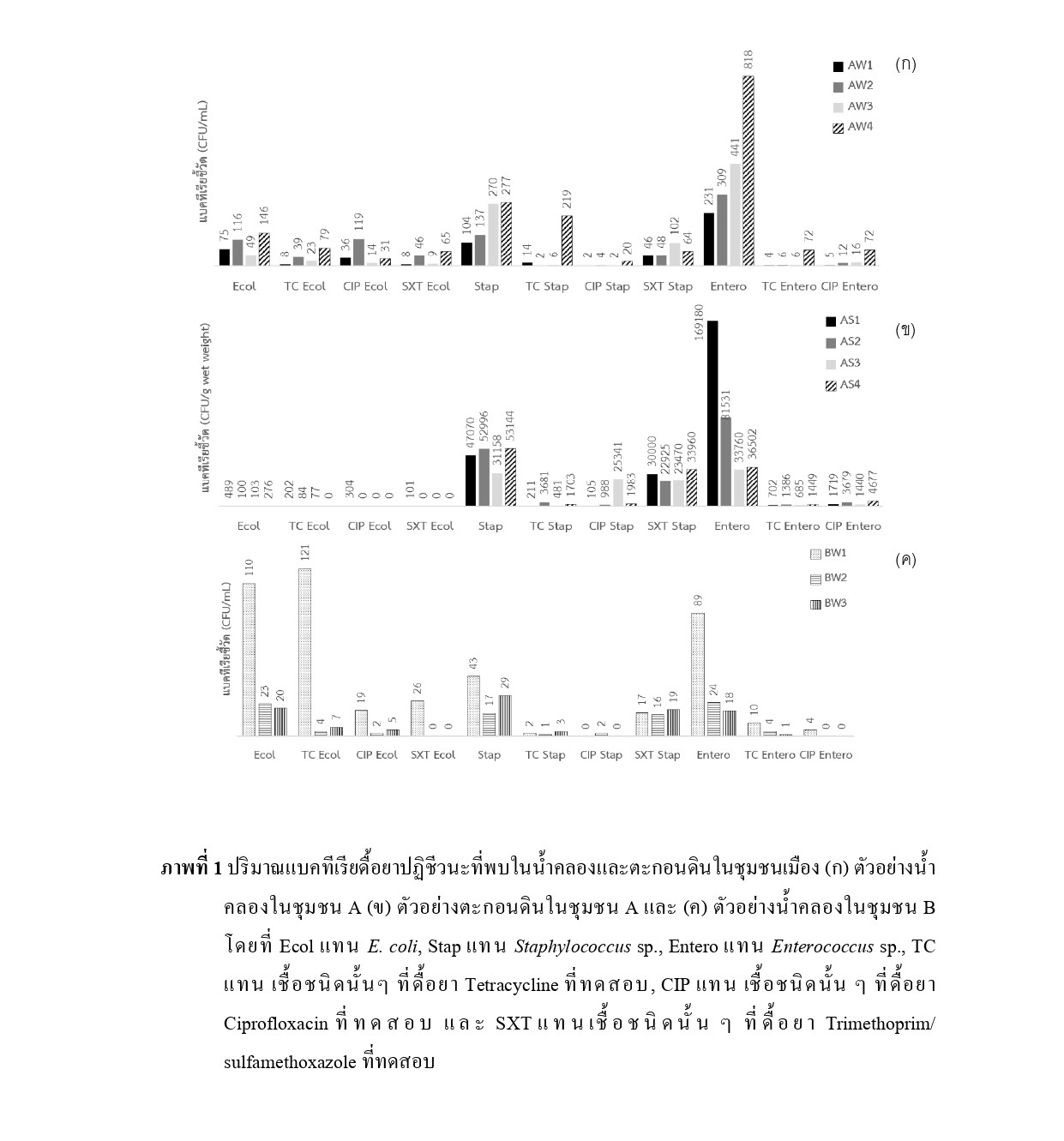
Results The research results showed the presence of Staphylococcus sp. (3.1x10^4 - 5.3x10^4 CFU/g wet weight) and Enterococcus sp. (3.4x10^4 - 1.7x10^5 CFU/g wet weight) accumulated in high amounts in the canal bank sediment compared to E. coli (1.0x10³-4.9x10³ CFU/g wet weight), while community water sample A had higher levels of all 3 bacterial groups compared to community B, with values of 4.9x101-8.2x10² CFU/mL and 1.7x101-1.1x10² CFU/mL, respectively. Additionally, three antibiotic-resistant bacteria were found at higher levels too. E. coli in community water sample A that survived were resistant to TC, CIP, and SXT at an average of 28.2-49.1%, and Staphylococcus sp. from the water samples from both communities had an average resistance to SXT of 35.0-65.5, indicating that activities in densely populated residential areas negatively impact the spread of antibiotic-resistant bacteria. Regarding health risks from environmental pollution in water sources as perceived by community members, an accidental sample of 80 people was selected, with 65% being elderly. The survey was conducted in community A using a quality-checked questionnaire. The research findings showed that health risks with low severity included disease contagions, unpleasant odors, and skin rashes, with percentages of 3.75%, 3.75%, and 1.25%, respectively. Health risks with very low severity included disease contagions, unpleasant odors, skin rashes, and difficulty breathing, with percentages of 81.25%, 53.75%, 41.25%, and 36.25%, respectively.
Conclusion and Recommendations It is essential to develop effective water source monitoring and management measures to reduce health risks to community members.
References
Clinical and Laboratory Standards Institute (CLSI). (2021). Performance standards for antimicrobial susceptibility testing (31st ed.). CLSI supplement M100.
Cui, Q., Huang, Y., Wang, H., & Fang, T. (2019). Diversity and abundance of bacterial pathogens in urban rivers impacted by domestic sewage. Environmental Pollution, 249, 24 - 35. http://doi.org/10.1016/j.envpol.2019.02.094
Ejiohuo, O., Onyeaka, H., Akinsemolu, A., Nwabor, O.F., Siyanbola, K.F., Tamasiga, P., & Al-Sharify, Z.T. (2025). Ensuring water purity: mitigating environmental risks and safeguarding human health. Water Biology and Security, 4(17), 100341. http://doi.org/10.1016/j.watbs. 2024.100341
Hamwi, A.M., & Salem-Sokhn, E. (2025). Methicillin-resistant Staphylococcus aureus (MRSA) and antimicrobial resistance in Lebanon: A scoping review. The Microbe, 7, 100405, http://doi.org/10.1016/j.microb.2025.100405
Hanna, N., Tamhankar, A.J., & Lundborg, C.S. (2023). Antibiotic concentrations and antibiotic resistance in aquatic environments of the WHO Western Pacific and South-East Asia regions: a systematic review and probabilistic environmental hazard assessment. Lancet Planet Health, 7(1), e45 - e54. http://doi.org/10.1016/S2542-5196(22)00254-6
Iqbal, F., Alocious, A., Joy, S.C., Stanly, E.A., Rajesh, V., Unnikrishnan, M.K., Steinke, D., & Chandra, P. (2024). Clinical Epidemiology and Global Health, 28, 101663. http://doi.org/ 10.1016/j.cegh.2024.10166
Larsson, D.G., & Flach, C.F. (2022). Antibiotic resistance in the environment. Nature Reviews Microbiology, 20, 257-269. http://doi.org/10.1038/s41579-021-00649-x
Lin, L., Yang, H. & Xu, X. (2022) Effects of water pollution on human health and disease heterogeneity. a review. Frontiers in Environmental Science, 10, 880246. http://doi.org/10.3389/fenvs.2022.880246
Mlynarczyk-Bonikowska, B., Kowalewski, C., Krolak-Ulinska, A., & Marusza, W. (2022). Molecular mechanisms of drug resistance in Staphylococcus aureus. International Journal of Molecular Science, 23(15), 8088. http://doi.org/10.3390/ijms23158088
Motlagh, A.M., & Yang, Z. (2019). Detection and occurrence of indicator organisms and pathogens. Water Environment Research, 91(10), 1402-1408. http://doi.org/10.1002/wer.1238
National Health Commission Office. (2024 May, 4). Aging society: 'crisis' or 'opportunity' for Thailand. https://old.nationalhealth.or.th/th/node/4901
Netthong, R., Donsamak, S., John, D.N., Kane, R., & Armani, K. (2024). Empowering Thai community pharmacists in combating antimicrobial resistance: qualitative insight and sentiment analysis. Exploratory Research in Clinical and Social Pharmacy, 16, 100535. http://doi.org/10.1016/j.rcsop.2024.100535
Okoye, C.O., Nyaruaba, R., Ita, R.E., Okon, S.U., Addey, C.I., Ebido, C.C., Opabunmi, A.O., Okeke, E.S., & Chukwudozie, K., I. (2022). Antibiotic resistance in the aquatic environment: analytical techniques and interactive impact of emerging contaminants. Environmental Toxicology and Pharmacology, 96, 103995. http://doi.org/10.1016/j.etap. 2022.103995
Peng, Q., Tang, X., Dong, W., Sun, N., & Yuan, W. (2022). A review of biofilm formation of Staphylococcus aureus and its regulation mechanism. Antibiotics (Basel), 12(1), 12. http://doi.org/10.3390/antibiotics12010012
Poomchaichote, T., Kiatying-Angsulee, N., Boonthaworn, K., Naemiratch, B., Ruangkajorn, S., Prapharsavat, R., Thirapantu, C., Sukrung, K., Limmathurotsakul, D., Osterrieder, A., & Cheah, P., Y. (2024). Embedding community and public voices in co-created solutions to mitigate antimicrobial resistance (AMR) in Thailand using the ‘Responsive Dialogues’ public engagement framework. Antimicrobial Resistance & Infection Control, 13(1), 71. http://doi.org/10.1186/s13756-024-01416-2
Sato, T., Kawamura, M., Furukawa, E., & Fujimura, S. (2018) Screening method for trimethoprim/sulfamethoxazole-resistant small colony variants of Staphylococcus aureus. Journal of Global Antimicrobial Resistance, 15, 1-5. http://doi.org/10.1016/j.jgar.2018.05.008
Straub, J., O. (2013). An environmental risk assessment for human-use Trimethoprim in European surface waters. Antibiotics, 2(1), 115-162. http://doi.org/10.3390/antibiotics2010115
Thongsamer, T., Neamchan, R., Blackburn, A., Acharya, K., Sutheeworapong, S., Tirachulee, B., Pattanachan, P., Vinitnantharat, S., Zhou, X.Y., Su, J.Q., Zhu, Y.G., Graham, D., & Werner, D. (2021). Environmental antimicrobial resistance is associated with faecal pollution in Central Thailand’s coastal aquaculture region. Journal of Hazardous Materials, 416, 125718. http://doi.org/10.1016/j.jhazmat.2021.125718
Threedeach, S., Yuvananont, P., Srichoopium, J., Srisaard, T, & Chiemchaisri, W. (2023). Fate of Escherichia coli and their antibiotic resistant pattern in food waste composting process. Agriculture and Technology Journal, 4(3), 14-26. https://li01.tci-thaijo.org/index.php/atj/ article/view/259352
Tuamsuwan, K., Chamawan, P., Boonyarit, P., Srisuphan, V., Klaytong, P., Rangsiwutisak, C., Wannapinij, P., Fongthong, T., Stelling, J., Turner, P., & Limmathurotsakul, D. (2024). Frequency of antimicrobial-resistant bloodstream infections in 111 hospitals in Thailand, 2022. Journal of Infection, 89(4), 106249. http://doi.org/10.1016/j.jinf.2024.106249
Wang, Y., Geng, M., Jia, H., Cui, J., Zhang, M., Zhao Y., & Wang, J. (2024). Removal of antibiotic resistant bacteria and antibiotic resistance genes: a bibliometric review. Frontiers of Environmental Science & Engineering, 18, 146. http://doi.org/10.1007/s11783-024-1906-2
World Health Organization. (2023, May 4). Thailand sounds the alarm on antimicrobial resistance.https://www.who.int/thailand/news/detail/14-06-2024-thailand-sounds-the-alarm-on-anti microbial-resistance
Zaheer, R., Cook, S.R., Barbieri, R., Goji, N., Cameron, A., Petkau, A., Polo, R.O., Tymensen, L., Stamm, C., Song, J., Hannon, S., Jones, T., Church, D., Booker, C.W., Amoako, K., Domselaar, G.V., Read., R.R., & McAllister, T.A. (2020). Surveillance of Enterococcus spp. reveals distinct species and antimicrobial resistance diversity across a One-Health continuum. Scientific Reports, 10, 3937. http://doi.org/10.1038/s41598-020-61002-5
Zhou, X., Cuasquer, G., J., Li, Z., Mang, H.P., & Lv, Y. (2021). Occurrence of typical antibiotics, representative antibiotic-resistant bacteria, and genes in fresh and stored source-separated human urine. Environment International, 146, 106280. http://doi.org/10.1016/j.envint.2020.106280
Downloads
Published
How to Cite
Issue
Section
License
Copyright (c) 2025 Princess of Naradhiwas University Journal

This work is licensed under a Creative Commons Attribution-NonCommercial-NoDerivatives 4.0 International License.