
การแพร่กระจายของแบคทีเรียดื้อยาปฏิชีวนะในแหล่งน้ำและตะกอนดินในชุมชนเมือง และความเสี่ยงด้านสุขภาพของคนในชุมชน
คำสำคัญ:
แบคทีเรียดื้อยาปฏิชีวนะ, ชุมชนเมือง, ความเสี่ยงด้านสุขภาพ, แหล่งน้ำธรรมชาติ, ตะกอนดินบทคัดย่อ
ความเป็นมาและวัตถุประสงค์ งานวิจัยนี้มีวัตถุประสงค์เพื่อศึกษาการแพร่กระจายของแบคทีเรียดื้อยาปฏิชีวนะในสิ่งแวดล้อม และความเสี่ยงด้านสุขภาพจากมลพิษสิ่งแวดล้อมในแหล่งน้ำตามการรับรู้ของคนในชุมชน
วิธีการวิจัย การศึกษาตัวอย่างทางสิ่งแวดล้อมจากน้ำในลำคลองและตะกอนดินของพื้นที่ชุมชนเมือง ซึ่งวิถีชีวิตแบบเมืองเป็นแหล่งกำเนิดสำคัญของแบคทีเรียดื้อยาปฏิชีวนะ โดยเปรียบเทียบระหว่างชุมชน A ซึ่งเป็นพื้นที่อยู่อาศัยหนาแน่น รายล้อมด้วยอาคารสูง และชุมชน B มีพื้นที่อยู่อาศัยเบาบางกว่า และทำการเกษตรร่วม โดยมีการติดตามแบคทีเรียก่อโรคระบบทางเดินอาหาร Escherichia coli, Staphylococcus sp. และ Enterococcus sp. และทดสอบการดื้อต่อยาปฏิชีวนะชนิด Tetracycline (TC), Ciprofloxacin (CIP) และ Trimethoprim/sulfamethoxazole (SXT) ที่ระดับความเข้มข้นต่ำสุดที่ก่อให้เกิดการดื้อยาปฏิชีวนะ (MIC)
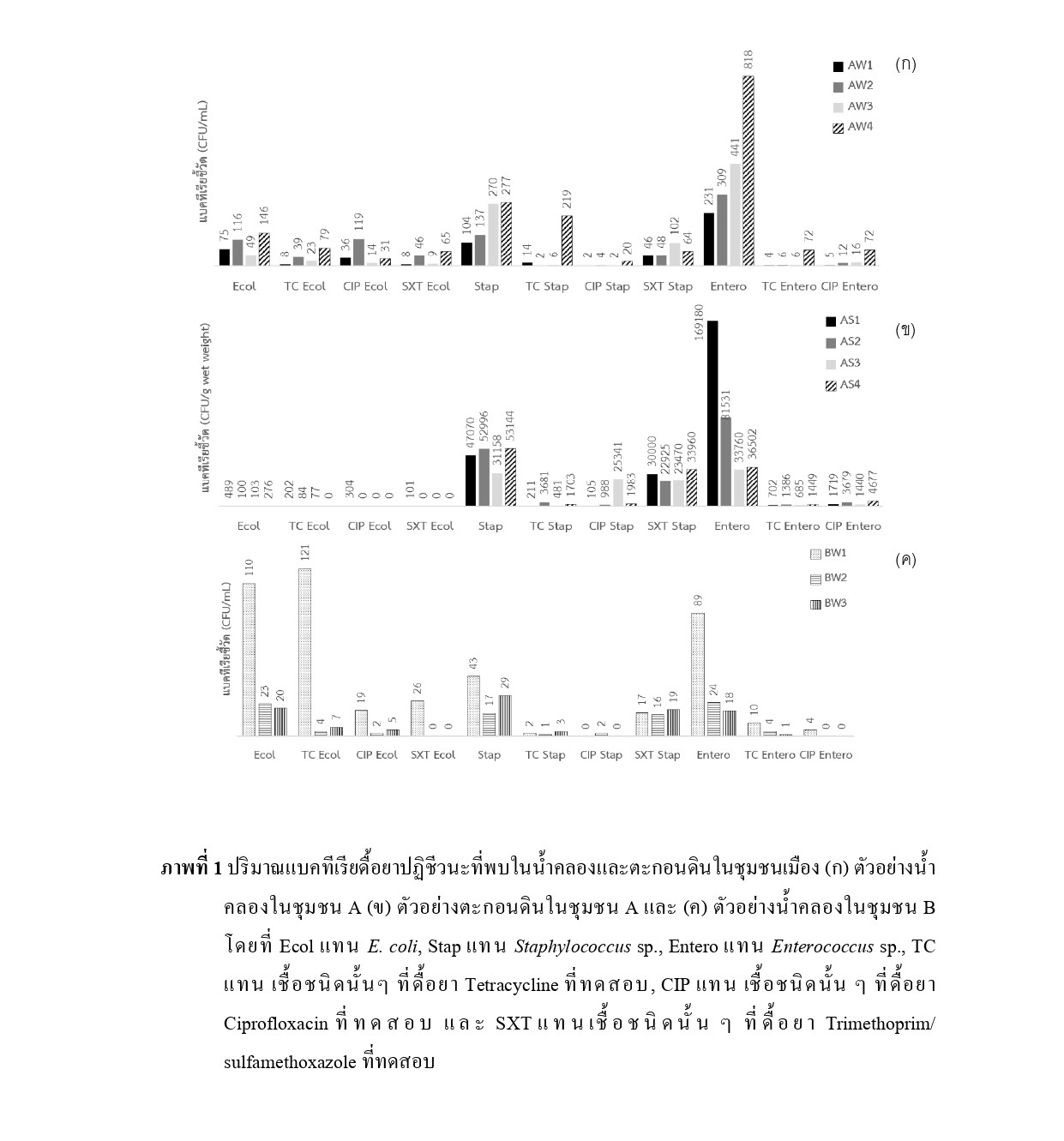
ผลการวิจัย พบ Staphylococcus sp. (3.1x10⁴-5.3x10⁴ CFU/g wet weight) และ Enterococcus sp. (3.4x10⁴-1.7x10⁵ CFU/g wet weight) สะสมในตะกอนดินริมคลองปริมาณสูงเมื่อเปรียบเทียบกับ
E. coli (1.0x10³-4.9x10³ CFU/g wet weight) ในขณะที่ตัวอย่างน้ำชุมชน A พบปริมาณแบคทีเรียทั้ง 3กลุ่ม สูงกว่าชุมชน B มีค่า 4.9x101-8.2x10² CFU/mL และ 1.7x101-1.1x10² CFU/mL ตามลำดับ อีกทั้งพบแบคทีเรียดื้อต่อยาปฏิชีวนะทั้ง 3 ชนิดในปริมาณที่สูงกว่าเช่นกัน E. coli ตัวอย่างน้ำชุมชน A ที่เหลือรอดดื้อต่อยา TC, CIP และ SXT เฉลี่ยร้อยละ 28.2-49.1 และ Staphylococcus sp. จากตัวอย่างน้ำทั้ง
2 ชุมชน ดื้อต่อยา SXT เฉลี่ย 35.0-65.5 แสดงให้เห็นว่าการดำเนินกิจกรรมของพื้นที่อยู่อาศัยหนาแน่นส่งผลกระทบเชิงลบต่อการแพร่กระจายของแบคทีเรียดื้อยาปฏิชีวนะ ส่วนความเสี่ยงด้านสุขภาพจากมลพิษสิ่งแวดล้อมในแหล่งน้ำตามการรับรู้ของคนในชุมชน เลือกกลุ่มตัวอย่างแบบบังเอิญ จำนวน 80 คน ร้อยละ 65 เป็นผู้สูงอายุ สำรวจในชุมชน Aโดยใช้แบบสอบถามที่ผ่านการตรวจสอบคุณภาพ ผลการวิจัย พบว่าความเสี่ยงภัยต่อสุขภาพที่มีความรุนแรงระดับน้อย ได้แก่ การก่อให้เกิดพาหะนำโรค การเกิดกลิ่นเหม็นรบกวน และผื่นคันร้อยละ 3.75, 3.75 และ 1.25 ตามลำดับ ความเสี่ยงภัยต่อสุขภาพที่มีความรุนแรงระดับน้อยมาก ได้แก่ การก่อให้เกิดพาหะนำโรค การเกิดกลิ่นเหม็นรบกวน ผื่นคัน และหายใจลำบาก ร้อยละ 81.25, 53.75, 41.25 และ 36.25 ตามลำดับ
สรุปและข้อเสนอแนะ จำเป็นอย่างยิ่งที่ต้องมีการพัฒนาระบบเฝ้าระวังและมาตรการจัดการแหล่งน้ำที่มีประสิทธิภาพ เพื่อลดความเสี่ยงภัยต่อสุขภาพของคนในชุมชน
เอกสารอ้างอิง
Clinical and Laboratory Standards Institute (CLSI). (2021). Performance standards for antimicrobial susceptibility testing (31st ed.). CLSI supplement M100.
Cui, Q., Huang, Y., Wang, H., & Fang, T. (2019). Diversity and abundance of bacterial pathogens in urban rivers impacted by domestic sewage. Environmental Pollution, 249, 24 - 35. http://doi.org/10.1016/j.envpol.2019.02.094
Ejiohuo, O., Onyeaka, H., Akinsemolu, A., Nwabor, O.F., Siyanbola, K.F., Tamasiga, P., & Al-Sharify, Z.T. (2025). Ensuring water purity: mitigating environmental risks and safeguarding human health. Water Biology and Security, 4(17), 100341. http://doi.org/10.1016/j.watbs. 2024.100341
Hamwi, A.M., & Salem-Sokhn, E. (2025). Methicillin-resistant Staphylococcus aureus (MRSA) and antimicrobial resistance in Lebanon: A scoping review. The Microbe, 7, 100405, http://doi.org/10.1016/j.microb.2025.100405
Hanna, N., Tamhankar, A.J., & Lundborg, C.S. (2023). Antibiotic concentrations and antibiotic resistance in aquatic environments of the WHO Western Pacific and South-East Asia regions: a systematic review and probabilistic environmental hazard assessment. Lancet Planet Health, 7(1), e45 - e54. http://doi.org/10.1016/S2542-5196(22)00254-6
Iqbal, F., Alocious, A., Joy, S.C., Stanly, E.A., Rajesh, V., Unnikrishnan, M.K., Steinke, D., & Chandra, P. (2024). Clinical Epidemiology and Global Health, 28, 101663. http://doi.org/ 10.1016/j.cegh.2024.10166
Larsson, D.G., & Flach, C.F. (2022). Antibiotic resistance in the environment. Nature Reviews Microbiology, 20, 257-269. http://doi.org/10.1038/s41579-021-00649-x
Lin, L., Yang, H. & Xu, X. (2022) Effects of water pollution on human health and disease heterogeneity. a review. Frontiers in Environmental Science, 10, 880246. http://doi.org/10.3389/fenvs.2022.880246
Mlynarczyk-Bonikowska, B., Kowalewski, C., Krolak-Ulinska, A., & Marusza, W. (2022). Molecular mechanisms of drug resistance in Staphylococcus aureus. International Journal of Molecular Science, 23(15), 8088. http://doi.org/10.3390/ijms23158088
Motlagh, A.M., & Yang, Z. (2019). Detection and occurrence of indicator organisms and pathogens. Water Environment Research, 91(10), 1402-1408. http://doi.org/10.1002/wer.1238
National Health Commission Office. (2024 May, 4). Aging society: 'crisis' or 'opportunity' for Thailand. https://old.nationalhealth.or.th/th/node/4901
Netthong, R., Donsamak, S., John, D.N., Kane, R., & Armani, K. (2024). Empowering Thai community pharmacists in combating antimicrobial resistance: qualitative insight and sentiment analysis. Exploratory Research in Clinical and Social Pharmacy, 16, 100535. http://doi.org/10.1016/j.rcsop.2024.100535
Okoye, C.O., Nyaruaba, R., Ita, R.E., Okon, S.U., Addey, C.I., Ebido, C.C., Opabunmi, A.O., Okeke, E.S., & Chukwudozie, K., I. (2022). Antibiotic resistance in the aquatic environment: analytical techniques and interactive impact of emerging contaminants. Environmental Toxicology and Pharmacology, 96, 103995. http://doi.org/10.1016/j.etap. 2022.103995
Peng, Q., Tang, X., Dong, W., Sun, N., & Yuan, W. (2022). A review of biofilm formation of Staphylococcus aureus and its regulation mechanism. Antibiotics (Basel), 12(1), 12. http://doi.org/10.3390/antibiotics12010012
Poomchaichote, T., Kiatying-Angsulee, N., Boonthaworn, K., Naemiratch, B., Ruangkajorn, S., Prapharsavat, R., Thirapantu, C., Sukrung, K., Limmathurotsakul, D., Osterrieder, A., & Cheah, P., Y. (2024). Embedding community and public voices in co-created solutions to mitigate antimicrobial resistance (AMR) in Thailand using the ‘Responsive Dialogues’ public engagement framework. Antimicrobial Resistance & Infection Control, 13(1), 71. http://doi.org/10.1186/s13756-024-01416-2
Sato, T., Kawamura, M., Furukawa, E., & Fujimura, S. (2018) Screening method for trimethoprim/sulfamethoxazole-resistant small colony variants of Staphylococcus aureus. Journal of Global Antimicrobial Resistance, 15, 1-5. http://doi.org/10.1016/j.jgar.2018.05.008
Straub, J., O. (2013). An environmental risk assessment for human-use Trimethoprim in European surface waters. Antibiotics, 2(1), 115-162. http://doi.org/10.3390/antibiotics2010115
Thongsamer, T., Neamchan, R., Blackburn, A., Acharya, K., Sutheeworapong, S., Tirachulee, B., Pattanachan, P., Vinitnantharat, S., Zhou, X.Y., Su, J.Q., Zhu, Y.G., Graham, D., & Werner, D. (2021). Environmental antimicrobial resistance is associated with faecal pollution in Central Thailand’s coastal aquaculture region. Journal of Hazardous Materials, 416, 125718. http://doi.org/10.1016/j.jhazmat.2021.125718
Threedeach, S., Yuvananont, P., Srichoopium, J., Srisaard, T, & Chiemchaisri, W. (2023). Fate of Escherichia coli and their antibiotic resistant pattern in food waste composting process. Agriculture and Technology Journal, 4(3), 14-26. https://li01.tci-thaijo.org/index.php/atj/ article/view/259352
Tuamsuwan, K., Chamawan, P., Boonyarit, P., Srisuphan, V., Klaytong, P., Rangsiwutisak, C., Wannapinij, P., Fongthong, T., Stelling, J., Turner, P., & Limmathurotsakul, D. (2024). Frequency of antimicrobial-resistant bloodstream infections in 111 hospitals in Thailand, 2022. Journal of Infection, 89(4), 106249. http://doi.org/10.1016/j.jinf.2024.106249
Wang, Y., Geng, M., Jia, H., Cui, J., Zhang, M., Zhao Y., & Wang, J. (2024). Removal of antibiotic resistant bacteria and antibiotic resistance genes: a bibliometric review. Frontiers of Environmental Science & Engineering, 18, 146. http://doi.org/10.1007/s11783-024-1906-2
World Health Organization. (2023, May 4). Thailand sounds the alarm on antimicrobial resistance.https://www.who.int/thailand/news/detail/14-06-2024-thailand-sounds-the-alarm-on-anti microbial-resistance
Zaheer, R., Cook, S.R., Barbieri, R., Goji, N., Cameron, A., Petkau, A., Polo, R.O., Tymensen, L., Stamm, C., Song, J., Hannon, S., Jones, T., Church, D., Booker, C.W., Amoako, K., Domselaar, G.V., Read., R.R., & McAllister, T.A. (2020). Surveillance of Enterococcus spp. reveals distinct species and antimicrobial resistance diversity across a One-Health continuum. Scientific Reports, 10, 3937. http://doi.org/10.1038/s41598-020-61002-5
Zhou, X., Cuasquer, G., J., Li, Z., Mang, H.P., & Lv, Y. (2021). Occurrence of typical antibiotics, representative antibiotic-resistant bacteria, and genes in fresh and stored source-separated human urine. Environment International, 146, 106280. http://doi.org/10.1016/j.envint.2020.106280
ดาวน์โหลด
เผยแพร่แล้ว
รูปแบบการอ้างอิง
ฉบับ
ประเภทบทความ
สัญญาอนุญาต
ลิขสิทธิ์ (c) 2025 วารสารมหาวิทยาลัยนราธิวาสราชนครินทร์

อนุญาตภายใต้เงื่อนไข Creative Commons Attribution-NonCommercial-NoDerivatives 4.0 International License.