
The Effects of Transitional Nursing Program from Hospital to Home on Self-Care Behaviors and Readmission Rates among Older Adult Patients with Pneumonia
Keywords:
Transitional care nursing, Older adults with pneumonia, Self-care behavior, Hospital readmissionAbstract
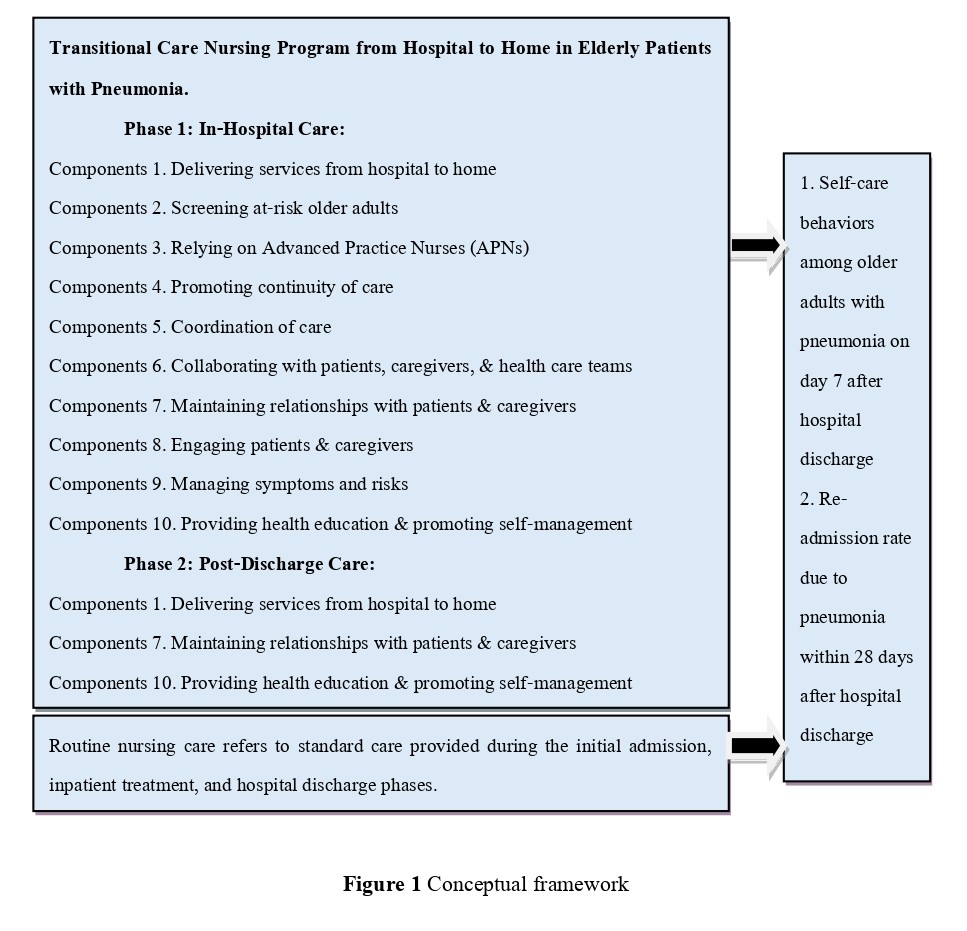
Background and Objective Pneumonia is a major cause of hospital readmission and mortality among older adults. Transitional care nursing plays an important role in ensuring continuity of care after hospital discharge. This study aimed to examine the effects of a transitional care nursing program from hospital to home on self-care behaviors and readmission rates among older adult patients with pneumonia.
Methods This study was quasi-experimental. The participants were 52 older adults who were admitted to a general hospital in southern Thailand. They were divided equally into two groups: an experimental group and a control group, each comprising 26 participants. The research instruments consisted of a transitional care nursing program, a readmission record form, and a self-care behavior assessment tool, which was reviewed by five experts, yielding a content validity index (CVI) of 0.98 and a Cronbach’s alpha coefficient of 0.98. Data were analyzed using descriptive statistics, paired t-tests, independent t-tests, and chi-square tests.
Results The findings revealed that the experimental group had significantly higher self-care behavior scores after receiving the program, with statistically significant differences from both their pre-intervention scores and the control group (p < 0.01). Moreover, no participants in the experimental group were readmitted within 28 days post-discharge, whereas the control group had a 15.4% readmission rate.
Conclusion and Recommendations The findings of this study indicate that the transitional care nursing program effectively promotes self-care behaviors and reduces hospital readmission rates. It is considered appropriate for implementation in the care of older adults with pneumonia.
References
Cohen, J. (2023). Statistical power analysis for the behavioral sciences (2nd ed.). Routledge.
Coleman, E. A., Parry, C., Chalmers, S., & Min, S. (2006). The care transitions intervention: Results of a randomized controlled trial. Archives of internal medicine, 166(17), 1822–1828. https://doi.org/10.1001/archinte.166.17.1822
Dadonaite, B., & Roser, M. (2024). Pneumonia. Our World in Data. https://ourworldindata.org/ pneumonia
Department of Disease Control. (2023). Pneumonia situation report 2018–2022 (Pneumonia situation report, 2018–2022). Ministry of Public Health, Thailand. https://ddc.moph.go.th
Faul, F., Erdfelder, E., Buchner, A., & Lang, A.-G. (2009). Statistical power analyses using G*Power 3.1: Tests for correlation and regression analyses. Behavior Research Methods, 41, 1149 –1160. http://doi.org/10.3758/BRM.41.4.1149
Gurvich, V., & Naumova, M. (2025, May 8). Critical issues with the Pearson’s chi-square test. https://doi.org/10.48550/arXiv.2305.06318
Heui, S., Kim, J., & Lee, H. (2020) (a). Self-care behaviors and transitional care in older adults with pneumonia. Journal of Geriatric Nursing, 45(2), 123 – 130. http://doi.org/10.1016/jqerinurse. 2003.10.008
Heui, J., Kim, Y., & Lee, H. (2020) (b). Transitional care model for older patients with pneumonia: Reducing readmission rates and improving self-care. Journal of Geriatric Pulmonology, 15(3), 211 - 220. http://doi.org/10.3346/jkmg.2020.35e352
Jehloh, L., Songwathana, P., Kitrungrote, L., & Bourbonnais, A. (2024). Perspectives of family caregivers and nurses on hospital discharge transitional care for Muslim older adults living with COPD: a qualitative study. BMC Nursing, 23(1), 1-11. http://doi.org/10.60099/ Prijmr.2024.264962
Klinkhajorn, A., & Woramalee, S. (2020). Nursing Manual for Elderly Patients with Pneumonia [Master’s thesis]. Mahidol University.
Narathiwat Rajanagarindra Hospital (2024). Hospital Statisties report. Author.
Naylor, M. D. (2018). The Transitional Care Model: Translating research into practice. University of Pennsylvania School of Nursing. https://www.transitionalcare.info
Naylor, M. D., Aiken, L. H., Kurtzman, E. T., Olds, D. M., & Hirschman, K. B. (2011). The importance of transitional care in achieving health reform. Health Affairs, 30(4), 746–754. http://doi.org/10.1377/tilgaff.2011.0041
Nilmarnat, K., Khaw, T., Purintharapibal, C., Saechit, K., & Thamachot, P. (2022). Experiences of nurses in transitional care for families of critically ill patients who decided to withdraw treatment: A case study. Thai Nursing Council Journal, 37(1), 42–57. http://www/nur.psu.ac.th/research/file_warsarn/1557jouranl/2.pdf
Nilsawat, W. (2022). The effect of a transitional care program for stroke patients and their caregivers on activities of daily living, complications, and self-management ability of caregivers. Journal of Nursing and Public Health Research, 2(3), 57–70. http://he02.tci-thaijo. org/index.php/juphr
Orem, D. E., Taylor, S. G., & Renpenning, K. M. (2001). Nursing: Concepts of practice (6th ed.). Mosby.
Santos, M. J., Dias, R. P., & Reis, F. M. (2020). Discharge planning and transitional care to prevent readmission in elderly patients with pneumonia. International Journal of Nursing Studies, 104, 103524. https://doi.org/10.1016/j.ijnurstu.2020.103524
Thaewiriyakun, C. (2020). Development of a discharge planning model for elderly pneumonia patients at the Institute of Chest Diseases. Nursing Journal, 69(3), 35–43. http://he02.tci-thaijo.org/index.php/TJN/article/download/245154/167198
Downloads
Published
How to Cite
Issue
Section
License
Copyright (c) 2025 Princess of Naradhiwas University Journal

This work is licensed under a Creative Commons Attribution-NonCommercial-NoDerivatives 4.0 International License.