
Development of a Prevention Model for Ventilator-Associated Pneumonia in Intensive Care Unit Patients at Thabo Crown Prince Hospital, Nong Khai Province
Keywords:
Model development, Infection prevention, Ventilator-associated pneumonia, Intensive care unitAbstract
Background and Objectives Patients who undergo endotracheal intubation and mechanical ventilation are approximately 3–20 times more likely to develop pneumonia than general patients. Continuous surveillance and infection prevention are therefore essential, particularly for professional nurses who play a critical role in patient care. This study aimed to investigate the current situation, develop a model, and evaluate the effectiveness of a pneumonia prevention model for mechanically ventilated patients in the intensive care unit at Thabo Crown Prince Hospital, Nong Khai Province.
Methods The research and development were conducted between January 2024 and June 2025 and consisted of three phases: 1) Studying the current situation and needs through a document review and qualitative research involving 10 registered nurses and 4 internists; 2) Developing the model; and 3) Examining the effectiveness of the model. The research instruments were validated by three experts, yielding an Index of Item-Objective Congruence (IOC) ranging from 0.67 to 1.00. The instruments used included the TIH2E Model, an infection data record form, a satisfaction evaluation form, and an observation form for model implementation. A one-group pretest-posttest quasi-experimental design was employed. The study sample consisted of 23 registered nurses and 34 patients on mechanical ventilation. Data were analyzed using descriptive statistics and the one-sample t-test.
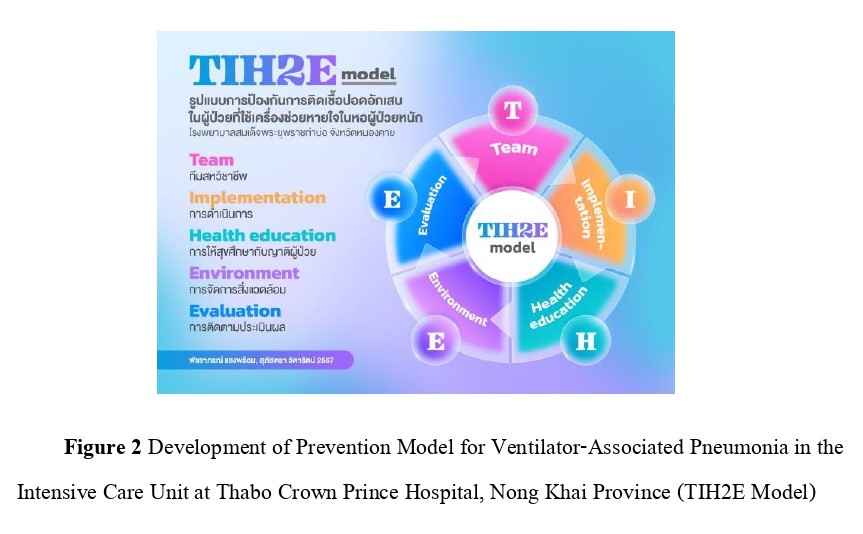
Results A retrospective review (2021–2023) revealed an increasing trend of ventilator-associated pneumonia: VAP incidence. Nursing practice in VAP bundle implementation was incomplete and lacked continuous monitoring. The TIH2E Model comprised: 1) Team (multidisciplinary team), 2) Implementation, 3) Health education (for caregivers), 4) Environment (environmental management), and 5) Evaluation (monitoring and evaluation). After implementation, 76.50 % of patients did not develop VAP. Nurses reported satisfaction levels exceeding 80 %, and adherence to the model was greater than 95 %, with statistically significant improvement (p < .001).
Conclusions and Recommendations The TIH2E Model proved effective in enhancing nursing practices and reducing ventilator-associated pneumonia among mechanically ventilated patients. The model contributes to improved quality of care and patient safety.
References
Alkasang, P. (2021). Nursing care of the patient with ventilator-associated pneumonia: Case study. Mahasarakham Hospital Journal, 18(1), 106 – 121. https://he02.tci-thaijo.org/index.php/ MKHJ/article/view/249515
Bunruang, P., Keawkongton, R., Bunkong, P., & Nahu, Y. (2025). Development of a nursing care model for mechanically ventilated patients in the intensive care unit at Walailak University Hospital. Multidisciplinary Digital Procedia, 1(2). 1-12 https://conference.afirstshare.com/ index.php/MDP/article/view/50
Centers for Disease Control and Prevention. (2023). Pneumonia (ventilator-associated [VAP] and non-ventilator-associated pneumonia [PNEU]) event. National Healthcare Safety Network. https://www.cdc.gov/nhsn/pdfs/pscmanual/6pscvapcurrent.pdf
Chirawatkun, A. (2013). Statistics in health science for research. Wittayapat Company. https://thaidj.org/index.php/JHS/article/view/6710/6329
Cohen, J. (1988). Statistical power analysis for the behavioral sciences. Lawrence Erlbaum Associates.
Crabtree, B.F., & Miller, W.L. (1992). A template approach to text analysis: Developing and using codebooks. In B. F. Crabtree & W. L. Miller (Eds.), Doing qualitative research in primary care: Multiple strategies (pp. 93–109). Sage Publications.
Faul, F., Erdfelder, E., Lang, A.G., & Buchner, A. (2007). G*Power 3: A flexible statistical power analysis program for the social, behavioral, and biomedical sciences. Behavior Research Methods, 39(2), 175-191. https://link.springer.com/article/10.3758/BF03193146
Kongdejsakda, W., Somboon, C., & Puangkamyad, A. (2024). Factors related to ventilator-associated
pneumonia in the intensive care unit of tertiary care hospitals. Journal of Bamrasnaradura Infectious Diseases Institute, 18(3),143–154. https://he01.tci-thaijo.org/index.php/bamras journal/article/view/274067
Kummom, D. (2022). Results of promoting the clinical nurse practice guidelines to prevent ventilator-associated pneumonia (VAP) in the medical intensive care unit at Phrae Hospital. Journal of the Phrae Hospital, 30(1), 15–31. https://thaidj.org/index.php/jpph/article/view/12611
Li, W., Cai, J., Ding, L., Chen, Y., Wang, X., & Xu, H. (2024). Incidence and risk factors of ventilator-associated pneumonia in the intensive care unit: A systematic review and meta-analysis. Journal of Thoracic Disease, 16(9), 5518–5528. https://doi.org/10.21037/jtd-24-150
Liankruea, K., Payunmahisorn, S., & Karuncharernpanit, S. (2022). The development of clinical supervision model for ventilator-associated pneumonia prevention among the intensive care unit in Phaholpolpayuhasaena Hospital. Journal of Roi Kaensarn Academi, 7(9), 301–315. https://so02. tci-thaijo.org/index.php/JRKSA/article/view/258511
Limjaroen, S. (2018). Nursing care of the patient with ventilator-associated pneumonia: Case study (2 cases). Journal of Bamrasnaradura Infectious Diseases Institute, 12(1), 32 – 42. https://he01.tci-thaijo.org/index.php/bamrasjournal/article/view/185410
Paleeniwes, R., Soothi, T., Piwpong, R., & Yearapan, J. (2022). The development of nursing care odel
for prevention of ventilator-associated pneumonia in the intensive care unit, Buri Rum Hospital. Medical Journal of Srisaket Surin
Buriram Hospitals, 37(2), 441 – 451. https://he02.tci-thaijo.org/index.php/MJSSBH/article/view/258931
Pimthong, S. (2024). Development of measuring instrument in behavioral science research. Book Plus.
Poomipuk, P., Somgit, W., Pukkaeraka, W., Thanoochan, R., & Dana, K. (2025). Development of a nursing management model for ventilator-associated pneumonia prevention in general ward, Mahasarakham Hospital. Journal of The Royal Thai Army Nurses, 26(1), 287 – 297. https://he01.tci-thaijo.org/index.php/JRTAN
Prajongtas, N., Usahapiriyakul, S., & Chunbang, S. (2025). Development of nursing care model to prevent ventilator-associated pneumonia at intensive care unit in Ratchaburi Hospital. Journal of Research for Health Improvement and Quality of Life, 5(1), 13 – 26. https://he02.tci-thaijo.org/ index.php/RHQJ
Proctor, B. (2001). Training for the supervision alliance attitude, skills and intention. In J. R. Cutcliffe, T. Butterworth, & B. Proctor (Eds.), Fundamental themes in clinical supervision (pp. 25–46). Routledge. https://doi.org/10.4324/9780203996010
Ramathibodi Hospital. (2023). VAP bundle new update. Author.
Soottiwirush, N., Jamnam, U., & Meebunmak, Y. (2021). The development of a nursing system for preventing of ventilator associated pneumonia. Journal of Nursing Division. 48(1), 131-144. https://he01.tci-thaijo.org/index.php/JND/article/view/262856/176960
Suwannakeere, W., & Jullmus, O. (2023). Prevention of Ventilator-Associated Pneumonia in Adults. Journal of Nursing and Health Sciences, 17(3), 13 - 25. https://he01.tci-thaijo.org/index.php/ NurseNu/article/view/263416/179548
Downloads
Published
How to Cite
Issue
Section
License
Copyright (c) 2025 Princess of Naradhiwas University Journal

This work is licensed under a Creative Commons Attribution-NonCommercial-NoDerivatives 4.0 International License.