
การพัฒนารูปแบบการป้องกันการติดเชื้อปอดอักเสบในผู้ป่วยที่ใช้เครื่องช่วยหายใจใน หอผู้ป่วยหนัก โรงพยาบาลสมเด็จพระยุพราชท่าบ่อ จังหวัดหนองคาย
คำสำคัญ:
พัฒนารูปแบบ, การป้องกันการติดเชื้อ, ปอดอักเสบจากการใช้เครื่องช่วยหายใจ, หอผู้ป่วยหนักบทคัดย่อ
ความเป็นมาและวัตถุประสงค์ ผู้ป่วยที่ได้รับการใส่ท่อช่วยหายใจและใช้เครื่องช่วยหายใจ
มีความเสี่ยงต่อการเกิดปอดอักเสบมากกว่าผู้ป่วยทั่วไปประมาณ 3 – 20 เท่า การเฝ้าระวังและการป้องกันการติดเชื้อจึงเป็นสิ่งจำเป็นที่บุคลากรทางการพยาบาล โดยเฉพาะพยาบาลวิชาชีพ ต้องให้ความสำคัญและปฏิบัติอย่างต่อเนื่อง การวิจัยนี้มีวัตถุประสงค์เพื่อศึกษาสภาพการณ์ พัฒนารูปแบบ และศึกษาประสิทธิผลของรูปแบบการป้องกันการติดเชื้อปอดอักเสบในผู้ป่วยที่ใช้เครื่องช่วยหายใจในผู้ป่วยที่ใช้เครื่องช่วยหายใจในหอผู้ป่วยหนัก โรงพยาบาลสมเด็จพระยุพราชท่าบ่อ จังหวัดหนองคาย
วิธีการวิจัย การวิจัยและพัฒนา แบ่งเป็น 3 ขั้นตอน ได้แก่ 1) ศึกษาสภาพการณ์และความต้องการโดยใช้การทบทวนเอกสารและการวิจัยเชิงคุณภาพกับพยาบาลวิชาชีพ 10 คน และอายุรแพทย์ 4 คน 2) พัฒนารูปแบบ และ 3) ศึกษาประสิทธิผลของรูปแบบ เครื่องมือวิจัยผ่านการตรวจสอบจากผู้เชี่ยวชาญ 3 คน ได้ค่าความสอดคล้องระหว่างข้อคำถามกับวัตถุประสงค์ (IOC) ระหว่าง .67–1.00 เครื่องมือที่ใช้ ได้แก่ TIH2E Model แบบบันทึกข้อมูลการติดเชื้อ แบบประเมินความพึงพอใจ แบบบันทึกการสังเกตการปฏิบัติการใช้รูปแบบ ใช้ระเบียบวิธีวิจัยกึ่งทดลองแบบกลุ่มเดียววัดก่อนและหลังทดลองกลุ่มตัวอย่างคือพยาบาลวิชาชีพ 23 คน และผู้ป่วยใช้เครื่องช่วยหายใจ 34 คน วิเคราะห์ข้อมูลด้วยสถิติเชิงพรรณนาและ One-sample t-test
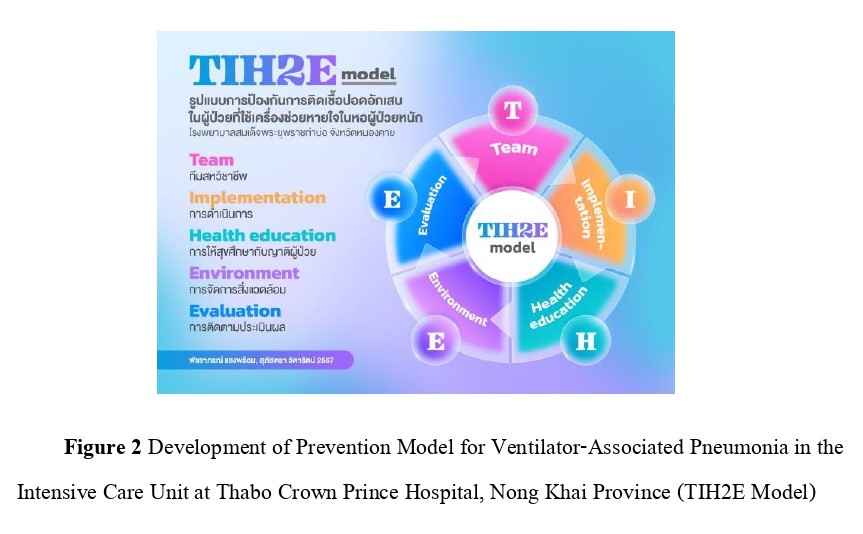
ผลการวิจัย การศึกษาสถานการณ์ย้อนหลัง (พ.ศ. 2564 – 2566) พบว่าอุบัติการณ์ภาวะปอดอักเสบจากการใช้เครื่องช่วยหายใจ (Ventilator-Associated Pneumonia: VAP) มีแนวโน้มเพิ่มขึ้น และการปฏิบัติงานด้าน VAP bundle ของพยาบาลยังไม่ครอบคลุมและขาดการติดตามอย่างต่อเนื่อง TIH2E Model ประกอบด้วย 1) Team (ทีมสหสาขาวิชาชีพ) 2) Implementation (การดำเนินการ) 3) Health education (การให้สุขศึกษาผู้ดูแล) 4) Environment (การจัดการสิ่งแวดล้อม) และ 5) Evaluation (การติดตามและประเมินผล) หลังการใช้รูปแบบ พบว่าผู้ป่วย 76.50 % ไม่เกิด VAP พยาบาลมีความพึงพอใจมากกว่า 80 % และมีการปฏิบัติตามรูปแบบเกิน 95 % อย่างมีนัยสำคัญทางสถิติ (p < .001)
สรุปและข้อเสนอแนะ TIH2E Model มีประสิทธิผลในการส่งเสริมการปฏิบัติการพยาบาลและลดการติดเชื้อปอดอักเสบในผู้ป่วยใช้เครื่องช่วยหายใจ ควรมีการติดตามผลในระยะยาวเพื่อประเมินประสิทธิผลอย่างต่อเนื่องในการดูแลผู้ป่วยให้มีคุณภาพและปลอดภัยยิ่งขึ้น
เอกสารอ้างอิง
Alkasang, P. (2021). Nursing care of the patient with ventilator-associated pneumonia: Case study. Mahasarakham Hospital Journal, 18(1), 106 – 121. https://he02.tci-thaijo.org/index.php/ MKHJ/article/view/249515
Bunruang, P., Keawkongton, R., Bunkong, P., & Nahu, Y. (2025). Development of a nursing care model for mechanically ventilated patients in the intensive care unit at Walailak University Hospital. Multidisciplinary Digital Procedia, 1(2). 1-12 https://conference.afirstshare.com/ index.php/MDP/article/view/50
Centers for Disease Control and Prevention. (2023). Pneumonia (ventilator-associated [VAP] and non-ventilator-associated pneumonia [PNEU]) event. National Healthcare Safety Network. https://www.cdc.gov/nhsn/pdfs/pscmanual/6pscvapcurrent.pdf
Chirawatkun, A. (2013). Statistics in health science for research. Wittayapat Company. https://thaidj.org/index.php/JHS/article/view/6710/6329
Cohen, J. (1988). Statistical power analysis for the behavioral sciences. Lawrence Erlbaum Associates.
Crabtree, B.F., & Miller, W.L. (1992). A template approach to text analysis: Developing and using codebooks. In B. F. Crabtree & W. L. Miller (Eds.), Doing qualitative research in primary care: Multiple strategies (pp. 93–109). Sage Publications.
Faul, F., Erdfelder, E., Lang, A.G., & Buchner, A. (2007). G*Power 3: A flexible statistical power analysis program for the social, behavioral, and biomedical sciences. Behavior Research Methods, 39(2), 175-191. https://link.springer.com/article/10.3758/BF03193146
Kongdejsakda, W., Somboon, C., & Puangkamyad, A. (2024). Factors related to ventilator-associated
pneumonia in the intensive care unit of tertiary care hospitals. Journal of Bamrasnaradura Infectious Diseases Institute, 18(3),143–154. https://he01.tci-thaijo.org/index.php/bamras journal/article/view/274067
Kummom, D. (2022). Results of promoting the clinical nurse practice guidelines to prevent ventilator-associated pneumonia (VAP) in the medical intensive care unit at Phrae Hospital. Journal of the Phrae Hospital, 30(1), 15–31. https://thaidj.org/index.php/jpph/article/view/12611
Li, W., Cai, J., Ding, L., Chen, Y., Wang, X., & Xu, H. (2024). Incidence and risk factors of ventilator-associated pneumonia in the intensive care unit: A systematic review and meta-analysis. Journal of Thoracic Disease, 16(9), 5518–5528. https://doi.org/10.21037/jtd-24-150
Liankruea, K., Payunmahisorn, S., & Karuncharernpanit, S. (2022). The development of clinical supervision model for ventilator-associated pneumonia prevention among the intensive care unit in Phaholpolpayuhasaena Hospital. Journal of Roi Kaensarn Academi, 7(9), 301–315. https://so02. tci-thaijo.org/index.php/JRKSA/article/view/258511
Limjaroen, S. (2018). Nursing care of the patient with ventilator-associated pneumonia: Case study (2 cases). Journal of Bamrasnaradura Infectious Diseases Institute, 12(1), 32 – 42. https://he01.tci-thaijo.org/index.php/bamrasjournal/article/view/185410
Paleeniwes, R., Soothi, T., Piwpong, R., & Yearapan, J. (2022). The development of nursing care odel
for prevention of ventilator-associated pneumonia in the intensive care unit, Buri Rum Hospital. Medical Journal of Srisaket Surin
Buriram Hospitals, 37(2), 441 – 451. https://he02.tci-thaijo.org/index.php/MJSSBH/article/view/258931
Pimthong, S. (2024). Development of measuring instrument in behavioral science research. Book Plus.
Poomipuk, P., Somgit, W., Pukkaeraka, W., Thanoochan, R., & Dana, K. (2025). Development of a nursing management model for ventilator-associated pneumonia prevention in general ward, Mahasarakham Hospital. Journal of The Royal Thai Army Nurses, 26(1), 287 – 297. https://he01.tci-thaijo.org/index.php/JRTAN
Prajongtas, N., Usahapiriyakul, S., & Chunbang, S. (2025). Development of nursing care model to prevent ventilator-associated pneumonia at intensive care unit in Ratchaburi Hospital. Journal of Research for Health Improvement and Quality of Life, 5(1), 13 – 26. https://he02.tci-thaijo.org/ index.php/RHQJ
Proctor, B. (2001). Training for the supervision alliance attitude, skills and intention. In J. R. Cutcliffe, T. Butterworth, & B. Proctor (Eds.), Fundamental themes in clinical supervision (pp. 25–46). Routledge. https://doi.org/10.4324/9780203996010
Ramathibodi Hospital. (2023). VAP bundle new update. Author.
Soottiwirush, N., Jamnam, U., & Meebunmak, Y. (2021). The development of a nursing system for preventing of ventilator associated pneumonia. Journal of Nursing Division. 48(1), 131-144. https://he01.tci-thaijo.org/index.php/JND/article/view/262856/176960
Suwannakeere, W., & Jullmus, O. (2023). Prevention of Ventilator-Associated Pneumonia in Adults. Journal of Nursing and Health Sciences, 17(3), 13 - 25. https://he01.tci-thaijo.org/index.php/ NurseNu/article/view/263416/179548
ดาวน์โหลด
เผยแพร่แล้ว
รูปแบบการอ้างอิง
ฉบับ
ประเภทบทความ
สัญญาอนุญาต
ลิขสิทธิ์ (c) 2025 วารสารมหาวิทยาลัยนราธิวาสราชนครินทร์

อนุญาตภายใต้เงื่อนไข Creative Commons Attribution-NonCommercial-NoDerivatives 4.0 International License.