Development of a Self-Care Model for Diabetic Patients with Uncontrolled Blood Sugar Levels in Sam Tumbon Community Medical Center, Songkhla Province
Keywords:
Self-care, Diabetic patients with uncontrolled blood sugar levels, Type 2 diabetes mellitusAbstract
Background and Objectives Self-care to control blood sugar levels is crucial for preventing or delaying complications of diabetes. Patients need knowledge and support from an interdisciplinary team to adjust their behavior and control their blood sugar levels. This research aimed to study the current situation, develop a model, and examine its effectiveness.
Methods The research and development was conducted in three phases: 1) document analysis and qualitative methods (R1), 2) model draft development (D1), and 3) effectiveness study (R2). A quasi-experimental design with two groups, pre- and post-measurement, was used. The sample consisted of 44 diabetic patients with uncontrolled blood sugar levels per group. The instruments used were the ATPH 3T Model, a self-care behavior questionnaire, and HbA1c measurements. The content validity index values ranged from .67 to 1.00, and the Cronbach's alpha reliability was 0.857. Data were analyzed using descriptive statistics, paired t-tests, and independent t-tests.
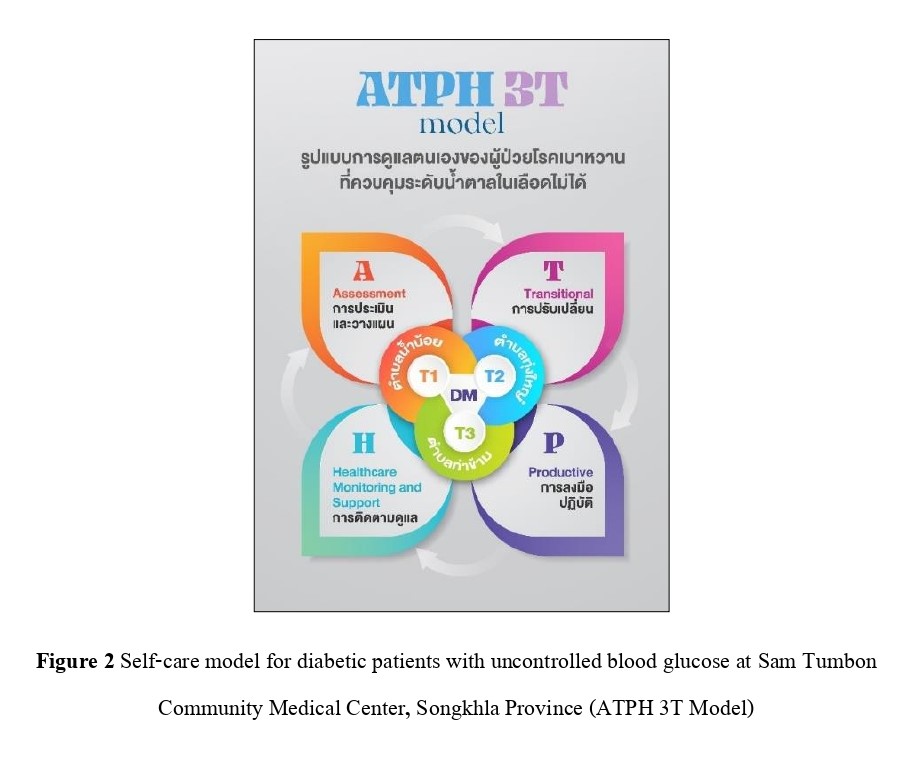
Results 1) There was an increase in the number of diabetic patients with uncontrolled blood sugar levels, but the number of blood tests has decreased. These patients have problems with diet, exercise, medication adherence, and complications. They required knowledge and monitoring. 2) The ATPH 3T Model consisted of Assessment (A), Transitional (T), Productive (P), and Healthcare Monitoring and Support (H). 3) The experimental group following the ATPH 3T Model showed a statistically significant increase in self-care behavior scores and a decrease in HbA1c levels (p < .001, .001), which was significantly better than the control group (p = .049, <.001).
Conclusion and Recommendations The ATPH 3T Model is effective in promoting self-care behaviors and reducing HbA1c levels. This model should be used to continuously organize activities.
References
Aroon, J. (2013). Statistics for health science research. Witthayapat.
Cohen, J. (1988). Statistical power analysis for the behavioral sciences (2nd ed.). Lawrence Erlbaum Associates.
Crabtree, B.F., & Miller, W.L. (1992). A template approach to text analysis: Developing and using codebooks. In B. F. Crabtree & W. L. Miller (Eds.), Doing qualitative research in primary care: Multiple strategies (pp. 93–109). Sage Publications.
Department of Disease Control. (2024). Annual report 2023, Non-communicable Diseases Division. Author.
Faul, F., Erdfelder, E., Lang, A.G., & Buchner, A. (2007). G*Power 3: A flexible statistical power analysis program for the social, behavioral, and biomedical sciences. Behavior Research Methods, 39(2), 175 - 191. https://link.springer.com/article/10.3758/BF03193146
Fraenkel, R.J., Wallen, E.N., & Hyun, H.H. (2012). How to design and evaluate research in education (8th ed.). McGraw-Hill.
Hair, F.J., Black, C.W., Babin, J.B., & Anderson, E.R. (2019). Multivariate data analysis (7th ed.). Pearson Education. https://www.rama.mahidol.ac.th/ramachannel/article/
Orem, D.E. (2001). Nursing: Concepts of practice (6th ed.). Mosby.
Paisan, T., Langporn, U., & Waratphit, K. (2019). Effects of interdisciplinary team-supported self-management to slow progression of chronic kidney disease in primary care settings, Khon Kaen Regional Hospital. Srinagarind Medical Journal, 34(6), 552 - 558. https://li01.tci-thaijo.org/index.php/SRIMEDJ/article/view/225103/154101
Pakwipa, R. (2019). “Diabetes” a behavioral NCD: Easy to prevent by adjusting lifestyle. Department of Family Medicine, Faculty of Medicine Ramathibodi Hospital, Mahidol University.
Panyaphet, K., Maharachpong, N., & Rodjakphai, Y. (2022). The effect of a self-care model based on self-care and self-regulation concepts on blood glucose control among patients with uncontrolled type 2 diabetes. Journal of Health and Health Management, 8(2), 105 - 118. https://he01.tci-thaijo.org/index.php/slc/article/view/256957/175707
Patcharin, C., Nipa, K., & Ratchanee, N. (2020). Effects of support and education programs on self-care behavior and HbA1c levels in newly diagnosed type 2 diabetes patients. Journal of Nursing Science and Health, 43(1), 78 - 86. https://he01.tci-thaijo.org/index.php/nah/article/view/185628/163893
Phunsap, S., Lalita, K., & Apinya, S. (2023). Effects of a self-care program based on Orem’s self-care theory and family involvement on blood glucose control in patients with type 2 diabetes. Region 11 Medical Journal, 37(4), 1 - 13. https://he02.tci-thaijo.org/index.php/Reg11MedJ/article/view/266102/182338
Sam Tambon Community Medical Center. (2024). Diabetes clinic patient records 2022–2024. Duplicated document, Department of Social Medicine, Hat Yai Hospital, Songkhla Province.
Somporn, K., Thaworn, L., & Natthaphon, P. (2020). Development of a diabetes care model in Lampang Province, 2018. The Southern College of Nursing and Public Health Network Journal, 7(1), 199 - 214. https://he01.tci-thaijo.org/index.php/scnet/article/view/204943/162604
Thanawut, R. (2024). Nursing care for elderly patients with COPD and bladder cancer who underwent bladder surgery and experienced fatigue and dizziness in the community using Orem’s nursing theory: A case study. Journal of Research for Health Improvement and Quality of Life, 4(1), 107 - 118. https://he02.tci-thaijo.org/index.php/RHQJ/article/view/265283
The Diabetes Association of Thailand. (2023). Clinical practice guideline for diabetes 2023. Srikrung.
The Nephrology Society of Thailand. (2022). Guidelines for the management of chronic kidney disease before renal replacement therapy, 2022 (revised edition). Srikrung.
Tuangrat, I. (2023). The development of a self-management model to promote blood sugar control among diabetic patients with poor glycemic control. Journal of MCU Nakhondhat, 10(8), 277 - 288. https://so03.tci-thaijo.org/index.php/JMND/article/view/270654/179736
Waralee, W., Wannipa, S., & Pimyada, N. (2024). Development of a health behavior modification model to reduce HbA1c in diabetic patients by raising self-awareness in the COVID-19 context: A case study of Na Kae Hospital, Nakhon Phanom Province. Journal of Environmental Health and Community Health, 9(5), 220 - 228. https://he03.tci-thaijo.org/index.php/ech/article/view/3367/2461
Warangkana, B., Ratana, B., & Channarong, S. (2021). Effects of an educational program on self-care behavior and blood sugar control in type 2 diabetic patients with poor glycemic control. Academic Journal of Eastern University of Management and Technology, 18(1), 13 - 25. https://so06.tci-thaijo.org/index.php/umt-poly/article/view/248797/168620
World Health Organization. (2021, June 23). Use of glycated hemoglobin (HbA1c) in diagnosis of diabetes mellitus. https://www.who.int/iris/handle/10665/70586
Wichian, K. (1995). Statistics for research (5th ed.). Srinakharinwirot University Press.
Downloads
Published
How to Cite
Issue
Section
License
Copyright (c) 2025 Princess of Naradhiwas University Journal

This work is licensed under a Creative Commons Attribution-NonCommercial-NoDerivatives 4.0 International License.