การพัฒนารูปแบบการดูแลตนเองของผู้ป่วยโรคเบาหวาน ที่ควบคุมระดับน้ำตาลในเลือดไม่ได้ ในศูนย์แพทย์ชุมชนสามตำบล จังหวัดสงขลา
คำสำคัญ:
การดูแลตนเอง, ผู้ป่วยโรคเบาหวานที่ควบคุมระดับน้ำตาลในเลือดไม่ได้, โรคเบาหวานชนิดที่ 2บทคัดย่อ
ความเป็นมาและวัตถุประสงค์ การดูแลตนเองเพื่อควบคุมระดับน้ำตาลในเลือดเป็นสิ่งสำคัญในการป้องกันหรือชะลอภาวะแทรกซ้อนของโรคเบาหวาน ผู้ป่วยต้องได้รับความรู้และการสนับสนุนจากทีมสหวิชาชีพเพื่อปรับพฤติกรรมและควบคุมระดับน้ำตาล การวิจัยนี้มีวัตถุประสงค์เพื่อศึกษาสภาพการณ์ พัฒนารูปแบบ และศึกษาประสิทธิผลของรูปแบบการดูแลตนเองของผู้ป่วยโรคเบาหวานที่ควบคุมระดับน้ำตาลในเลือดไม่ได้ ในศูนย์แพทย์ชุมชนสามตำบล จังหวัดสงขลา
วิธีการวิจัย การวิจัยและพัฒนาดำเนินการ 3 ขั้นตอน 1) วิเคราะห์จากเอกสารและวิธีเชิงคุณภาพ (R1) 2) พัฒนาร่างรูปแบบ (D1) 3) ศึกษาประสิทธิผล (R2) วิจัยกึ่งทดลองแบบสองกลุ่มวัดก่อนและหลัง กลุ่มตัวอย่างคือผู้ป่วยเบาหวานที่ควบคุมระดับน้ำตาลในเลือดไม่ได้ จำนวนกลุ่มละ 44 คน เครื่องมือที่ใช้คือรูปแบบ ATPH 3T Model แบบสอบถามพฤติกรรมการดูแลตนเอง และค่าน้ำตาลสะสมในเลือด ได้ค่าความสอดคล้อง .67 - 1.00 ค่าความเชื่อมั่น Cronbach’s alpha เท่ากับ 0.86 วิเคราะห์ข้อมูลด้วยสถิติเชิงพรรณนา paired t-test และ Independence t-test
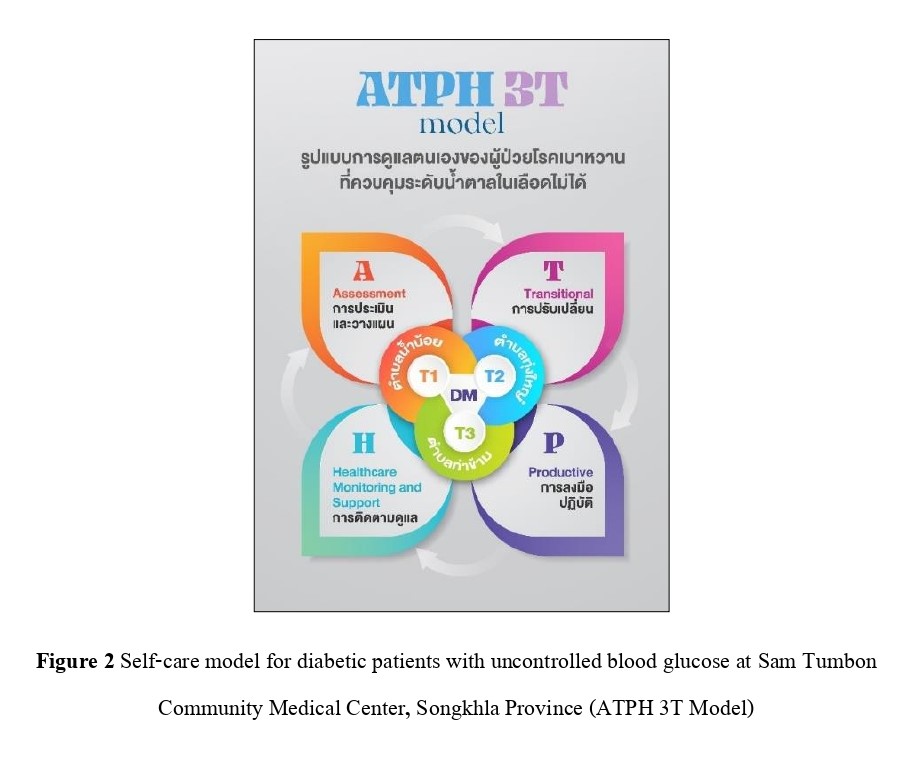
ผลการวิจัย 1) พบแนวโน้มผู้ป่วยโรคเบาหวานที่ควบคุมระดับน้ำตาลในเลือดไม่ได้จำนวน เพิ่มขึ้นแต่การเลือดตรวจลดลง มีปัญหาด้านควบคุมอาหาร ออกกำลังกาย การรับประทานยา ภาวะแทรกซ้อน ต้องการความรู้และการติดตาม 2) ATPH 3T Model ประกอบด้วย การประเมิน (Assessment: A) การปรับเปลี่ยน (Transitional: T) การลงมือปฏิบัติ (Productive: P) การติดตามโดยบุคลากรทางการแพทย์ (Healthcare Monitoring and Support: H) 3) กลุ่มทดลองที่ปฏิบัติตาม ATPH 3T Model มีคะแนนพฤติกรรมการดูแลตนเองเพิ่มขึ้นและระดับน้ำตาลสะสมในเลือดลดลงอย่างมีนัยสำคัญ .001 (p<.001, .001) และดีกว่ากลุ่มควบคุมอย่างมีนัยสำคัญ (p = .049, <.001)
สรุปและข้อเสนอแนะ ATPH 3T Model มีประสิทธิผลในการส่งเสริมพฤติกรรมการดูแลตนเองและลดระดับน้ำตาลสะสมในเลือด ควรนำรูปแบบนี้ไปใช้จัดกิจกรรมอย่างต่อเนื่อง
เอกสารอ้างอิง
Aroon, J. (2013). Statistics for health science research. Witthayapat.
Cohen, J. (1988). Statistical power analysis for the behavioral sciences (2nd ed.). Lawrence Erlbaum Associates.
Crabtree, B.F., & Miller, W.L. (1992). A template approach to text analysis: Developing and using codebooks. In B. F. Crabtree & W. L. Miller (Eds.), Doing qualitative research in primary care: Multiple strategies (pp. 93–109). Sage Publications.
Department of Disease Control. (2024). Annual report 2023, Non-communicable Diseases Division. Author.
Faul, F., Erdfelder, E., Lang, A.G., & Buchner, A. (2007). G*Power 3: A flexible statistical power analysis program for the social, behavioral, and biomedical sciences. Behavior Research Methods, 39(2), 175 - 191. https://link.springer.com/article/10.3758/BF03193146
Fraenkel, R.J., Wallen, E.N., & Hyun, H.H. (2012). How to design and evaluate research in education (8th ed.). McGraw-Hill.
Hair, F.J., Black, C.W., Babin, J.B., & Anderson, E.R. (2019). Multivariate data analysis (7th ed.). Pearson Education. https://www.rama.mahidol.ac.th/ramachannel/article/
Orem, D.E. (2001). Nursing: Concepts of practice (6th ed.). Mosby.
Paisan, T., Langporn, U., & Waratphit, K. (2019). Effects of interdisciplinary team-supported self-management to slow progression of chronic kidney disease in primary care settings, Khon Kaen Regional Hospital. Srinagarind Medical Journal, 34(6), 552 - 558. https://li01.tci-thaijo.org/index.php/SRIMEDJ/article/view/225103/154101
Pakwipa, R. (2019). “Diabetes” a behavioral NCD: Easy to prevent by adjusting lifestyle. Department of Family Medicine, Faculty of Medicine Ramathibodi Hospital, Mahidol University.
Panyaphet, K., Maharachpong, N., & Rodjakphai, Y. (2022). The effect of a self-care model based on self-care and self-regulation concepts on blood glucose control among patients with uncontrolled type 2 diabetes. Journal of Health and Health Management, 8(2), 105 - 118. https://he01.tci-thaijo.org/index.php/slc/article/view/256957/175707
Patcharin, C., Nipa, K., & Ratchanee, N. (2020). Effects of support and education programs on self-care behavior and HbA1c levels in newly diagnosed type 2 diabetes patients. Journal of Nursing Science and Health, 43(1), 78 - 86. https://he01.tci-thaijo.org/index.php/nah/article/view/185628/163893
Phunsap, S., Lalita, K., & Apinya, S. (2023). Effects of a self-care program based on Orem’s self-care theory and family involvement on blood glucose control in patients with type 2 diabetes. Region 11 Medical Journal, 37(4), 1 - 13. https://he02.tci-thaijo.org/index.php/Reg11MedJ/article/view/266102/182338
Sam Tambon Community Medical Center. (2024). Diabetes clinic patient records 2022–2024. Duplicated document, Department of Social Medicine, Hat Yai Hospital, Songkhla Province.
Somporn, K., Thaworn, L., & Natthaphon, P. (2020). Development of a diabetes care model in Lampang Province, 2018. The Southern College of Nursing and Public Health Network Journal, 7(1), 199 - 214. https://he01.tci-thaijo.org/index.php/scnet/article/view/204943/162604
Thanawut, R. (2024). Nursing care for elderly patients with COPD and bladder cancer who underwent bladder surgery and experienced fatigue and dizziness in the community using Orem’s nursing theory: A case study. Journal of Research for Health Improvement and Quality of Life, 4(1), 107 - 118. https://he02.tci-thaijo.org/index.php/RHQJ/article/view/265283
The Diabetes Association of Thailand. (2023). Clinical practice guideline for diabetes 2023. Srikrung.
The Nephrology Society of Thailand. (2022). Guidelines for the management of chronic kidney disease before renal replacement therapy, 2022 (revised edition). Srikrung.
Tuangrat, I. (2023). The development of a self-management model to promote blood sugar control among diabetic patients with poor glycemic control. Journal of MCU Nakhondhat, 10(8), 277 - 288. https://so03.tci-thaijo.org/index.php/JMND/article/view/270654/179736
Waralee, W., Wannipa, S., & Pimyada, N. (2024). Development of a health behavior modification model to reduce HbA1c in diabetic patients by raising self-awareness in the COVID-19 context: A case study of Na Kae Hospital, Nakhon Phanom Province. Journal of Environmental Health and Community Health, 9(5), 220 - 228. https://he03.tci-thaijo.org/index.php/ech/article/view/3367/2461
Warangkana, B., Ratana, B., & Channarong, S. (2021). Effects of an educational program on self-care behavior and blood sugar control in type 2 diabetic patients with poor glycemic control. Academic Journal of Eastern University of Management and Technology, 18(1), 13 - 25. https://so06.tci-thaijo.org/index.php/umt-poly/article/view/248797/168620
World Health Organization. (2021, June 23). Use of glycated hemoglobin (HbA1c) in diagnosis of diabetes mellitus. https://www.who.int/iris/handle/10665/70586
Wichian, K. (1995). Statistics for research (5th ed.). Srinakharinwirot University Press.
ดาวน์โหลด
เผยแพร่แล้ว
รูปแบบการอ้างอิง
ฉบับ
ประเภทบทความ
สัญญาอนุญาต
ลิขสิทธิ์ (c) 2025 วารสารมหาวิทยาลัยนราธิวาสราชนครินทร์

อนุญาตภายใต้เงื่อนไข Creative Commons Attribution-NonCommercial-NoDerivatives 4.0 International License.