
Caregiver’s Factors Influencing Time to Access an Emergency Department among Older Persons with Acute Ischemic Stroke
Keywords:
Acute ischemic stroke, Caregiver, Older persons, Time to access careAbstract
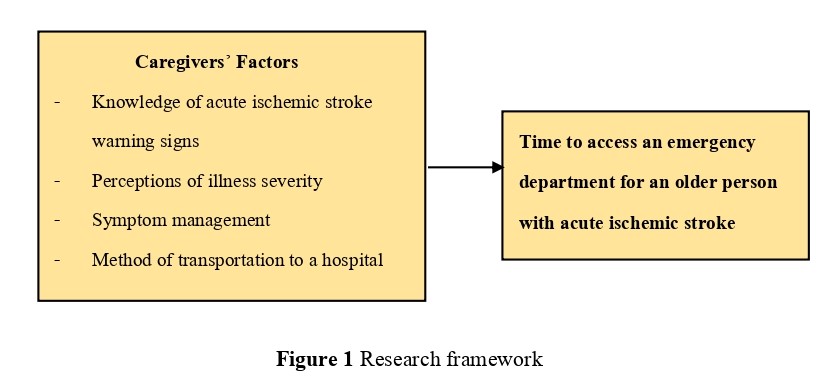
Background and Objectives Caregivers play a crucial role in deciding to transfer patients with symptoms of acute ischemic stroke for treatment within 4.5 hours or 270 minutes. This study aimed to investigate 1) the emergency department length of stay of older adults with prodromal symptoms of acute ischemic stroke, and 2) caregiver factors influencing the emergency department length of stay of older adults with acute ischemic stroke.
Methods Predictive research. The sample consisted of 100 caregivers or individuals who brought older adults to the emergency department. Data were collected at the emergency department and stroke ward of a central hospital in Samut Sakhon Province. The instruments used for data collection included 1) a general information questionnaire, 2) a knowledge questionnaire about stroke prodromal symptoms, 3) a disease severity perception assessment, 4) a symptom management questionnaire, and 5) a hospital arrival method questionnaire. These instruments had validated content validity with scores of 1.00, .96, .90, .94, and 1.00, respectively. The reliability analysis of questionnaires number 2, 3, 4, and 5 yielded scores of .70, .63, .94, and 1.00, respectively. Data were analyzed using descriptive statistics and multiple regression analysis.
Results The emergency department length of stay for older adults with acute ischemic stroke was 399 minutes. Factors related to knowledge about the prodromal symptoms of acute ischemic stroke and the management of symptoms by caregivers or transporters influenced the emergency department length of stay by 14.5% (adjusted R² = .14, p<.001).
Conclusion and Recommendation The study results provide foundational information for educating caregivers or individuals who encounter elderly patients suspected of having acute ischemic stroke about the prodromal symptoms and symptom management, ensuring that the elderly patients receive timely treatment in the emergency department.
References
Advani, R., Naess, H., & Kurz, M. W. (2017). The golden hour of acute ischemic stroke. Scandinavian Journal of Trauma, Resuscitation and Emergency Medicine, 25(54). https://doi.org/10.1186/s13049-017-0398-5
Andersson, J., Rejno, A., Jakobsson, S., Hansson, P., Nielsan, S. J., & Bjorck, L. (2024). Symptoms at stroke onset as described by patients: a qualitative study. BMC Neurology, 24(150), 1-8. https://bmcneurol.biomedcentral.com/articles/10.1186/s12883-024-03658-4
Anees, A., Panicker, P., Lype, T., & Sreelekha, K. R. (2024). Assessment of onset-to-door time in acute ischemic stroke and factors associated with delay at a tertiary care center in South India. Journal of Neurosciences in Rural Practice, 15(1), 86-94. https://pubmed.ncbi.nlm.nih.gov/38476422/
Bai, Q., Zhao, Z., Lu, L., Shen, J., Zhang, J., Sui, H., Xie, X., Chen, J., Yang, J., & Chen, C. (2019). Treating ischemic stroke with intravenous tPA beyond 4.5 hours under the guidance of a MRI DWI/T2WI mismatch was safe and effective. Stroke and Vascular Neurology, 4(1), 8-13. https://pmc.ncbi.nlm.nih.gov/articles/PMC6475081/
Boonsauykwan, W., & Klabrod, A. (2022). Factors related to hospital arrival time of acute stroke patients at emergency department of ChianYai hospital in Nakhon Si Thammarat. Journal of Health Sciences and Pedagog, 2(2), 61-75. https://he02.tci-thaijo.org/index.php/JHSP/article/view/257418/61-75
Boontho, J. (2021). Factor related to pre-hospital delay in acute ischemic stroke patients at Somdejprabuddhalertla Hospital. Hua Hin Medical Journal, 1(3), 1-13. https://he01.tci-thaijo.org/index.php/hhsk/article/view/252714
Capirossi, C., Laiso, A., Renieri, L., Capasso, F., & Limbucci, N. (2023). Epidemiology, organization, diagnosis and treatment of acute ischemic stroke. European Journal of Radiology Open, 11, 100527. doi. 10.1016/j.ejro.2023.100527
Chitchaichum, S., Somboontanont, W., Leelahakul, V., & Thosingha, O. (2018). Factors related to time to access the rt-PA treatment after the onset of acute ischemic stroke among older adults. Royal Thai Navy Medical Journal, 45(1), 85-105. https://he01.tci-thaijo.org/index.php/nmdjournal/article/view/142800
Dimitriou, P., Tziomalos, K., Christou, K., Kostaki, S., Angelopoulou, S. M., Papagianni, M., Ztriva, E., Chatzopoulos, G., Savopoulos, C., & Hatzitolios, A. I. (2019). Factors associated with delayed presentation at the emergency department in patients with acute ischemic stroke. Brain Injury, 33(9), 1257-1261. https://pubmed.ncbi.nlm.nih.gov/31293186/
Department of Disease Control. (2023). Division of non-communicable disease [cited 2023 May 16]. Available from: https://ddc.moph.go.th/brc/news.php?
Jaipong, S., Srithumsuk, W., Charoensan, P., Chamnongchit, S., Munsil, J., & Pansri, S. (2020). A study of severity and perception of disease’s severity to hospital arrival time for relatives of acute stroke patient. Journal of The Royal Thai Army Nurses, 21(2), 273-85. https://he01.tci-thaijo.org/index.php/JRTAN/article/view/234916/166221
Noommeechai, N., Samartkit, N., & Masingboon, K. (2017). Factors related to response to stroke symptoms in family members of patients with acute ischemic stroke. Journal of Nursing and Education, 13(3), 23-38. https://he01.tci-thaijo.org/index.php/JNAE/article/view/118886
Rakchue, P., & Poonphol, S. (2019). Factor influencing pre-hospital delay among acute ischemic stroke patients in rajavithi hospital. Journal of Thai Stroke Society, 18(1), 5-13. https://thaistrokesociety.org/wp-content/uploads/2019/04/c07-factor-influencing-pre-hospital-delay-among-acute-ischemic-
Ramani, L., Huang, X., Cheripelli, B., & Muir, K. W. (2015). Intravenous thrombolysis for acute stroke: current standards and future directions. Cardiovascular Medicine,17(16), 1-14. https://pubmed.ncbi.nlm.nih.gov/25778425/
Ritson, A., & Phatisena, T. (2024). Factors associated with the duration of referral acute ischemic stroke patients to receive treatment at Maharat Nakhon Ratchasima hospital. Regional Health Promotion Center 9 Journal, 18(3), 1062-73. https://he02.tci-thaijo.org/index.php/RHPC9Journal/article/view/269548/184279
Seremwe, F., Kaseke, F., Chikwanha, T. M., & Chikwasha, V. (2017). Factors associated with hospital arrival time after the onset of stroke symptoms: A cross-sectional study at two teaching hospitals in Harare, Zimbabwe. Malawi Medical Journal, 29(2), 171-176. https://pmc.ncbi.nlm.nih.gov/articles/PMC5610291/
Sonti, S., Noppakhun, T., & Duangchan, C. (2022). Factors influencing early hospital arrival among acute ischemic stroke patients in Hua Hin hospital. Journal of Prachomklao College of Nursing, Phetchaburi Province, 5(3), 24-38. https://he01.tci-thaijo.org/index.php/pck/article/view/259897/176010
Swanmongkol, W., Masingboon, K., & Kunsongkeit, W. (2020). Pre-hospital delay in family members of patients with acute ischemic stroke. The Journal of Faculty of Nursing Burapha University, 28(3), 90-101. https://he02.tci-thaijo.org/index.php/Nubuu/article/view/246088/167304
Wang, R., Wang, Z., Yang, D., Wang, J., Gou, C., Zhang, Y., Xian, L., & Wang, Q. (2021). Early hospital arrival after acute ischemic stroke is associated with family members' knowledge about stroke. Frontiers in Neurology, 12. https://pmc.ncbi.nlm.nih.gov/articles/PMC8187751/
Wannarong, T., Chotik-anuchit, S., & Nilanont, Y. (2019). Factors associated with hospital arrival time in acute stroke. Journal of the Medical Association of Thailand, 102(5), 547-553. http://www.jmatonline.com/view.php?id=2189
Downloads
Published
How to Cite
Issue
Section
License
Copyright (c) 2026 Princess of Naradhiwas University Journal

This work is licensed under a Creative Commons Attribution-NonCommercial-NoDerivatives 4.0 International License.