
ปัจจัยด้านผู้ดูแลที่มีอิทธิพลต่อระยะเวลาเข้ารับการรักษาที่แผนกฉุกเฉิน ของผู้สูงอายุโรคหลอดเลือดสมองขาดเลือดเฉียบพลัน
คำสำคัญ:
ผู้ดูแล, ผู้สูงอายุ, โรคหลอดเลือดสมองขาดเลือดเฉียบพลัน, ระยะเวลาเข้ารับการรักษาบทคัดย่อ
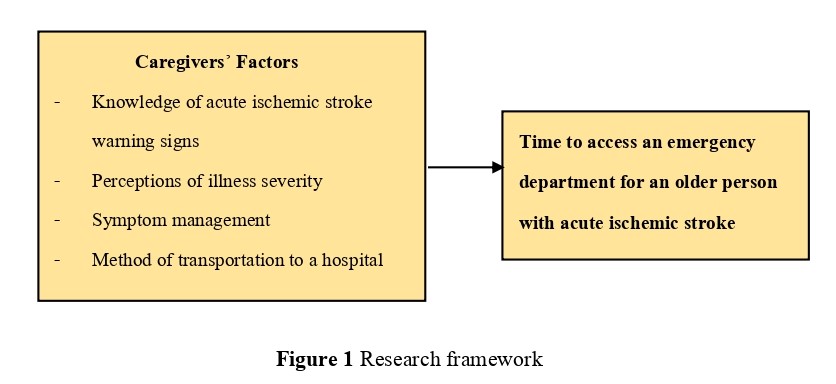
ความเป็นมาและวัตถุประสงค์ ผู้ดูแลมีความสำคัญในการตัดสินใจนำส่งผู้ป่วยที่มีอาการของโรคหลอดเลือดสมองขาดเลือดเฉียบพลันเข้ารับการรักษาภายใน 4.5 ชั่วโมงหรือ 270 นาที การศึกษาครั้งนี้มีวัตถุประสงค์เพื่อ 1) ระยะเวลาเข้ารับการรักษาที่แผนกฉุกเฉินของผู้สูงอายุที่มีอาการนำของโรคหลอดเลือดสมองขาดเลือดเฉียบพลัน และ 2) ปัจจัยด้านผู้ดูแลที่มีอิทธิพลต่อระยะเวลาเข้ารับการรักษาที่แผนกฉุกเฉินของผู้สูงอายุโรคหลอดเลือดสมองขาดเลือดเฉียบพลัน
วิธีการวิจัย การวิจัยเชิงทำนาย กลุ่มตัวอย่างคือผู้ดูแลหรือผู้นำส่งผู้สูงอายุ จำนวน 100 ราย เก็บข้อมูล ณ แผนกฉุกเฉินและหอผู้ป่วยหลอดเลือดสมอง โรงพยาบาลศูนย์แห่งหนึ่ง จังหวัดสมุทรสาคร เครื่องมือที่ใช้ในการเก็บรวบรวมข้อมูล ได้แก่ 1) แบบสอบถามข้อมูลทั่วไป 2) แบบสอบถามความรู้เกี่ยวกับอาการนำของโรค 3) แบบประเมินการรับรู้ความรุนแรงของโรค 4) แบบสอบถามการจัดการอาการและ 5) แบบสอบถามวิธีการมาโรงพยาบาล ผ่านการตรวจสอบความตรงตามเนื้อหาได้เท่ากับ 1.00, .96, .90, .94, และ 1.00 ตามลำดับ วิเคราะห์ความเที่ยงของแบบสอบถามชุดที่ 2, 3, 4, และ 5 ได้เท่ากับ .70, .63, .94, และ 1.00 ตามลำดับ วิเคราะห์ข้อมูลด้วยสถิติพรรณนาและการวิเคราะห์ถดถอยพหุคูณ
ผลการวิจัย ระยะเวลาเข้ารับการรักษาที่แผนกฉุกเฉินของผู้สูงอายุโรคหลอดเลือดสมองขาดเลือดเฉียบพลันมีค่าเฉลี่ยเท่ากับ 399 นาที ปัจจัยด้านความรู้เกี่ยวกับอาการนำของโรคหลอดเลือดสมองขาดเลือดเฉียบพลันและการจัดการอาการของผู้ดูแลหรือผู้นำส่งมีอิทธิพลต่อระยะเวลาเข้ารับการรักษาที่แผนกฉุกเฉินร้อยละ 14.5 (Adjusted R2 = .145, p<.001)
สรุปและข้อเสนอแนะ ผลการศึกษาเป็นข้อมูลพื้นฐานในการให้ความรู้กับผู้ดูแลหรือผู้พบเห็นผู้ป่วยสูงอายุที่สงสัยมีภาวะหลอดเลือดสมองขาดเลือดเฉียบพลันเกี่ยวกับอาการนำและการจัดการอาการเพื่อให้ผู้สูงอายุได้รับการรักษาที่แผนกฉุกเฉินอย่างทันท่วงที
เอกสารอ้างอิง
Advani, R., Naess, H., & Kurz, M. W. (2017). The golden hour of acute ischemic stroke. Scandinavian Journal of Trauma, Resuscitation and Emergency Medicine, 25(54). https://doi.org/10.1186/s13049-017-0398-5
Andersson, J., Rejno, A., Jakobsson, S., Hansson, P., Nielsan, S. J., & Bjorck, L. (2024). Symptoms at stroke onset as described by patients: a qualitative study. BMC Neurology, 24(150), 1-8. https://bmcneurol.biomedcentral.com/articles/10.1186/s12883-024-03658-4
Anees, A., Panicker, P., Lype, T., & Sreelekha, K. R. (2024). Assessment of onset-to-door time in acute ischemic stroke and factors associated with delay at a tertiary care center in South India. Journal of Neurosciences in Rural Practice, 15(1), 86-94. https://pubmed.ncbi.nlm.nih.gov/38476422/
Bai, Q., Zhao, Z., Lu, L., Shen, J., Zhang, J., Sui, H., Xie, X., Chen, J., Yang, J., & Chen, C. (2019). Treating ischemic stroke with intravenous tPA beyond 4.5 hours under the guidance of a MRI DWI/T2WI mismatch was safe and effective. Stroke and Vascular Neurology, 4(1), 8-13. https://pmc.ncbi.nlm.nih.gov/articles/PMC6475081/
Boonsauykwan, W., & Klabrod, A. (2022). Factors related to hospital arrival time of acute stroke patients at emergency department of ChianYai hospital in Nakhon Si Thammarat. Journal of Health Sciences and Pedagog, 2(2), 61-75. https://he02.tci-thaijo.org/index.php/JHSP/article/view/257418/61-75
Boontho, J. (2021). Factor related to pre-hospital delay in acute ischemic stroke patients at Somdejprabuddhalertla Hospital. Hua Hin Medical Journal, 1(3), 1-13. https://he01.tci-thaijo.org/index.php/hhsk/article/view/252714
Capirossi, C., Laiso, A., Renieri, L., Capasso, F., & Limbucci, N. (2023). Epidemiology, organization, diagnosis and treatment of acute ischemic stroke. European Journal of Radiology Open, 11, 100527. doi. 10.1016/j.ejro.2023.100527
Chitchaichum, S., Somboontanont, W., Leelahakul, V., & Thosingha, O. (2018). Factors related to time to access the rt-PA treatment after the onset of acute ischemic stroke among older adults. Royal Thai Navy Medical Journal, 45(1), 85-105. https://he01.tci-thaijo.org/index.php/nmdjournal/article/view/142800
Dimitriou, P., Tziomalos, K., Christou, K., Kostaki, S., Angelopoulou, S. M., Papagianni, M., Ztriva, E., Chatzopoulos, G., Savopoulos, C., & Hatzitolios, A. I. (2019). Factors associated with delayed presentation at the emergency department in patients with acute ischemic stroke. Brain Injury, 33(9), 1257-1261. https://pubmed.ncbi.nlm.nih.gov/31293186/
Department of Disease Control. (2023). Division of non-communicable disease [cited 2023 May 16]. Available from: https://ddc.moph.go.th/brc/news.php?
Jaipong, S., Srithumsuk, W., Charoensan, P., Chamnongchit, S., Munsil, J., & Pansri, S. (2020). A study of severity and perception of disease’s severity to hospital arrival time for relatives of acute stroke patient. Journal of The Royal Thai Army Nurses, 21(2), 273-85. https://he01.tci-thaijo.org/index.php/JRTAN/article/view/234916/166221
Noommeechai, N., Samartkit, N., & Masingboon, K. (2017). Factors related to response to stroke symptoms in family members of patients with acute ischemic stroke. Journal of Nursing and Education, 13(3), 23-38. https://he01.tci-thaijo.org/index.php/JNAE/article/view/118886
Rakchue, P., & Poonphol, S. (2019). Factor influencing pre-hospital delay among acute ischemic stroke patients in rajavithi hospital. Journal of Thai Stroke Society, 18(1), 5-13. https://thaistrokesociety.org/wp-content/uploads/2019/04/c07-factor-influencing-pre-hospital-delay-among-acute-ischemic-
Ramani, L., Huang, X., Cheripelli, B., & Muir, K. W. (2015). Intravenous thrombolysis for acute stroke: current standards and future directions. Cardiovascular Medicine,17(16), 1-14. https://pubmed.ncbi.nlm.nih.gov/25778425/
Ritson, A., & Phatisena, T. (2024). Factors associated with the duration of referral acute ischemic stroke patients to receive treatment at Maharat Nakhon Ratchasima hospital. Regional Health Promotion Center 9 Journal, 18(3), 1062-73. https://he02.tci-thaijo.org/index.php/RHPC9Journal/article/view/269548/184279
Seremwe, F., Kaseke, F., Chikwanha, T. M., & Chikwasha, V. (2017). Factors associated with hospital arrival time after the onset of stroke symptoms: A cross-sectional study at two teaching hospitals in Harare, Zimbabwe. Malawi Medical Journal, 29(2), 171-176. https://pmc.ncbi.nlm.nih.gov/articles/PMC5610291/
Sonti, S., Noppakhun, T., & Duangchan, C. (2022). Factors influencing early hospital arrival among acute ischemic stroke patients in Hua Hin hospital. Journal of Prachomklao College of Nursing, Phetchaburi Province, 5(3), 24-38. https://he01.tci-thaijo.org/index.php/pck/article/view/259897/176010
Swanmongkol, W., Masingboon, K., & Kunsongkeit, W. (2020). Pre-hospital delay in family members of patients with acute ischemic stroke. The Journal of Faculty of Nursing Burapha University, 28(3), 90-101. https://he02.tci-thaijo.org/index.php/Nubuu/article/view/246088/167304
Wang, R., Wang, Z., Yang, D., Wang, J., Gou, C., Zhang, Y., Xian, L., & Wang, Q. (2021). Early hospital arrival after acute ischemic stroke is associated with family members' knowledge about stroke. Frontiers in Neurology, 12. https://pmc.ncbi.nlm.nih.gov/articles/PMC8187751/
Wannarong, T., Chotik-anuchit, S., & Nilanont, Y. (2019). Factors associated with hospital arrival time in acute stroke. Journal of the Medical Association of Thailand, 102(5), 547-553. http://www.jmatonline.com/view.php?id=2189
ดาวน์โหลด
เผยแพร่แล้ว
รูปแบบการอ้างอิง
ฉบับ
ประเภทบทความ
สัญญาอนุญาต
ลิขสิทธิ์ (c) 2026 วารสารมหาวิทยาลัยนราธิวาสราชนครินทร์

อนุญาตภายใต้เงื่อนไข Creative Commons Attribution-NonCommercial-NoDerivatives 4.0 International License.