Developing a Strategic Management Model for Preventing and Controlling Tuberculosis in the Community
Keywords:
Tuberculosis control in the community, Management model, Community participationAbstract
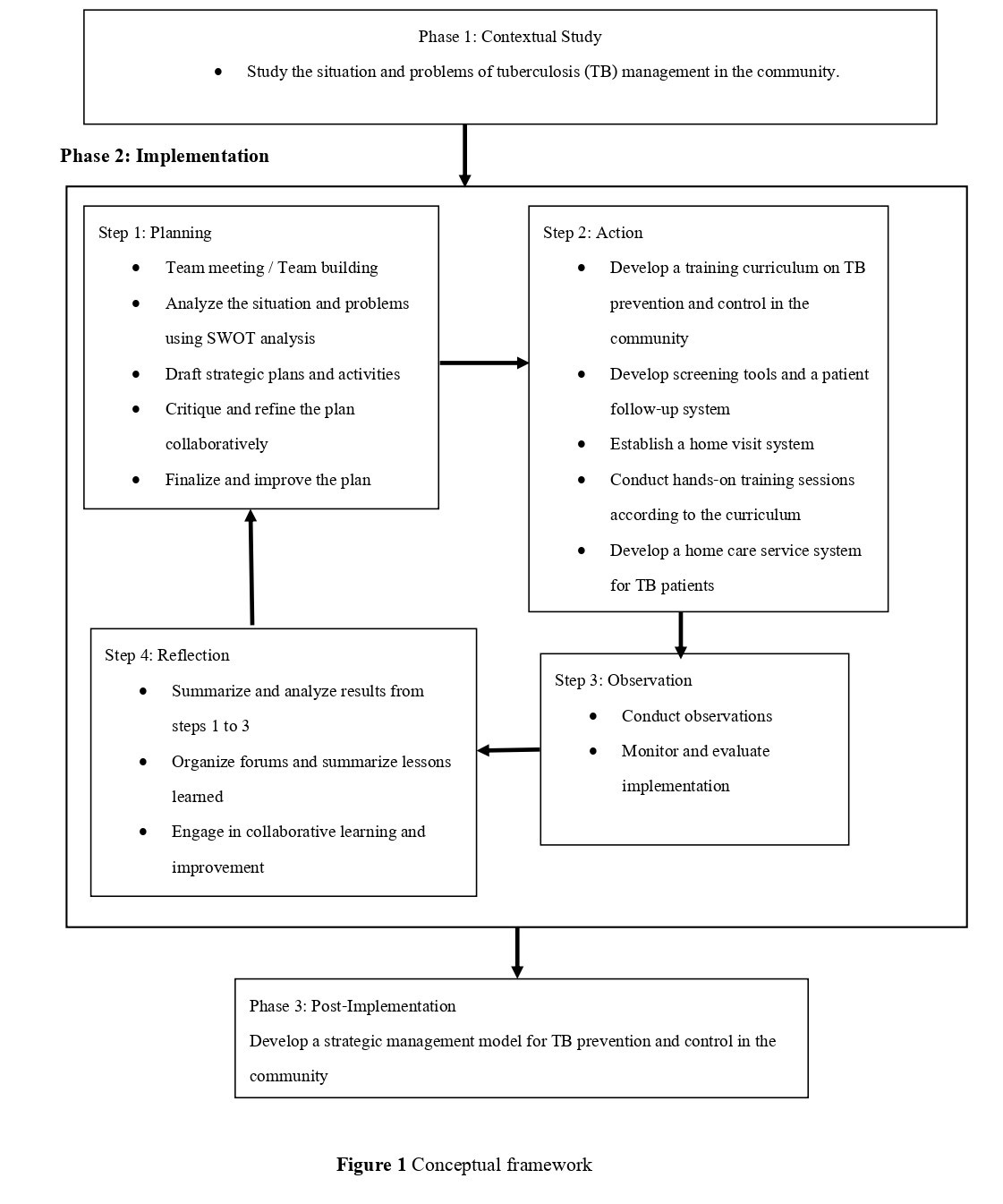
Background and Objectives This research aimed to develop a strategic management model for preventing and controlling tuberculosis in the community through an action research process.
Methods The primary target groups for this study were 1) provincial and hospital-level health policy administrators, 2) relevant healthcare service providers, including doctors, nurses, pharmacists, public health officials, and village health volunteers, and 3) a total of 96 tuberculosis patients and caregivers. Data collection tools included in-depth interviews, participation questionnaires, knowledge tests, behavioral observations, and satisfaction assessments. Quantitative data analysis involved calculating means and standard deviations. Qualitative data analysis was conducted through content analysis to identify key themes.
Results The research findings show that :
Phase 1 Problem analysis identified the following issues in tuberculosis management in the area: lack of continuity in the service system, delayed information transfer, ineffective home patient follow-up, high mortality rate of tuberculosis patients in the community, incomplete coverage of tuberculosis medication for all patients, lack of specialized personnel, and inconsistent adherence to the main guidelines for tuberculosis control (DOTS). We observed inconsistent medication adherence, a lack of knowledge about treatment and prevention, and a lack of support from family and society regarding patient issues.
Phase 2 involved the design and development of a strategic management model with the participation of all sectors through workshop actions, SWOT analysis, and the creation of a community-based tuberculosis management strategic plan. The results of the development in the first cycle included the creation of the action plan, which included developing action planning, training curricula, training personnel and network teams, communicating advertisements in the community, developing information systems, and establishing a home care system (Home Ward). Care teams were divided, and the LINE OA platform was used for monitoring and communicating within the community system. In the second phase of development, feedback from the first phase was reflected upon, and the data was used to adjust the plan to align with the problems and limitations identified.
Phase 3 Results of the effectiveness of the model found that the target group's participation was found to be at a high to the highest level (x̄ = 4.52, SD = 0.14), particularly in terms of receiving benefits, and monitoring and evaluating the knowledge test of village health volunteers and community leaders, after receiving training, found a statistically significant increase in their average scores (p < .001), while patients and caregivers were highly satisfied with the model (x̄ = 4.47, SD = 0.25), particularly regarding the attitudes of the care team and effective coordination.
Conclusion and Recommendations This model can be effectively used to manage tuberculosis in the community, leading to a coordinated system of patient care across all sectors, reducing medication non-adherence, decreasing the mortality rate of tuberculosis patients, and increasing cure rates. Furthermore, it fosters mutual understanding between the community and healthcare services, contributing to the sustainability of tuberculosis control efforts.
References
Apichon, C. (2021). Development of tuberculosis management model at Lad Lum Kaew Hospital, Pathum Thani Province. Journal of Public Health, 30(4), 679 - 689. https://thaidj.org/index.php/JHS/article/download/10611/9346/16302
Chokworakul, U. (2023). Development of tuberculosis patient care model in Phayakkhaphum Phisai District, Maha Sarakham Province. Maha Sarakham Hospital Journal, 20(1), 42 - 55. https://he02.tci-thaijo.org/index.php/MKHJ/article/download/260931/179017/1022059
Department of Tuberculosis Control (2023). National action plan for tuberculosis control phase 2 (2023-2027). Aksorn Graphic & Design.
Kampong, K., & Pornsuk, H. (2023). Development of health literacy model for tuberculosis prevention among household contacts through community participation in Health Region 13, Bangkok. Journal of Nursing, Ministry of Public Health, 33(2), 11 - 25. https://he02.tci-thaijo.org/index.php/tnaph/article/view/265069
Kemmis, S., & McTaggart, R. (1988). The Action Research Reader. (3rd ed.). Deakin.
Khrongyut, P., Lopongphanit, P., Surawan, J., Chaiyathongsri, J., & Norrapati., K. (2022). Development of a management model for new pulmonary tuberculosis patients in Khon Kaen Province. Journal of Community Public Health, 8(1), 15. https://he02.tci-thaijo.org/index.php/ajcph/article/view/252219
Moonrat, T. (2023). Factors Related to the Participation of People’s Groups in the Operations of the Local Health Security Fund in the Lom Raet Town Municipality. Thoen District, Lampang Province [Master’s thesis]. Sukhothai Thammathirat Open University. http://ir.stou.ac.th/bitstream/123456789/13789/1/264500379.pdf
Nuchan, S. (2022) Development of a Prevention and Control Model for Tuberculosis Infection in Household Contact by Community Participation, Jarakae Health Promoting Hospital, Nong Ruea District, Khon Kaen Province. Journal of Health Science of Thailand, 31(4), 665 – 673. https://thaidj.org/index.php/JHS/article/view/12558
Oranapa, W., & Suchan, W. (2023). Guidelines for developing tuberculosis patient follow-up model in Nonthaburi Province. Journal of Science and Technology to Community, 1(1), 19 - 34. https://li02.tcithaijo.org/index.php/STC/article/download/509/312/4038
Pichit, S., & Somlak, H. (2022). Development of tuberculosis infection prevention and control model among household contacts through community participation at Jarakhe Sub-district Health Promoting Hospital, Nong Rua District, Khon Kaen Province. Journal of Public Health, 31(4), 665 - 673. https://he02.tci-thaijo.org/index.php/jkkpho/article/download/ 260408/178211
Srisaad, B. (2017). Basic research (10th ed., revised ed.). Suveeriyasarn.
World Health Organization. (2022, October 27). Global tuberculosis report 2022. https://www.who.int/publications/i/item/9789240061729
Downloads
Published
How to Cite
Issue
Section
License
Copyright (c) 2025 Princess of Naradhiwas University Journal

This work is licensed under a Creative Commons Attribution-NonCommercial-NoDerivatives 4.0 International License.