
Development of a Suicide Prevention Surveillance Model in Patients with Depression at Krasaesin Hospital
Keywords:
Depression, Suicide, Surveillance, Prevention, Model DevelopmentAbstract
Background and Objectives Suicide is a significant public health issue, particularly among patients with depression who are at high risk. Therefore, developing a model for suicide prevention surveillance that is appropriate for the service unit context is necessary. This study aimed to examine the situation and factors affecting suicide, develop a model for suicide prevention surveillance, and evaluate the model's effectiveness in patients with depression at Krasaesin Hospital.
Methods The research and development process was divided into three steps: 1) Study the situation and factors affecting suicide and a suicide prevention surveillance model through in-depth interviews with 14 patients aged 15 years and older with a history of suicide attempts and focus group discussions with 10 mental health service providers, including doctors, pharmacists, psychiatric nurses, home visit nurses, psychologists, and primary care psychiatric nurses from five facilities; 2) Develop a model for suicide prevention surveillance based on qualitative data analysis; 3) Test and evaluate the effectiveness of the model in 34 patients with depression, collecting pre- and post-test data using the 9Q Depression Screening Questionnaire, the 8Q Suicide Risk Assessment, and the Suicide Prevention Behavior Questionnaire. Data were analyzed using the paired sample t-test, and the benefits and value of the model were assessed.
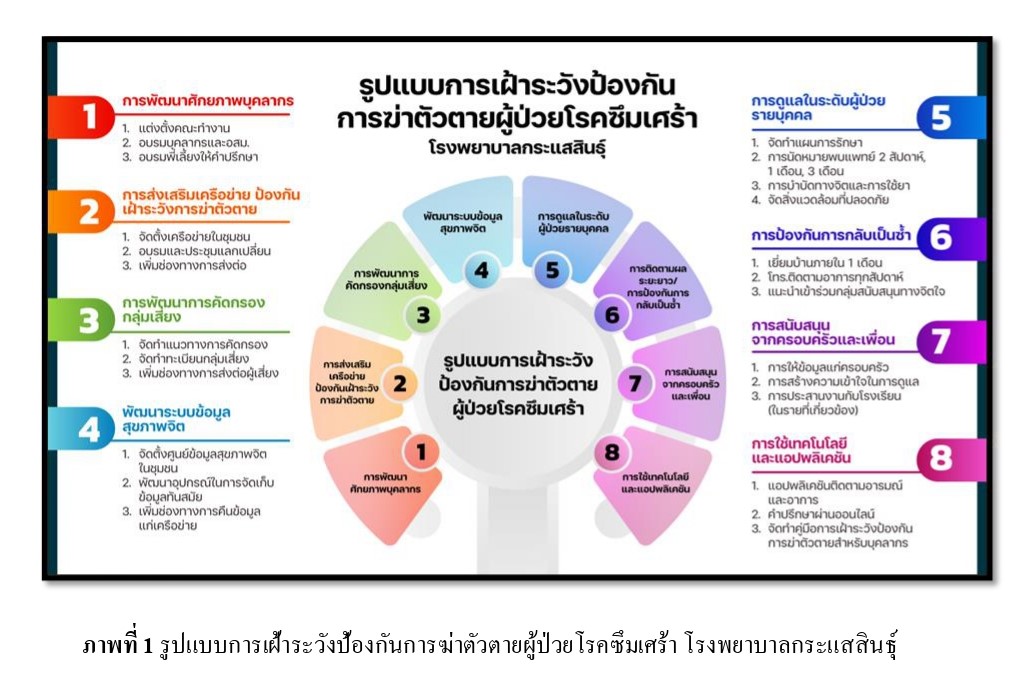
Results Research findings indicated that the screening and assessment of suicide risk still lack a systematic approach. The influencing factors included personal factors, experiences, health, and environment. The model assisted in developing staff capabilities, screening at-risk groups, promoting family and community networks, managing mental health data, providing individual care, following up to prevent recurrence, and utilizing technology. After implementing the model, depression levels decreased from 2.68 ± 0.72 to 0.52 ± 0.83, suicide risk decreased from 1.59 ± 0.65 to 0.38 ± 0.49, and suicide prevention behaviors increased from 77.32 ± 7.17 to 86.21 ± 4.98, with statistical significance (p < .001). The model was beneficial for systematic surveillance and enhancing confidence in caring for patients with depression.
Conclusion and Recommendations The model is suitable for the context of community hospitals. It is effective in reducing depression and suicide risk and increasing preventive behaviors. It helps develop staff potential, monitor individual patients, and promote participation. The model should be implemented in the development of health service systems and communities.
References
Arun, J. (2013). Biostatistics for health science research. Witthayaphat.
Berkman, L. F., & Glass, T. A. (2000). Social integration, social networks, social support, and health. In L. F. Berkman & I. Kawachi (Eds.), Social epidemiology (pp. 137–173). Oxford University Press.
Bohanna, I., & Wang, X. (2021). Suicide risk and prevention in patients with depression: Community-based interventions and follow-up care. International Journal of Mental Health, 50(2), 123 – 136. https://doi.org/10.1111/j.1753-6405.2012.00888.x
Buriram Hospital (2020). Annual report on mental health and suicide prevention among psychiatric patients and youth 2020. Author.
Cohen, J. (1977). Statistical power analysis for the behavioral sciences (Rev. ed.). Academic Press.
Cohen, J. (1988). Statistical power analysis for the behavioral sciences (2nd ed.). Lawrence Erlbaum Associates.
Cohen, S., & Wills, T. A. (1985). Stress, social support, and the buffering hypothesis. Psychological Bulletin, 98(2), 310–357. https://doi.org/10.1037/0033-2909.98.2.310
Crabtree, B. F., & Miller, W. L. (1992). Doing qualitative research. Sage Publications.
Department of Mental Health. (2022) (a). Community-based suicide prevention program for patients with depression. Ministry of Public Health.
Department of Mental Health. (2022) (b) Suicide situation report in Thailand. Ministry of Public Health.
Department of Mental Health. (2023). (a) Development of a suicide prevention surveillance model for patients with depression. Ministry of Public Health.
Department of Mental Health. (2023). (b) Situation and surveillance report on suicide in psychiatric and depressed patients. Ministry of Public Health.
Faul, F., Erdfelder, E., Lang, A.-G., & Buchner, A. (2007). G*Power 3: A flexible statistical power analysis program for the social, behavioral, and biomedical sciences. Behavior Research Methods, 39(2), 175 – 191. https://doi.org/10.3758/BF03193146
Franklin, J. C., Ribeiro, J. D., Fox, K. R., Bentley, K. H., Kleiman, E. M., Huang, X., & Nock, M. K. (2022). Risk factors for suicidal thoughts and behaviors: A meta-analysis of 50 years of research. Psychological Bulletin, 143(2), 187 – 232. https://doi.org/10.1037/bul0000346
Hawton, K., & Williams, K. (2022). Suicide prevention in healthcare settings: Gaps and challenges in community hospitals. The Lancet Psychiatry, 9(3), 123 – 135. https://doi.org/10.1016/S2215-0366(21)00466-4
Jirawattankul, A. (2013). Health science statistics for research. Vithayaphat Publishing.
Kanfer, F. H., & Gaelick-Buys, L. (1991). Self-management methods. In F. H. Kanfer & A. P. Goldstein (Eds.), Helping people change: A textbook of methods (4th ed., pp. 305–360). Pergamon Press.
Khammee, P., Punjaroen, S., Kongsuk, T., & Wannasinp, J. (2022). A study of risk and protective factors among suicide attempters in Health Region 7. Journal of Suicide Prevention of Thailand, 1(1), 15–28. https://doi.org/10.14456/jspt.2022.2
Krasaesin Hospital. (2023). Report on the suicide situation at Krasaesin Hospital, 2021–2023. Author.
National Health Commission Office. (2023). Mental health in adolescents: Stress, bullying, and depression. Author.
Phamarapa, N., Khammee, P., Tansri, P., & Kongsuk, T. (2022). Effectiveness of a suicide prevention and surveillance model for at-risk groups in the community. Journal of Psychiatric Nursing and Mental Health, 36(2), 45 – 60. https://he02.tci-thaijo.org/index.php/JPNMH
Phrommas, C., Khammee, P., Tansri, P., & Kongsuk, T. (2022). Accessibility of mental health services and support network building in rural communities: A case study of the Northeastern region. Journal of Health Science, 31(Suppl.), 112 – 125. https://thaidj.org/index.php/JHS
Regional Health Statistics Office 12 Songkhla. (2023). Suicide statistics in Health Region 12, Songkhla province: 2021–2023. Ministry of Public Health.
Sawat, P., Tansri, P., Khammee, P., Kongsuk, T., & Wannasinp, J. (2023). Development of a mental health support system in rural communities: Networking and access to services. Thai Journal of Mental Health, 31(2), 85 – 98. https://he01.tci-thaijo.org/index.php/TJMH
Tansri, P., Khammee, P., Kongsuk, T., Wannasinp, J., & Punjaroen, S. (2021). Evaluation of a community-based care and surveillance model for depressed patients to prevent suicide. Thai Journal of Mental Health, 29(3), 150 – 163. https://he01.tci-thaijo.org/index.php/TJMH
Turecki, G., Brent, D. A., Gunnell, D., O’Connor, R. C., & Pirkis, J. (2021). Suicide and suicide risk. Nature Reviews Disease Primers, 7, 1–26. https://doi.org/10.1038/s41572-021-00275-6
Waltz, C. F., Strickland, O. L., & Lenz, E. R. (2010). Measurement in nursing and health research (4th ed.). Springer Publishing Company.
World Health Organization. (2021). Suicide worldwide in the 21st century. Author.
World Health Organization. (2022). World suicide prevention report 2022: Mental health and suicide surveillance in the Western Pacific region. Author.
World Health Organization. (2023). Suicide worldwide in the 21st century: Global age-standardized suicide rates. Author.
Downloads
Published
How to Cite
Issue
Section
License
Copyright (c) 2025 Princess of Naradhiwas University Journal

This work is licensed under a Creative Commons Attribution-NonCommercial-NoDerivatives 4.0 International License.