Development of Lankasuka Massage Oil Combined with Black Cumin Seed Extract (Nigella sativa) on Constipation Symptoms in Stroke Patients Receiving Intermediate Care
Keywords:
Langkasuka massage oil, Constipation, Stroke patients, Intermediate care, Nigella sativa (Black cumin)Abstract
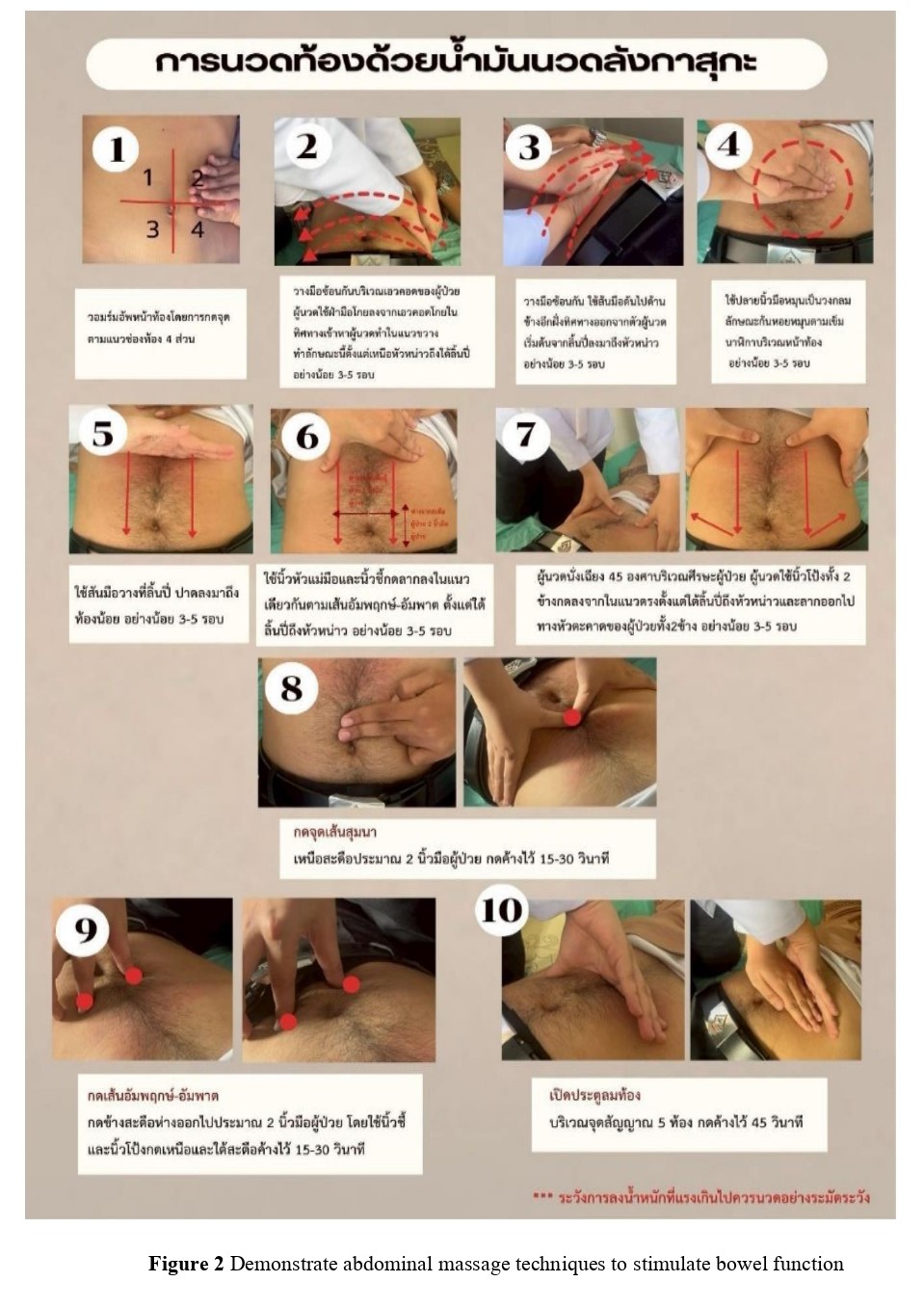
Background and Objectives Narathiwat Rajanagarindra Hospital has observed a continuous increase in the number of stroke patients experiencing constipation. The local wisdom of Narathiwat Province, Lankasuka massage oil, has been developed by combining it with black cumin seed extract (Nigella sativa)to study its effectiveness in stimulating the excretory system and evaluating patient satisfaction. Lankasuka massage oil is a therapeutic practice based on local wisdom in the three southern border provinces. It is unique, especially in the Narathiwat area. The objectives were: 1) to study the problem of constipation in stroke patients receiving intermediate care, 2) to develop Lankasuka massage oil combined with black cumin seed extract, and 3) to evaluate the effectiveness of abdominal massage by Lankasuka massage oil combined with black cumin seed extract on the frequency of bowel movements and patient satisfaction levels.
Methods This study was research and development with three steps: 1) Investigating the problem by analyzing documentary data combined with interviews of patients and caregivers, 2) Developing Lankasuka massage oil combined with black cumin seed extract, using 14 types of herbs, and 3) Evaluating the effectiveness of Lankasuka massage oil combined with black cumin seed extract in 27 stroke patients receiving intermediate care who had constipation symptoms. A quasi-experimental pretest- and posttest-design was used, assessing satisfaction after the experiment. Data was analyzed using descriptive statistics and repeated measures ANOVA.
Results Research results found that 1) the condition of constipation in stroke patients receiving intermediate care was due to lesions, dietary habits lacking fiber, and the traditional Lankasuka massage oil (other products) containing synthetic colors, causing allergic reactions, with a viscous and sticky texture; 2) the Lankasuka massage oil combined with black cumin seed extract was developed to relieve constipation; and 3) the frequency of bowel movements in patients continuously increased, with an average of 2.89 times per week before the experiment, rising to 3.93 times in the third month. The analysis using repeated measures ANOVA showed a statistically significant difference (F3,78 = 46.521, p < .001). In addition, the overall satisfaction assessment revealed an average score at the highest level (xˉ=4.89, S.D. = 0.32).
Conclusion and Recommendations This study demonstrates that abdominal massage with Lankasuka massage oil combined with black cumin seed extract may serve as an alternative for individuals suffering from constipation. Additionally, it can provide foundational data for further development of Lankasuka massage oil combined with black cumin seed extract. Long-term studies should be conducted to confirm the safety and efficacy of its real-world use comprehensively. This research can also be extended and developed into a health innovation at both community and commercial levels.
References
Cohen, J. (1988). Statistical Power Analysis for the Behavioral Sciences (2nd ed.). Routledge. https://doi.org/10.4324/9780203771587
Department of Disease Control. (2024). HDC health database reporting system. Ministry of Public Health Thailand.
Drossman, D.A. (2006). The functional gastrointestinal disorders and the Rome III process. Gastroenterology, 130(5), 1377 – 1390. https://doi.org/10.1053/j.gastro.2006.03.008
Faul, F., Erdfelder, E., Lang, A.G., & Buchner, A. (2007) G*Power 3: A Flexible Statistical Power Analysis Program for the Social, Behavioral, and Biomedical Sciences. Behavior Research Methods, 39, 175-191. http://doi.org/10.3758/BF03193146
Feigin, V.L., Stark, B.A., Johnson, C.O., Roth, G.A., Bisignano, C., Abady, G.G., Abbasifard, M., Abbasi-Kangevari, M., Abd-Allah, F., Abedi, V., Abualhasan, A., Abu-Rmeileh, N.M., Abushouk, A.I., Adebayo, O.M., Agarwal, G., Agasthi, P., Ahinkorah. B.O., Ahmad, S., … Murray, C.J.L. (2021). Global, regional, and national burden of stroke and its risk factors, 1990 – 2019. The Lancet Neurology, 20(10), 795 – 820. https://doi.org/10.1016/S1474-4422(21)00252-0
Hannan, M. A., Rahman, M. A., Sohag, A. A. M., Uddin, M. J., Dash, R., Sikder, M. H., Rahman, M. S., Timalsina, B., Munni, Y. A., Sarker, P. P., Alam, M., Mohibbullah, M., Haque, M. N., Jahan, I., Hossain, M. T., Afrin, T., Rahman, M. M., Tahjib-Ul-Arif, M., Mitra, S., Oktaviani, D. F., Khan, M. K., Choi, H. J., Moon, I. S., & Kim, B. (2021). Black cumin (Nigella sativa L.): A comprehensive review on phytochemistry, health benefits, molecular pharmacology, and safety. Nutrients, 13(6), 1784. https://doi.org/10.3390/nu13061784
Ito, T., Sakakibara, R., Uchiyama, T., Liu, Z., Yamamoto, T., & Hattori, T. (2006). Videomanometry of the pelvic organs: A comparison of the normal lower urinary and gastrointestinal tracts. International Journal of Urology, 13(1), 29 – 35. https://doi.org/10.1111/j.14422042.2006.01224.x
Kamalakannan, S., Gudlavalleti, M.V., Prost, A., Natarajan, S., Pant, H., Chitalurri, N., Goenka, S., & Kuper, H. (2016). Rehabilitation needs of stroke survivors after discharge from hospital in India. Archives of Physical Medicine and Rehabilitation, 97(9), 1526 – 1532. E 9. https://doi.org/10.1016/j.apmr.2016.02.008
Kleindorfer, D.O., Towfighi, A., Chaturvedi, S., Cockroft, K.M., Gutierrez, J., Lombardi-Hill, D., Kamel, H., Kernan, W.N., Kittner, S.J., Leira, E.C., Lennon, O., Meschia, J.F., Nguyen, T.N., Pollak, P.M., Santangeli, P., Sharrief, A.Z., Smith, S.C., Turan, T.N., & Williams, L.S. (2021, May 24). 2021 Guideline for the Prevention of Stroke in Patients with Stroke and Transient Ischemic Attack: A Guideline from the American Heart Association/American Stroke Association. Stroke, 52(7), e364–e467. https://doi.org/10.1161/STR.0000000000000375
Lamas, K., Lindholm, L., Stenlund, H., Engström, B., & Jacobsson, C. (2009). Effects of abdominal massage in management of constipation: A randomized controlled trial. International Journal of Nursing Studies, 46(6), 759 – 767. https://doi.org/10.1016/j.ijnurstu.2009.01.007
Li, J., Yuan, M., Liu, Y., Zhao, Y., Wang, J., & Guo, W. (2017). Incidence of constipation in stroke patients: A systematic review and meta-analysis. Medicine, 96(25), e7225. https://doi.org/10.1097/MD.0000000000007225
Longstreth, G.F., Thompson, W.G., Chey, W.D., Houghton, L.A., Mearin, F., & Spiller, R.C. (2006). Functional bowel disorders. Gastroenterology, 130(5), 1480 – 1491. https://doi.org/10.1053/j.gastro.2005.11.061
McClurg, D., Hagen, S., Jamieson, K., Paul, L., Dickinson, L., & Cunnington, A.-L. (2016). Abdominal massage for the alleviation of symptoms of constipation in people with Parkinson's: A randomised controlled pilot study. Age and Ageing, 45(2), 299 – 303. https://doi.org/10.1093/ageing/afw005
Pinto, C.F.C.S., Oliveira, P.D.C.M., Fernandes, O.M.F.S.O., Padilha, J.M.S.C., Machado, P.A.P., Ribeiro, A.L.A., & Ramos, J.L.N. (2020). Nonpharmacological clinical effective interventions in constipation: A systematic review. Journal of Nursing Scholarship, 52(3), 261 – 269. https://doi.org/10.1111/jnu.12555
Preiser, J.-C., van Zanten, A.R.H., Berger, M.M., Biolo, G., Casaer, M.P., Doig, G.S., Griffiths, R.D., Heyland, D.K., Hiesmayr, M., Iapichino, G., Laviano, A., Pichard, C., Singer, P., Van den Berghe, G., Wernerman, J., Wischmeyer, P., & Vincent, J.-L. (2015). Metabolic and nutritional support of critically ill patients: Consensus and controversies. Critical Care, 19, 35. https://doi.org/10.1186/s13054-015-0737-8
Simarmata, J.M., & Maulina, R. (2023). The effect of abdominal massage on constipation in stroke patients at Grandmed Lubuk Pakam Hospital in 2023. Jurnal Kesmas dan Gizi (JKG), 6(1), 136 – 141. https://doi.org/10.35451/jkg.v6i1.1931
Subramanian, G. (2020). Early and late complications of stroke. In S.K. Munshi & R. Harwood (Eds.) Stroke in the Older Person (pp. 231 – 248). Oxford University Press.
Wang, J., Kong, W., Liu, M., Wang, Y., Zheng, Y., & Zhou, Y. (2023). Association between dietary carotenoids intake and chronic constipation in American men and women adults: a cross-sectional study. BMC Public Health, 23, 1597. https://doi.org/10.1186/s12889023-16367-3
World Stroke Organization. (2023). Global stroke fact sheet 2023. Author.
Yimer, E.M., Tuem, K.B., Karim, A., Ur-Rehman, N., & Anwar, F. (2019). Nigella sativa L. (Black cumin): A promising natural remedy for wide range of illnesses. Evidence-Based Complementary and Alternative Medicine, 1528635. https://doi.org/10.1155/2019/1528635
Yue, P., Xu, T., Greene, B., Wang, Y., Wang, R., Dai, G., & Xu, L. (2020). Caring in community nursing practice: Inductive content analysis reveals an inter-dynamic system between patients and nurses. Journal of Clinical Nursing, 29(15 – 16), 3025 – 3041. https://doi.org/10.1111/jocn.15312
Downloads
Published
How to Cite
Issue
Section
License
Copyright (c) 2026 Princess of Naradhiwas University Journal

This work is licensed under a Creative Commons Attribution-NonCommercial-NoDerivatives 4.0 International License.