
Factors Affecting the Occurrence of Depression in Pregnant Women in the Southern Border Communities
Keywords:
Depression, Pregnant women, Southern border communities, Spousal relationships, FamilyAbstract
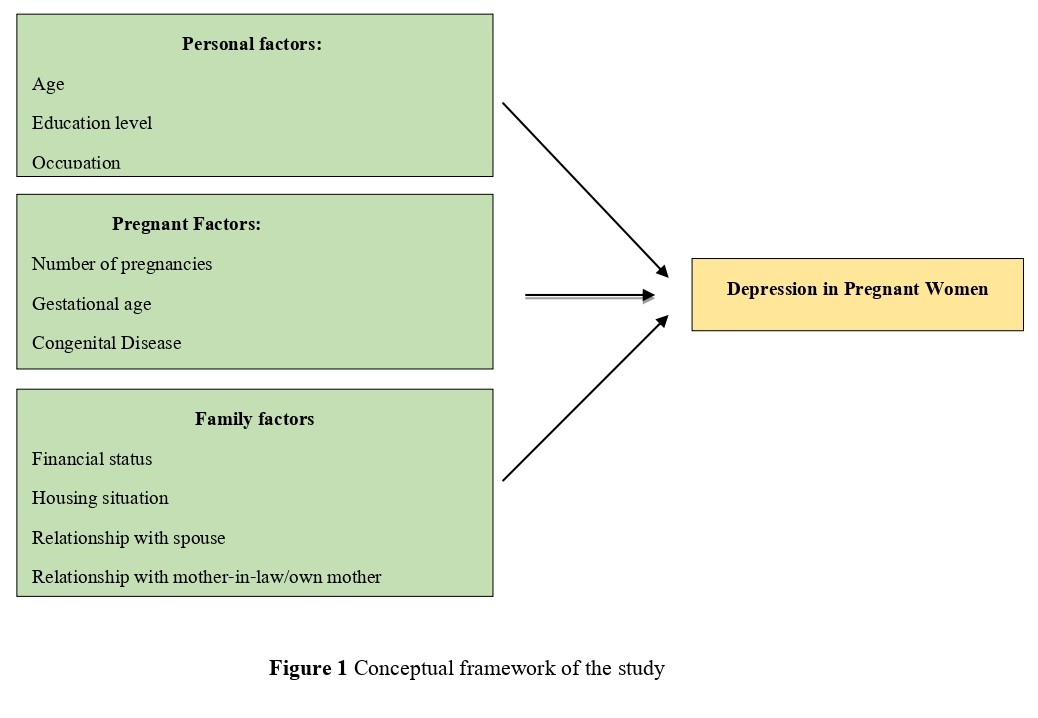
Background and Objectives Pregnant women in the southern border communities are at risk of depression due to personal, pregnancy, and family factors, which need to be addressed to prevent severe mental health issues. This study aimed to investigate depression and the factors affecting its occurrence in pregnant women in the southern border communities.
Methods The sample group consisted of 150 pregnant women, specifically selected based on predetermined criteria. The instruments used included a questionnaire on personal factors, family factors, and pregnancy factors, which were content-validated by three experts and had a Cronbach's alpha coefficient of 0.82, as well as the 9Q Depression Assessment from the Department of Mental Health. Data were analyzed using descriptive statistics and multiple logistic regression.
Results 68.00% of the sample group exhibited depressive symptoms. Among those with depressive symptoms, most were at a moderate level (38.70%), followed by a mild level (29.30%), and no severe depression was found. Factors significantly affecting the occurrence of depression (p < .05) included age, particularly in the group under 20 years old, who had a 3.67 times higher chance of depression compared to the group aged 35 and above (OR = 3.67, 95% CI = 0.87-15.38). Family factors, particularly the quality of the relationship with a spouse, indicated that individuals with poor spousal relationships had an 87.0% chance of experiencing depression and were 3.66 times more likely to be depressed compared to those with positive spousal relationships (OR = 3.66, 95% CI = 1.03 - 12.99).
Conclusion and Recommendations The study results reflect that age factors and family factors related to spousal relationships are significantly important to the depression of pregnant women in border communities. Therefore, comprehensive mental health promotion and care should be implemented to prevent depression during pregnancy.
References
American College of Obstetricians and Gynecologists. (2023). Treatment and Management of Mental Health Conditions During Pregnancy and Postpartum. Obstetrics & Gynecology, 141(6), 1262 – 1288. http://doi.org/10.1097/AOG.0000000000005202
Anusornteerakul, S., Sitthi, K., Ounkaew, A., Hanklar, S., & Mokarat, P. (2022). The prevalence and coherence of stress, risk of depression, and depression among pregnant women. Journal of Nursing Science & Health, 45(3), 37 – 47. https://he01.tci-thaijo.org/index.php/nah/article/view/256018
Boonpaisarnbundarn, P., & Bangoen, P. (2025). Prevalence and factors associated with depression among pregnant women attending antenatal care at Prakhon Chai Hospital, Buriram Province. Mahasarakham Hospital Journal, 22(2), 87 – 97. https://he02.tcithaijo.org/index.php/MKHJ/article/view/273713
Bornstein, M.H., Henry, L.M., & Manian, N. (2021). Language development in children of clinically depressed mothers in remission: Early experience effects. Developmental Psychology, 57(6), 876 – 887. https://doi.org/10.1037/dev0001182
Buranacharoenkit, D. (2021). The situation of children, youth and women in the Southern Border Provinces. https://peaceresourcecollaborative.org/wp-content/uploads/2021/11/2021_Duanghatai_Situation.of_.Women_.Youth_.Children_DeepSouth.Thailand.pdf
Department of Mental Health. (2018). Handbook for surveillance and management of depression. Ministry of Public Health.
Department of Mental Health. (2020). Depression screening tool (9Q and 8Q). https://dmh.go.th/test/download/files/2Q%209Q%208Q%20(1).pdf
Khamngoen, R., Soparat, P., Pongsiri, D., & Klaokla, J. (2022). Factors associated with depression among pregnant adolescents. Journal of Network in Nursing and Midwifery of Southern Region, 9(1), 29 – 41. https://he01.tci-thaijo.org/index.php/scnet/article/view/244512
Namsorot, Y. (2021). Screening for depression and factors associated with depression in pregnant women visiting for the first antenatal care visit at Public Health Center 7, Khon Kaen [Master’s thesis]. KhonKaen University.
Narathiwat Provincial Office. (2018). Narathiwat provincial development plan 2018 - 2021. https://narathiwat.nso.go.th/images/stitic/t1.pdf
Okagbue, H. I., Adamu, P. I., Bishop, S. A., Oguntunde, P. E., Opanuga, A. A., & Akhmetshin, E. M. (2019). Systematic review of prevalence of antepartum depression during the trimesters of pregnancy. Open Access Macedonian Journal of Medical Sciences, 7(9), 1555 – 1560. https://pmc.ncbi.nlm.nih.gov/articles/PMC6542400/
Public Health Department, Narathiwat Provincial. (2022). Medical and public health data warehouse system Health Region 12: Screening for depression (2Q) in pregnant women. Author.
Quiñones, F., Winters, C., Hu, L., & Suvarnakar, A. (2023). Untreated major depression during gestation: The physical and mental implications in women and their offspring. Georgetown Medical Review, 7(1), e2023015. https://doi.org/10.52504/001c.83340
Seakarmela, K.P., Mashaba, R.G., Ntimana, C.B., Mbombi, M.O., Tlouyamma, J., Mphekgwana, P., Nemuramba, R., Mothapo, K., & Maimela, E. (2023). Prevalence and associated factors of probable depression amongst pregnant and parenting young females: A comparison of adolescents and young adults in rural South Africa. Frontiers in Child and Adolescent Psychiatry, 2, 1200759. https://doi.org/10.3389/frcha.2023.1200759
Smith, A., Twynstra, J., & Seabrook, J. (2019). Antenatal depression and offspring health outcomes. Obstetric Medicine, 13(2), 55 – 61. https://doi.org/10.1177/1753495X19843015
Thongsomboon, W., Kaewkiattikun, K., & Kerdcharoen, N. (2020). Perceived stress and associated factors among pregnant women attending antenatal care in urban Thailand. Psychology Research and Behavior Management, 13, 1115 – 1122. https://doi.org/10.2147/PRBM.S290196
Thorndike, R. L. (1978). Correlational procedures for research. Gardner Press.
Vongpradit, S., Chuennuan, S., & Yangwanichseth, S. (2022). Factors associated with depression in adolescent pregnant women. The Southern College Network Journal of Nursing and Public Health, 9(1), 29 – 41. https://he01.tci-thaijo.org/index.php/scnet/article/view/244512
Wongchantorn, N., Poomcharoen, R., & Seesuponkornkul, A. (2023). Stress and coping behavior among teenage pregnancy. Christian University Journal, 29(4), 103 – 117. https://he01.tci-thaijo.org/index.php/CUTJ/article/view/267034
World Health Organization. (2023, August 29). Depressive disorder (depression). https://www.who.int/news-room/fact-sheets/detail/depression
Zhang, L., Wang, L., Cui, S., Yuan, Q., Huang, C., & Zhou, X. (2021). Prenatal depression in women in the third trimester: Prevalence, predictive factors, and relationship with maternal-fetal attachment. Frontiers in Public Health, 8, 602005. https://doi.org/10.3389/fpubh. 2020.602005
Downloads
Published
How to Cite
Issue
Section
License
Copyright (c) 2026 Princess of Naradhiwas University Journal

This work is licensed under a Creative Commons Attribution-NonCommercial-NoDerivatives 4.0 International License.