
The Development and Effectiveness of the Innovation “4 in 1 Infant Manikin” Intradermal Injection in Infants
Keywords:
Mannequin, Nursing students, Innovation, Intradermal injection, InfantAbstract
Background and Objectives Practicing with simulation mannequins is critical to building the skills and confidence of nursing students, enabling them to perform procedures on real patients accurately and safely. This research aimed to develop an innovative mannequin for practicing intradermal injection skills in infants and to study the effectiveness of this innovative mannequin for practicing intradermal injection skills in infants.
Methods This research was a research and development (R&D) process with a sample of 81 third-year nursing students, selected through simple random sampling. The instruments used included the innovative mannequin and equipment, as well as an effectiveness assessment form, which had an item-objective congruence (IOC) value ranging from 0.67 to 1.00 and reliability values of 0.78 and 0.89, respectively. Data were analyzed using mean, standard deviation, frequency, and percentage.
Results
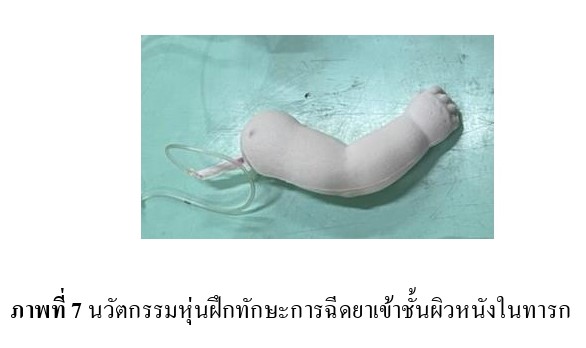
- The innovative mannequin had an exterior part made from natural latex, coated with a mixture of latex and acrylic paint to give the skin and arm shape a realistic appearance. The inside part contained a hollow silicone bag with a diameter of 0.5 cm that held air (simulating the injected fluid) and included a valve to release air after skill practice.
- The effectiveness of the innovative mannequin found that 78 students had practical injection skills at a good level (96.30%) and had the highest level of overall satisfaction with the innovation (M = 4.72, SD = 0.36).
Conclusion and Recommendations This innovative mannequin can be used to support learning in pediatric and adolescent nursing courses, allowing learners to practice independently until they achieve proficiency before performing on actual patients. A recommendation for further development is to enhance the structural accuracy according to anatomical principles.
References
Anurak, C., Prommul, J., Fuengthin, A., Jitjum, C., Nancha, S., & Maming, H. (2023). Research and Innovation in nursing: An infant heel venipuncture-training manikin. The Southern College Network Journal of Nursing and Public Health, 11(3), 1 - 13. e270579. https://he01.tci-thaijo. org/index.php/scnet/article/view/270579
Best, J. W. (1981). Research in education (4th ed.). Prentice-Hall.
Bland, A. J., Topping, A., & Wood, B. (2011). A concept analysis of simulation as a learning strategy in nursing. Nurse Education Today, 31(7), 664 – 670. https://doi.org/10.1016/j.nedt.2010.10.013
Chaiyasang, P., Machompoo, N., Sakulkhaemaruethai, C., Sridet, R., & Nanudorn, A. (2022). Development of an innovative model from natural rubber for practicing suture skills. Journal of Health Science Research. 16(3), 13 - 25. https://he01.tcithaijo.org/index.php/JHR/issue/view/17600
Cheychom, S., & Rujiwattanakorn, D. (2015). Using innovative arm puppets in practicing intravenous fluid administration.The veins of nursing students. Ramathibodi Nursing News. 21(3), 395-407. https://www.rama.mahidol.ac.th/ramanursej/rnj-v21-no3-sep-dec-2015-09
Charoensuk, S., Tasbut, W., & Setthawanit, H. (2023). Strategic Plan for the Development of the Boromarajonani College of Nursing, 2023-2027 Revised Edition, Budget 2020. Office of Strategy and International Affairs, Boromarajonani College of Nursing. Boromarajonani College of Nursing.
Chonlatankampanat, W., Suwannarat, K., & Pornngam, K. (2020). The development of a part-changed newborn model innovation to promote self-confidence and nursing practice skills among nursing students. Journal of Phrapokklao Nursing College. 34(1). 1 - 16. https://he01.tci-thaijo.org/index.php/pnc/article/view/261296/178327
Cohen, J. (1988). Statistical Power Analysis for the Behavioral Sciences (2nd ed.). Ni Lawrence Earm Associates.
College of Nursing Boromarajonani Songkhla. (2021). Strategic Plan, Boromarajonani College of Nursing, Songkhla, Fiscal Year 2022-2026. Author.
Faul, F., Erdfelder, E., Lang, A., G., & Buchner, A. (2007). G*Power 3: A flexible statistical power analysis program for the social, behavioral, and biomedical sciences. Behavior Research Methods, 39(2), 175 - 191. https://doi.org/10.3758/BF03193146
Henkaew, S., Thongsawat, S., & Yotkat, W. (2018). Development of the “Dee Tor Jai” prototype manikin for chest compression training among nursing students. Journal of Nursing Science & Health, 41(2), 1 – 12. https://he01.tcithaijo.org/index.php/nah/article/view/137637
Jones, A. M., & Brown, L. K. (2023). Pediatric nursing skills and simulation-based training. Journal of Clinical Nursing Education, 15(2), 112 – 125. https://doi.org/10.1016/j.jcne.2023.01.004
Kameg, K. M., Szpak, J. L., & Mohn, K. E. (2020). The use of low-fidelity simulation in nursing education. Journal of Nursing Education, 59(9), 500 - 504. https://doi.org/10.3928/01484834-20200820-04
Laoprachawit, K., Prommul, J., Aitsaro, C., Chuklang, C., Jitbanjong, J., & Phokwan, C. (2025) The Development of an Intramuscular Injection Simulation Pad Innovation. Princess of Naradhiwas University Journal, 17(2). 62 - 80. http://li01.tci-thaijo.org/index.php/pnujr/article/view/266298/180126
Larew, C., Lessans, S., Spunt, D., Foster, D., & Covington, K. (2006). Innovations in clinical simulation: Application of Benner's theory in an interactive patient care simulation. Nursing Education Perspectives, 27(1), 16 – 21. http://doi.org/10.1043/1094-2831(2006)027[0016:IICSAO]2.0.CO;2
Nontaput, T., & Chotiban, P. (2021). Intravenous venipuncture: New development in training on arm manikin. The Southern College Network Journal of Nursing and Public Health, 8(3), 49 - 60. https://he01.tci-thaijo.org/index.php/scnet/article/view/249150
McGaghie, W. C., Issenberg, S. B., Cohen, E. R., Barsuk, J. H., & Wayne, D. B. (2011). Does simulation-based medical education with deliberate practice yield better outcomes than traditional clinical education? A meta-analytic comparative review of the evidence. Academic Medicine, 86(6), 706 - 713. https://doi.org/10.1097/ACM.0b013e318217e119
McGaghie, W.C., Issenberg, S.B., Petrusa, E.R., & Scalese, R.J. (2010). A critical review of simulation-based medical education research: 2003-2009. Medical Education, 44(1), 50 – 63. http://doi.org/10.1111/j.1365-2923.2009.03547.x
Miller, R., & Davis, S. (2024). Sustainability and maintenance in medical simulation task trainers (2nd ed.). Springer.
Panvijitsiri, K., Sirisomboon, S., & Thipduangta, P. (2018). Development of artificial human tissue and artificial skin from natural rubber latex for medical models. Journal of Health Science Research and Development, 11(2), 85 - 94. https://he02.tci-thaijo.org/index.php/reshsd
Phutdee, W., Methakarnjanasak, N., & Uangpanyasuk, S. (2022). The development of rubber manikin innovation for nursing skills training: A systematic review. Journal of Nursing Science and Health, 45(2), 1 – 15. https://he01.tcithaijo.org/index.php/jns/article/view/256158
Prajankett, O., & Prasittivechchakoon, A. (2017). The development of a prototype simulator for abdominal examination training. The Journal of Royal Thai Army Nurses, 18(3), 44 - 50. https://he01.tci-thaijo.org/index.php/JRTAN
Prasit, W., Thipawan, P., & Sawaddisan, C. (2022). The effectiveness of natural rubber latex manikin for practicing uterine contraction assessment skills among nursing students. Rachabhadi Journal, Boromarajonani College of Nursing Surin, 12(2), 114 - 125. https://he01.tci-thaijo.org/index.php/Rachawadee
Prommul. J, Intaranaron. K, Perngyai. C, Klerlhee. T., & Mangmee. T. (2025). The Effects of an Innovative Infant Oral Feeding Tube Insertion Manikin on the Nursing Students' Skills. The Southern College Network Journal of Nursing and Public Health, 12(3), 14 - 26. https://he01.tci-thaijo.org/index.php/scnet/article/view/277075.
Prommul. J., Perngyai, C., Nelson, W., Klerlhee, C., Intaranarong, K., & Mangme, T. (2025). Development and effectiveness of a “4-in-1 infant”. (Research Report). Boromarajonani College of Nursing, Songkhla.
Rattanathongkam, S. (2020). Teaching and learning management using medical simulation: theory to practice. Khon Kaen University Press.
Rompipat, S. (2020). Developing a model for intradermal injection and its effect upon performance skills and satisfaction levels of third-year nursing students. Journal of Science and Technology (Science Technology), 29(4), 688 - 700. https://li01.tcithaijo.org/index.php/tstj/article/view/242725
Saengwiman. S, Chooduang. S,Taksapattanakul. K. (2024). A Self-Repairing Natural Rubber as a Novel Material Pad to Develop an Electro-Surgical Training Prototype. Proceedings of Engineering and Technology Innovation, 27. 97 - 109. https://doi.org/10.46604/peti.2024.13509
Sasitornampa, S., Prommul, J., Chainin, V., Waehama, W., Madadam, S., & Cheni, N. (2025). The development of natural rubber manikins innovation for suction skill practice. Journal of Health and Nursing Education, 2(1). https://he02.tci-thaijo.org/index.php/JHNE
Sinsawad, P., & ChewongJoumal, P. (2022). Innovative development of assisted model for suction skill. Joumal of The Royal Thal Ammy Nurses. 23(3), 409 - 410. https://he01.tci-thaijo.org/index.php/JRTAN/article/view/253823.
Smith, J. T., Wilson, P., & Garcia, M. (2021). Evaluation of natural rubber latex and polymers in skin-mimicking phantoms for intradermal injections. Biomedical Materials and Engineering, 32(4), 455 – 468. https://doi.org/10.3233/BME-211234
Downloads
Published
How to Cite
Issue
Section
License
Copyright (c) 2026 Princess of Naradhiwas University Journal

This work is licensed under a Creative Commons Attribution-NonCommercial-NoDerivatives 4.0 International License.