
การพัฒนาและประสิทธิผลนวัตกรรม “หุ่นฝึกทักษะ 4 in 1 ในทารก” การฉีดยาเข้าชั้นผิวหนังในทารก
คำสำคัญ:
หุ่นฝึกทักษะ, นักศึกษาพยาบาล, นวัตกรรม, การฉีดยาเข้าชั้นผิวหนัง, ทารกบทคัดย่อ
ความเป็นมาและวัตถุประสงค์ การฝึกปฏิบัติกับหุ่นจำลองมีความสำคัญอย่างยิ่งในการพัฒนาทักษะและความมั่นใจของนักศึกษาพยาบาล เพื่อให้สามารถปฏิบัติหัตถการกับผู้ป่วยจริงได้อย่างถูกต้องและปลอดภัย การวิจัยครั้งนี้มีวัตถุประสงค์เพื่อพัฒนานวัตกรรมหุ่นฝึกทักษะการฉีดยาเข้าชั้นผิวหนังในทารก และศึกษาประสิทธิผลนวัตกรรมหุ่นฝึกทักษะการฉีดยาเข้าชั้นผิวหนังในทารก
วิธีการวิจัย การวิจัยครั้งนี้ ใช้กระบวนการวิจัยและพัฒนา (R&D) กลุ่มตัวอย่างเป็นนักศึกษาพยาบาลศาสตร์ ชั้นปีที่ 3 จำนวน 81 คน ซึ่งได้มาจากการสุ่มตัวอย่างแบบง่าย เครื่องมือที่ใช้ ได้แก่
หุ่นนวัตกรรมและอุปกรณ์ และแบบประเมินประสิทธิผล ซึ่งมีค่าความสอดคล้อง (IOC) ระหว่าง 0.67 – 1.00 และค่าความเชื่อมั่นเท่ากับ 0.78 และ 0.89 ตามลำดับ วิเคราะห์ข้อมูลด้วยค่าเฉลี่ย ส่วนเบี่ยงเบนมาตรฐาน ความถี่ และร้อยละ
ผลการวิจัย พบว่า
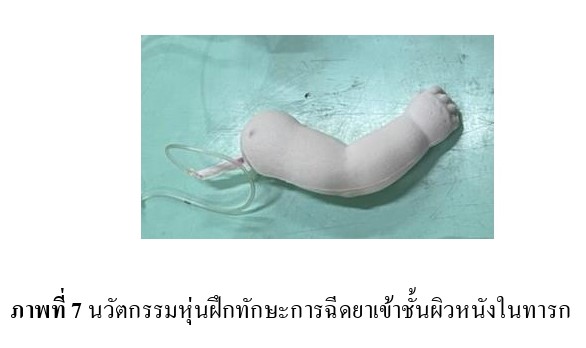
- 1. นวัตกรรมหุ่นฝึก ลักษณะภายนอก ทำจากน้ำยางธรรมชาติ เคลือบด้วยน้ำยางพาราผสม
สีอะคริลิกเพื่อให้ผิวและรูปร่างแขนเสมือนทารกจริงภายใน มีภายในมีถุงซิลิโคนกลวงขนาดเส้นผ่าศูนย์กลาง 5 ซม. สำหรับรองรับลม (เสมือนน้ำยาที่ฉีด) พร้อมท่อระบายลมออกเมื่อฝึกเสร็จ - 2. ประสิทธิผลนวัตกรรมหุ่นฝึก พบว่า นักศึกษามีทักษะการปฏิบัติการฉีดยา จำนวน 78 คน อยู่ในระดับดี (ร้อยละ 30) และมีความพึงพอใจต่อภาพรวมของนวัตกรรมในระดับมากที่สุด (M = 4.72, S.D. = 0.36)
สรุปและข้อเสนอแนะ หุ่นนวัตกรรมนี้สามารถนำไปใช้สนับสนุนการเรียนการสอนในวิชาการพยาบาลเด็กและวัยรุ่น ช่วยให้ผู้เรียนฝึกฝนได้ด้วยตนเองจนเกิดความเชี่ยวชาญก่อนปฏิบัติจริงกับผู้ป่วย ข้อเสนอแนะสำหรับการพัฒนาต่อยอดคือการเพิ่มความสมบูรณ์ของโครงสร้างให้ถูกต้องตามหลัก
กายวิภาคมากยิ่งขึ้น
เอกสารอ้างอิง
Anurak, C., Prommul, J., Fuengthin, A., Jitjum, C., Nancha, S., & Maming, H. (2023). Research and Innovation in nursing: An infant heel venipuncture-training manikin. The Southern College Network Journal of Nursing and Public Health, 11(3), 1 - 13. e270579. https://he01.tci-thaijo. org/index.php/scnet/article/view/270579
Best, J. W. (1981). Research in education (4th ed.). Prentice-Hall.
Bland, A. J., Topping, A., & Wood, B. (2011). A concept analysis of simulation as a learning strategy in nursing. Nurse Education Today, 31(7), 664 – 670. https://doi.org/10.1016/j.nedt.2010.10.013
Chaiyasang, P., Machompoo, N., Sakulkhaemaruethai, C., Sridet, R., & Nanudorn, A. (2022). Development of an innovative model from natural rubber for practicing suture skills. Journal of Health Science Research. 16(3), 13 - 25. https://he01.tcithaijo.org/index.php/JHR/issue/view/17600
Cheychom, S., & Rujiwattanakorn, D. (2015). Using innovative arm puppets in practicing intravenous fluid administration.The veins of nursing students. Ramathibodi Nursing News. 21(3), 395-407. https://www.rama.mahidol.ac.th/ramanursej/rnj-v21-no3-sep-dec-2015-09
Charoensuk, S., Tasbut, W., & Setthawanit, H. (2023). Strategic Plan for the Development of the Boromarajonani College of Nursing, 2023-2027 Revised Edition, Budget 2020. Office of Strategy and International Affairs, Boromarajonani College of Nursing. Boromarajonani College of Nursing.
Chonlatankampanat, W., Suwannarat, K., & Pornngam, K. (2020). The development of a part-changed newborn model innovation to promote self-confidence and nursing practice skills among nursing students. Journal of Phrapokklao Nursing College. 34(1). 1 - 16. https://he01.tci-thaijo.org/index.php/pnc/article/view/261296/178327
Cohen, J. (1988). Statistical Power Analysis for the Behavioral Sciences (2nd ed.). Ni Lawrence Earm Associates.
College of Nursing Boromarajonani Songkhla. (2021). Strategic Plan, Boromarajonani College of Nursing, Songkhla, Fiscal Year 2022-2026. Author.
Faul, F., Erdfelder, E., Lang, A., G., & Buchner, A. (2007). G*Power 3: A flexible statistical power analysis program for the social, behavioral, and biomedical sciences. Behavior Research Methods, 39(2), 175 - 191. https://doi.org/10.3758/BF03193146
Henkaew, S., Thongsawat, S., & Yotkat, W. (2018). Development of the “Dee Tor Jai” prototype manikin for chest compression training among nursing students. Journal of Nursing Science & Health, 41(2), 1 – 12. https://he01.tcithaijo.org/index.php/nah/article/view/137637
Jones, A. M., & Brown, L. K. (2023). Pediatric nursing skills and simulation-based training. Journal of Clinical Nursing Education, 15(2), 112 – 125. https://doi.org/10.1016/j.jcne.2023.01.004
Kameg, K. M., Szpak, J. L., & Mohn, K. E. (2020). The use of low-fidelity simulation in nursing education. Journal of Nursing Education, 59(9), 500 - 504. https://doi.org/10.3928/01484834-20200820-04
Laoprachawit, K., Prommul, J., Aitsaro, C., Chuklang, C., Jitbanjong, J., & Phokwan, C. (2025) The Development of an Intramuscular Injection Simulation Pad Innovation. Princess of Naradhiwas University Journal, 17(2). 62 - 80. http://li01.tci-thaijo.org/index.php/pnujr/article/view/266298/180126
Larew, C., Lessans, S., Spunt, D., Foster, D., & Covington, K. (2006). Innovations in clinical simulation: Application of Benner's theory in an interactive patient care simulation. Nursing Education Perspectives, 27(1), 16 – 21. http://doi.org/10.1043/1094-2831(2006)027[0016:IICSAO]2.0.CO;2
Nontaput, T., & Chotiban, P. (2021). Intravenous venipuncture: New development in training on arm manikin. The Southern College Network Journal of Nursing and Public Health, 8(3), 49 - 60. https://he01.tci-thaijo.org/index.php/scnet/article/view/249150
McGaghie, W. C., Issenberg, S. B., Cohen, E. R., Barsuk, J. H., & Wayne, D. B. (2011). Does simulation-based medical education with deliberate practice yield better outcomes than traditional clinical education? A meta-analytic comparative review of the evidence. Academic Medicine, 86(6), 706 - 713. https://doi.org/10.1097/ACM.0b013e318217e119
McGaghie, W.C., Issenberg, S.B., Petrusa, E.R., & Scalese, R.J. (2010). A critical review of simulation-based medical education research: 2003-2009. Medical Education, 44(1), 50 – 63. http://doi.org/10.1111/j.1365-2923.2009.03547.x
Miller, R., & Davis, S. (2024). Sustainability and maintenance in medical simulation task trainers (2nd ed.). Springer.
Panvijitsiri, K., Sirisomboon, S., & Thipduangta, P. (2018). Development of artificial human tissue and artificial skin from natural rubber latex for medical models. Journal of Health Science Research and Development, 11(2), 85 - 94. https://he02.tci-thaijo.org/index.php/reshsd
Phutdee, W., Methakarnjanasak, N., & Uangpanyasuk, S. (2022). The development of rubber manikin innovation for nursing skills training: A systematic review. Journal of Nursing Science and Health, 45(2), 1 – 15. https://he01.tcithaijo.org/index.php/jns/article/view/256158
Prajankett, O., & Prasittivechchakoon, A. (2017). The development of a prototype simulator for abdominal examination training. The Journal of Royal Thai Army Nurses, 18(3), 44 - 50. https://he01.tci-thaijo.org/index.php/JRTAN
Prasit, W., Thipawan, P., & Sawaddisan, C. (2022). The effectiveness of natural rubber latex manikin for practicing uterine contraction assessment skills among nursing students. Rachabhadi Journal, Boromarajonani College of Nursing Surin, 12(2), 114 - 125. https://he01.tci-thaijo.org/index.php/Rachawadee
Prommul. J, Intaranaron. K, Perngyai. C, Klerlhee. T., & Mangmee. T. (2025). The Effects of an Innovative Infant Oral Feeding Tube Insertion Manikin on the Nursing Students' Skills. The Southern College Network Journal of Nursing and Public Health, 12(3), 14 - 26. https://he01.tci-thaijo.org/index.php/scnet/article/view/277075.
Prommul. J., Perngyai, C., Nelson, W., Klerlhee, C., Intaranarong, K., & Mangme, T. (2025). Development and effectiveness of a “4-in-1 infant”. (Research Report). Boromarajonani College of Nursing, Songkhla.
Rattanathongkam, S. (2020). Teaching and learning management using medical simulation: theory to practice. Khon Kaen University Press.
Rompipat, S. (2020). Developing a model for intradermal injection and its effect upon performance skills and satisfaction levels of third-year nursing students. Journal of Science and Technology (Science Technology), 29(4), 688 - 700. https://li01.tcithaijo.org/index.php/tstj/article/view/242725
Saengwiman. S, Chooduang. S,Taksapattanakul. K. (2024). A Self-Repairing Natural Rubber as a Novel Material Pad to Develop an Electro-Surgical Training Prototype. Proceedings of Engineering and Technology Innovation, 27. 97 - 109. https://doi.org/10.46604/peti.2024.13509
Sasitornampa, S., Prommul, J., Chainin, V., Waehama, W., Madadam, S., & Cheni, N. (2025). The development of natural rubber manikins innovation for suction skill practice. Journal of Health and Nursing Education, 2(1). https://he02.tci-thaijo.org/index.php/JHNE
Sinsawad, P., & ChewongJoumal, P. (2022). Innovative development of assisted model for suction skill. Joumal of The Royal Thal Ammy Nurses. 23(3), 409 - 410. https://he01.tci-thaijo.org/index.php/JRTAN/article/view/253823.
Smith, J. T., Wilson, P., & Garcia, M. (2021). Evaluation of natural rubber latex and polymers in skin-mimicking phantoms for intradermal injections. Biomedical Materials and Engineering, 32(4), 455 – 468. https://doi.org/10.3233/BME-211234
ดาวน์โหลด
เผยแพร่แล้ว
รูปแบบการอ้างอิง
ฉบับ
ประเภทบทความ
สัญญาอนุญาต
ลิขสิทธิ์ (c) 2026 วารสารมหาวิทยาลัยนราธิวาสราชนครินทร์

อนุญาตภายใต้เงื่อนไข Creative Commons Attribution-NonCommercial-NoDerivatives 4.0 International License.