
Predicting Factors of Executive Function Development among Preschoolers in Orhanages
Keywords:
Executive Function, Preschool Children, Orphanages, Sleep Behavior, Language DevelopmentAbstract
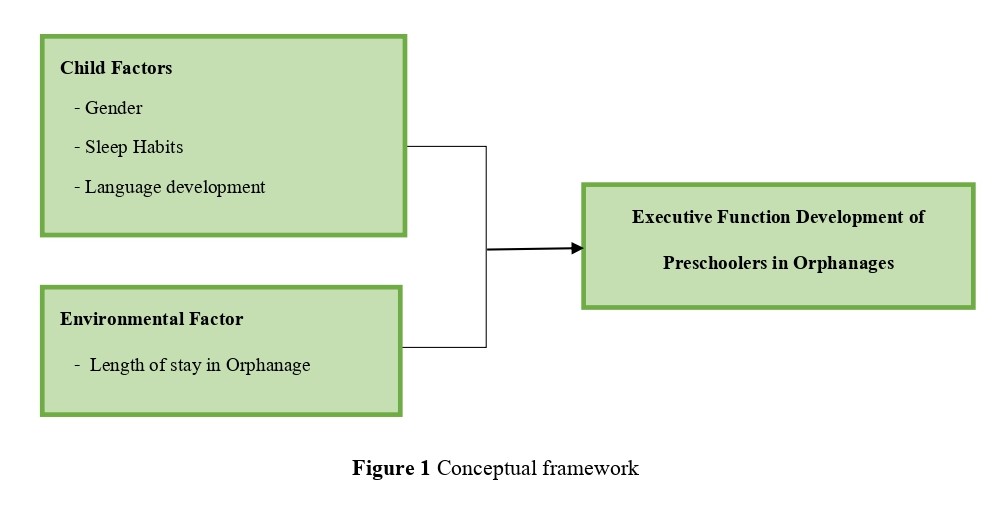
Background and Objectives Executive function development is a fundamental foundation for learning, emotional regulation, and behavioral control in children. Preschool children with well-developed executive functions can engage in analytical thinking, planning, problem-solving, impulse control, and social adaptation in the future. This study aimed to examine factors predicting executive function development among preschool children living in orphanages.
Methods This study employed a predictive correlational research design. The simple random sampling of 85 preschool children aged 3- 6 years residing in three government orphanages in Bangkok and its surrounding areas. Samples were selected using a multistage random sampling. The research instruments consisted of four questionnaires: a general information; Child’s Sleeping Habits: Thai version (abridged version); a preschool language development; and the Executive Function Development for Early Childhood. The second and fourth questionnaires demonstrated Cronbach’s alpha reliability coefficients of 0.78 and 0.96, respectively. The language development questionnaires showed a sensitivity of 41.70% and a specificity of 75.50%. Data were analyzed using descriptive statistics and stepwise multiple regression analysis.
Results The overall executive function development of preschool children in orphanages was at a moderate level, with a mean score of 81.61 (S.D. = 25.20, range = 14-127) and a mean T-score of 51. Gender was identified as only significant predictor, explaining 33.40% of the variance in executive function development (R² = .334, p < .001). Boys showed significantly lower executive function development than girls (β = -.578, p < .001).
Conclusion and Recommendations Gender significantly predicts executive function development among preschool children living in orphanages. Pediatric nurses and child caregivers are encouraged to develop appropriate strategies to enhance executive function skills, particularly among boys.
References
Cohen, J. (1992). A power primer. Psychological Bulletin, 112(1), 155-159. https://doi.org/10.1037/0033-2909.112.1.155
Chutabhakdikul, N., Thanasetkorn, P., Lertawasdatrakul, O., & Ruksee, N. (2017). Develop tools and to construct the normative criteria for Assessing Executive function skill in Preschooler [Master’s thesis]. Mahidol University.
Chutabhakdikul, N. (2018). Executive function skill handbook for early childhood teachers. Matichon Public Company Limited.
Chutabhakdikul, N. (2020). Executive Functions Development Assessment Tool for Early Childhood (MU.EF-101) [Master’s thesis]. Mahidol University.
Department of Children and Youth. (2024). Statistics on Beneficiaries in Shelters, Fiscal Years 2021-2023. https://www.dcy.go.th/publication/1646639100012
Diamond, A. (2013). Executive functions. Annual Review of Psychology, 64, 135–168. https://doi.org/ 10.1146/annurev-psych-113011-143750
Faul, F., Erdfelder, E., Buchner, A., & Lang, A.-G. (2009). Statistical power analyses using G*Power 3.1: Tests for correlation and regression analyses. Behavior Research Methods, 41, 1149-1160. https://doi.org/10.3758/BRM.41.4.1149
Herbers, J.E., Cutuli, J.J., Keane, J.N., & Leonard, J.A. (2020). Childhood homelessness, resilience, and adolescent mental health: A prospective, person-centered approach. Psychology in the Schools, 57(12), 1830–1844. https://doi.org/10.1002/pits.22331
Kaewlin, W. (2021). Comprehensive Loving Care for Neglected Children: A Team Based Approach. In Suphapeetiporn, K., Chongsrisawat, V., Deekajorndech, V., Chatrproedprai, S., Sosothikul, D., Rianthavorn, P., Chomtho, S., Tempark, T., Sintusek, P., Kongkiattikul, L., & Anugulruengkitt, S. (Eds.), Interprofessional Team Care in Pediatrics: Learn and Work Together. (p1-13). https://ped.md.chula.ac.th/wp-content/uploads/2021/09/00_CUPA2021-ebook.pdf
Lanais, K., Gnanamanickam, E., Maclean, M., & Segal, L. (2024). Investigating the impact of out-of-home care on early childhood development. Child Abuse & Neglect, 154, 106856. http://doi.org/10.1016/j.chiabu.2024.106856
Lawrence, C. R., Carlson, E. A., & Egeland, B. (2006). The impact of foster care on development. Development and Psychopathology, 18(1), 57 – 76. https://www.cambridge.org/core/ journals/development-and-psychopathology/article/abs/impact-of-foster-care-on-development/9B6A8059208B7FA5F677E2A063968C5B
Leungratanamart, L., Sudjainark, S., Wattanaviroj, N., & Meelai, W. (2021). Factors Influencing the Executive Function in Preschool-Age Children. Nursing Journal of the Ministry of Public Health, 31(3), 15–27. https://he02.tci-thaijo.org/index.php/tnaph/article/view/255634
Lim, S., Han, C. E., Uhlhaas, P. J., & Kaiser, M. (2015). Preferential detachment during human brain development: Age- and sex-specific structural connectivity in diffusion tensor imaging (DTI) data. Cerebral Cortex, 25(5), 1477–1489. https://doi.org/10.1093/cercor/bht333
McHugh, M.L. (2012). Interrater reliability: The kappa statistic. Biochemia Medica, 22(3), 276 – 282. https://doi.org/10.11613/BM.2012.031
McLaughlin, K.A., Sheridan, M.A., & Nelson, C.A. (2017). Neglect as a violation of species-expectant experience: Neurodevelopmental Consequences. Biological Psychiatry, 82(7), 462 – 471. https://pmc.ncbi.nlm.nih.gov/articles/PMC5572554/
Ministry of Public Health. (2023). Developmental Surveillance and Promotion Manual. Author.
Nelson, C. A., Fox, N. A., & Zeanah, C. H. (2019). Romania’s abandoned children: Deprivation, brain development, and the struggle for recovery. Harvard University Press.
Owens, J.A., Spirito, A., & McGuinn, M. (2000). The Children's Sleep Habits Questionnaire (CSHQ): Psychometric Properties of A Survey Instrument for School-Aged Children. Sleep, 23(8), 1 - 9. https://doi.org/10.1093/sleep/23.8.1d
Özsoy, Ş.Ö., Dağlı, H., & Dağlıoğlu, H.E. (2025). The relationship between executive function skills and motivation in preschool children. Journal of Pedagogical Research, 9(4), 35 – 52. https://doi.org/10.33902/JPR.202534723
Piaget, J. (1976). Piaget’s theory. In B. Inhelder, H. H. Chipman, & C. Zwingmann (Eds.), Piaget and his school (pp. 11–23). Springer.
Phianthanyakam, N., Santati, S., & Pookboonmee, R. (2021). Factors predicting sleeping habits in pre-school children in Bangkok Metropolis. The BCNNON Health Science Research Journal, 15(1), 59 – 69. https://he01.tci-thaijo.org/index.php/JHR/article/view/242861
Slot, P. L., & von Suchodoletz, A. (2018). Bidirectionality in preschool children’s executive functions and language skills: Is one developing skill the better predictor of the other?. Early Childhood Research Quarterly, 42, 205-214. https://doi.org/10.1016/j.ecresq.2017.10.005
Sirithongthaworn, S. (2018). The Development of Developmental Surveillance and Promotion Manual; DSPM. Journal of the Psychiatric Association of Thailand, 63(1), 3 – 12. https://he01.tci-thaijo.org/index.php/JPAT/article/view/117142
Sukjai, K. (2019). Single parent families: Challenges to overcome in contemporary Thai society. Committee for the Study and Development of Psychological and Social Knowledge.
Tangwijitsakul, H., Likhitweerawong, N., Boonchooduang, N., Chonchaiya, W., & Louthrenoo, O. (2024). Sleep problems and executive dysfunctions in pre-school children. Journal of Paediatrics and Child Health, 60(11), 703–708. https://doi.org/10.1111/jpc.16662
Thato, R. (2025). Nursing research: concepts to application (9th ed.). Chulalongkorn University Press.
UNICEF Thailand. (2023). No child left behind: No less than 120,000 Children in Institutional Care in Thailand. https://shorturl.asia/YJlPx
Wade, M., Fox, N. A., Zeanah, C. H., & Nelson, C. A. (2019). Long-term effects of institutional rearing, foster care, and brain activity on memory and executive functioning. Proceedings of the National Academy of Sciences of the United States of America, 116(5), 1808–1813. https://doi.org/10.1073/pnas.1809145116
Downloads
Published
How to Cite
Issue
Section
License
Copyright (c) 2026 Princess of Naradhiwas University Journal

This work is licensed under a Creative Commons Attribution-NonCommercial-NoDerivatives 4.0 International License.