
Factors Related to Health Literacy in Caring for Pregnant Female Prisoners among Female Correctional Officers
Keywords:
Health literacy, Role perception, Social support, Female correctional officers, Pregnant female prisonersAbstract
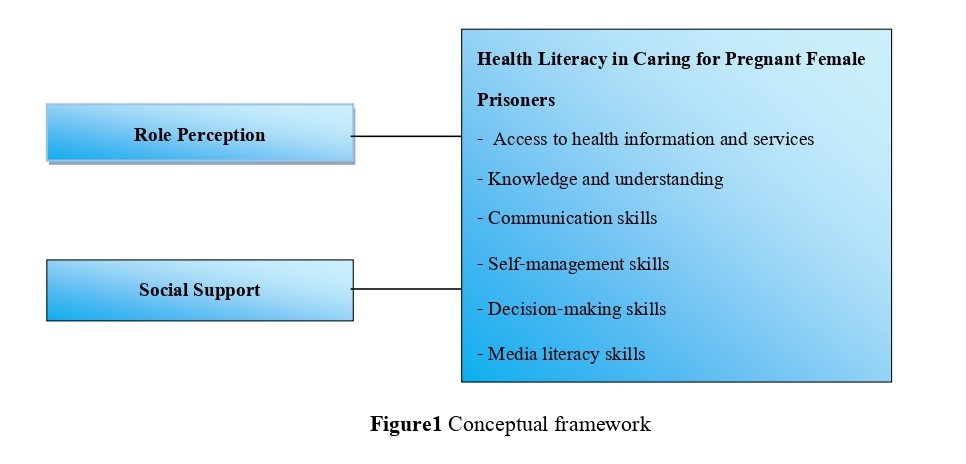
Background and Objectives: Pregnant female prisoners are a vulnerable population requiring continuous healthcare. Female correctional officers play important roles in monitoring health conditions, providing basic health information, and coordinating referrals; therefore, they need health literacy appropriate to their roles. This study aimed to 1) examine role perception, social support, and health literacy in caring for pregnant female prisoners among female correctional officers, and 2) examine the relationships of role perception and social support with health literacy in caring for pregnant female prisoners among female correctional officers.
Methods: This descriptive correlational study included 85 female correctional officers working at the Nakhon Ratchasima Central Women Correctional Institution, selected through purposive sampling. Data were collected using questionnaires with S-CVI/UA values ranging from .88 to 1.00 and reliability coefficients ranging from .70 to .96. Data were analyzed using descriptive statistics, Pearson’s product-moment correlation coefficient, and Spearman’s rank correlation coefficient.
Results: The mean role perception score was 50.82 (S.D. = 12.16), the mean social support score was 20.40 (S.D. = 2.88), and the mean overall health literacy score was 95.11 (S.D. = 18.25), indicating at a fair level. Knowledge and understanding and media literacy were at poor levels. Role perception was positively correlated with overall health literacy (rₛ = .254, p < .05), access to health information and services (rₛ = .456, p < .05), communication (rₛ = .430, p < .05), and self-management (rₛ = .330, p < .05), but was negatively correlated with knowledge and understanding
(rₛ = -.318, p < .05). Social support was positively correlated with overall health literacy (rₛ = .388,
p < .05), access to health information and services (r = .546, p < .05), communication (r = .427,
p < .05), self-management (r = .413, p < .05), and decision-making (r = .341, p < .05).
Conclusion and Recommendations: Female correctional officers had a fair overall level of health literacy in caring for pregnant female prisoners, with limitations in knowledge and understanding and media literacy. Role perception and social support were associated with several dimensions of health literacy. Health literacy should be strengthened, particularly in knowledge and understanding and information appraisal skills. The findings can be used to inform staff development content, develop reliable informational materials or practice guidelines, and establish support systems involving healthcare personnel that are appropriate to the context of correctional institutions.
References
Abbott, L., Scott, T., & Thomas, H. (2026). Institutional thoughtlessness and the incarcerated pregnancy. Criminology & Criminal Justice, 26(1), 3 – 21. https://doi.org/10.1177/17488958241228995
Alirezaei, S., & Latifnejad Roudsari, R. (2022). The needs of incarcerated pregnant women: A systematic review of literature. International Journal of Community Based Nursing and Midwifery, 10(1), 2 – 17. https://doi.org/10.30476/IJCBNM.2021.89508.1613
Asamani, L., Acquah-Coleman, R., Senayah, W. K., & Oppong, S. (2025). Interactive roles of resource availability, role clarity and employee motivation in enhancing organisational effectiveness through employee performance and job satisfaction. Discover Psychology, 5, 12. https://doi.org/10.1007/s44202-025-00333-8
Bancroft, X., Parayre, A.F., McGee, A., Morgan, L., & Peterson, W. (2025). “Is that a policy thing or is that a guard thing?”: A qualitative study of providers’ experiences supporting pregnant individuals incarcerated in Ontario, Canada. BMC Pregnancy and Childbirth, 25, 575. https://doi.org/10.1186/s12884-025-07696-9
Cohen, J. (1992). A power primer. Psychological Bulletin, 112(1), 155 – 159. https://doi.org/10.1037/ 0033-2909.112.1.155
Corrections Act, B.E. 2560 (2017, February 18). Royal Thai Government Gazette, 134(21A), 1 – 24. https://www.ratchakitcha.soc.go.th/DATA/PDF/2560/A/021/1.PDF
Damri, P. (2024). Factors affecting health literacy of village health volunteers at Klong Si Health Promoting Hospital, Village No. 13, Klong Si Sub-district, Klong Luang District, Pathum Thani Province. Journal of Environmental and Community Health, 9(5), 845 – 852. https://he03.tci-thaijo.org/index.php/ech/article/view/3471
Department of Corrections. (2018). Regulation of the Department of Corrections on the care of pregnant or breastfeeding female prisoners, B.E. 2561 (2018). Author.
Fair, H., & Walmsley, R. (2024). World prison population list (14th ed.). Institute for Crime & Justice Policy Research.
Fair, H., & Walmsley, R. (2025). World female imprisonment list (6th ed.). Institute for Crime & Justice Policy Research.
Forsyth, J., Shaw, J., & Shepherd, A. (2025). Reflecting the voices of prison officers with respect to their support, supervision, and wellbeing training needs: A reflexive thematic analysis. Frontiers in Public Health, 13, 1656223. https://doi.org/10.3389/fpubh.2025.1656223
Friedman, S. H., Kaempf, A., & Kauffman, S. (2020). The realities of pregnancy and mothering while incarcerated. The Journal of the American Academy of Psychiatry and the Law, 48(3), 365 – 375. https://jaapl.org/content/48/3/365
Gharagozloo, M., Moridi, M., Alimardi, M., & Behboodi Moghadam, Z. (2025). Reproductive health needs of incarcerated women in developed countries: A mixed-method systematic review. European Journal of Medical Research, 30, 200. https://doi.org/10.1186/s40001-025-02458-x
Gill, S., Zeki, R., Kaye, S., Zingirlis, P., Archer, V., Lewandowski, A., Creighton, G., Shaw, C., & Bowman, J. (2023). Health literacy strengths and challenges of people in New South Wales prisons: A cross-sectional survey using the Health Literacy Questionnaire (HLQ). BMC Public Health, 23, 1520. https://doi.org/10.1186/s12889-023-16464-3
Health Education Division, Department of Health Service Support. (2017). Health education and health behavior guidelines for fiscal year 2018: Promoting the development of health literacy and health behaviors. Ministry of Public Health.
Hooper, M., Virdun, C., & Phillips, J. L. (2025). Capacity-building strategies that support correctional and justice health professionals to provide best-evidenced based healthcare for people in prison: A systematic review. International Journal for Equity in Health, 24, 115. https://doi.org/10.1186/s12939-025-02462-x
Kirubarajan, A., Tsang, J., Dong, S., Hui, J., Sreeram, P., Mohmand, Z., Leung, S., Ceccacci, A., & Sobel, M. (2022). Pregnancy and childbirth during incarceration: A qualitative systematic review of lived experiences. BJOG: An International Journal of Obstetrics & Gynaecology, 129(9), 1460 – 1472. https://doi.org/10.1111/1471-0528.17137
Liauw, J., Jurgutis, J., Nouvet, E., Dineley, B., Kearney, H., Reaka, N., Fitzpatrick-Lewis, D., Peirson, L., & Kouyoumdjian, F. G. (2021). Reproductive healthcare in prison: A qualitative study of women’s experiences and perspectives in Ontario, Canada. PLOS ONE, 16(5), e0251853. https://doi.org/10.1371/journal.pone.0251853
Lochmannová, A. (2025). Health literacy behind bars: A hidden burden of incarceration. Sociológia - Slovak Sociological Review, 57(2), 124–153. https://doi.org/10.31577/sociologia.2025.57.2.5
Nielsen, A.M., Maindal, H. T., & Valentin, G. (2024). The role of health literacy in the association between social support and self-rated health: A Danish population-based study in 10,787 individuals with a long-term condition. BMC Public Health, 24, 2739. https://doi.org/ 10.1186/s12889-024-20223-3
Nutbeam, D. (2000). Health literacy as a public health goal: A challenge for contemporary health education and communication strategies into the 21st century. Health Promotion International, 15(3), 259 – 267. https://doi.org/10.1093/heapro/15.3.259
Nutbeam, D. (2008). The evolving concept of health literacy. Social Science & Medicine, 67(12), 2072 – 2078. https://doi.org/10.1016/j.socscimed.2008.09.050
Pholphantin, P., & Jiamjarasrangsi, W. (2025). Occupational Health Literacy among Aircraft Maintenance Mechanics in Private Aircraft Maintenance Repair and Overhaul Facilities in Thailand. Royal Thai Navy Medical Journal, 52(2). 355 – 371. https://he01.tci-thaijo.org/ index.php/nmdjournal/article/view/281928
Phudphad, P. (2024). Factors influencing the health literacy of public health volunteers: Village health volunteers working in Ratchaburi Municipality, Ratchaburi Province. Journal of Public Health and Innovation, 4(1), 74 – 87. https://he01.tci-thaijo.org/index.php/J-PHIN/article/view/267016
Polit, D.F., & Beck, C.T. (2022). Essentials of nursing research: Appraising evidence for nursing practice (10th ed.). Wolters Kluwer.
Prastiwi, R.S., Mulyanto, M., Pamungkasari, E.P., & Habsari, S.K. (2024). Pregnant self-care during incarceration: The perspective of correctional health workers. In Hidayat, A., Handoko, T., Khoiriyah, S., Arif, A., & Saptaningtyas, H. (Eds.), Proceedings of the International Conference on Multidisciplinary Studies (ICoMSi 2023): Advances in Social Science, Education and Humanities Research (pp. 576 – 584), Atlantis Press. http://doi.org/10.2991/978-2-38476-228-6_48
Puektes, S., & Sawasdipanich, N. (2015). Pregnant inmates’ perceptions of health care service management in the prisons. The Journal of Faculty of Nursing Burapha University, 23(3), 56 – 67. https://he02.tci-thaijo.org/index.php/Nubuu/article/view/49444
Rakpaitoon, S., Thanapop, S., & Thanapop, C. (2022). Correctional officers’ health literacy and practices for pulmonary tuberculosis prevention in prison. International Journal of Environmental Research and Public Health, 19(18), 11297. https://doi.org/10.3390/ ijerph191811297
Ranee, S., Langputeh, P., & Lertariyapongkul, N. (2020). Health literacy and health behavior of female prisoners in three southern border provinces. Princess of Naradhiwas University Journal, 12(3), 44 – 60. https://li01.tci-thaijo.org/index.php/pnujr/article/view/227746
Rattanachankorn, K., Sritoomma, N., Ketprathum, P., & Rattanachankorn, K. (2024). Factors related to health literacy in hypertension prevention among village health volunteers in Don Tum District, Nakhon Pathom Province. Journal of Research in Nursing-Midwifery and Health Sciences, 44(3), 39 – 51. https://he02.tci-thaijo.org/index.php/nur-psu/article/view/270615
Roma, W., Kloyiam, S., Sookawong, W., Kaew-Amdee, T., Tunnung, A., Khampang, R., & Butchon, R. (2019). Thai health literacy survey (THL-S) of Thais aged 15 years and above, 2019. Health Systems Research Institute.
Saengwichian, S. (2025). Caring for pregnant female inmates awaiting trial in Thailand: Threads of life behind high walls. Journal of Social Work Professions Council of Thailand, 1(3), 65 – 77. https://so19.tci-thaijo.org/index.php/SWPCTH/article/view/2602
Sapkota, D., Dennison, S., Allen, J., Gamble, J., Williams, C., Malope-Rwodzi, N., Baar, L., Ransley, J., & McGee, T.R. (2022). Navigating pregnancy and early motherhood in prison: A thematic analysis of mothers’ experiences. Health & Justice, 10, 32. https://doi.org/10.1186/s40352-022-00196-4
Snibsøer, A. K., Ciliska, D., Yost, J., Graverholt, B., Nortvedt, M. W., Riise, T., & Espehaug, B. (2018). Self-reported and objectively assessed knowledge of evidence-based practice terminology among healthcare students: A cross-sectional study. PLOS ONE, 13(7), e0200313. https://doi.org/10.1371/journal.pone.0200313
Srikwan, R., Khlaewkhlad,G., & Poowaruttanawiwit, P. (2026). Assessing knowledge of village health volunteers on pharmaceutical consumer protection and unsafe health products in Thailand. Pharmacy Practice, 24(1), 3536. https://doi.org/10.18549/PharmPract.2026.1.3536
Suvithayasiri, C. & Lukkanalikitkul, E. (2025). Factors Influencing Occupational Health and Safety Literacy among Healthcare Workers in a Hospital, Chonburi Province. Thai Journal of Public Health, 55(3), 1365 – 1382. https://he02.tcithaijo.org/index.php/jph/article/view/275454
Thato, R. (2022). Nursing Research: Concepts for Application. Degree Vision.
Thongpaiboon, P., Sawasdipanich, N., Rojanaprasert, P., & Wannasuntad, S. (2015). Health care services for postpartum incarcerated women in prison. The Journal of Boromarajonani College of Nursing, Nakhonratchasima, 21(1), 5 – 17. https://he02.tcithaijo.org/index.php/ Jolbcnm/article/view/39757
United Nations General Assembly. (2011). United Nations Rules for the Treatment of Women Prisoners and Non-custodial Measures for Women Offenders (the Bangkok Rules). Author.
Downloads
Published
How to Cite
Issue
Section
License
Copyright (c) 2026 Princess of Naradhiwas University Journal

This work is licensed under a Creative Commons Attribution-NonCommercial-NoDerivatives 4.0 International License.