
Comparative Effectiveness of Glycopyrrolate, Butylscopolamine or Normal Saline Solution Premedication in Preventing Postoperative Catheter Related Bladder Discomfort
Keywords:
Glycopyrrolate, Butylscopolamine, Catheter related bladder discomfort: CRBD, UreteroscopyAbstract
Background and Objectives Patients who have undergone ureteral stone surgery via cystoscopy commonly experience post-operative bladder discomfort and pain due to catheterization, also known as catheter related bladder discomfort (CRBD). This pain is generally of moderate to severe intensity, making it essential to implement effective pain management strategies. The objective of this study is to evaluate the effectiveness of CRBD treatment with three different drugs: glycopyrrolate, butylscopolamine, and normal saline solution (NSS), administered intravenously before anesthesia to patients undergoing ureteroscopic removal of ureter stones.
Methods This was a randomized controlled study involving 21 patients. The patients were divided into three groups of seven, identified by their treatments as glycopyrrolate 0.2 mg IV, butylscopolamine 20 mg IV, and normal saline solution (NSS) IV. In the recovery room, pain scores were assessed using the numeric rating scale (NRS). If the NRS score was greater than 5, fentanyl 0.5 mcg/kg was administered intravenously. The pain score was reassessed 5 min later. If the NRS was still above 5, fentanyl was administered again, with a maximum of three doses. The effectiveness of the treatments was compared using a One-Way ANOVA. The proportion of patients in each treatment who received fentanyl was also compared, using Fisher’s exact test with a significance level of α = 0.05.
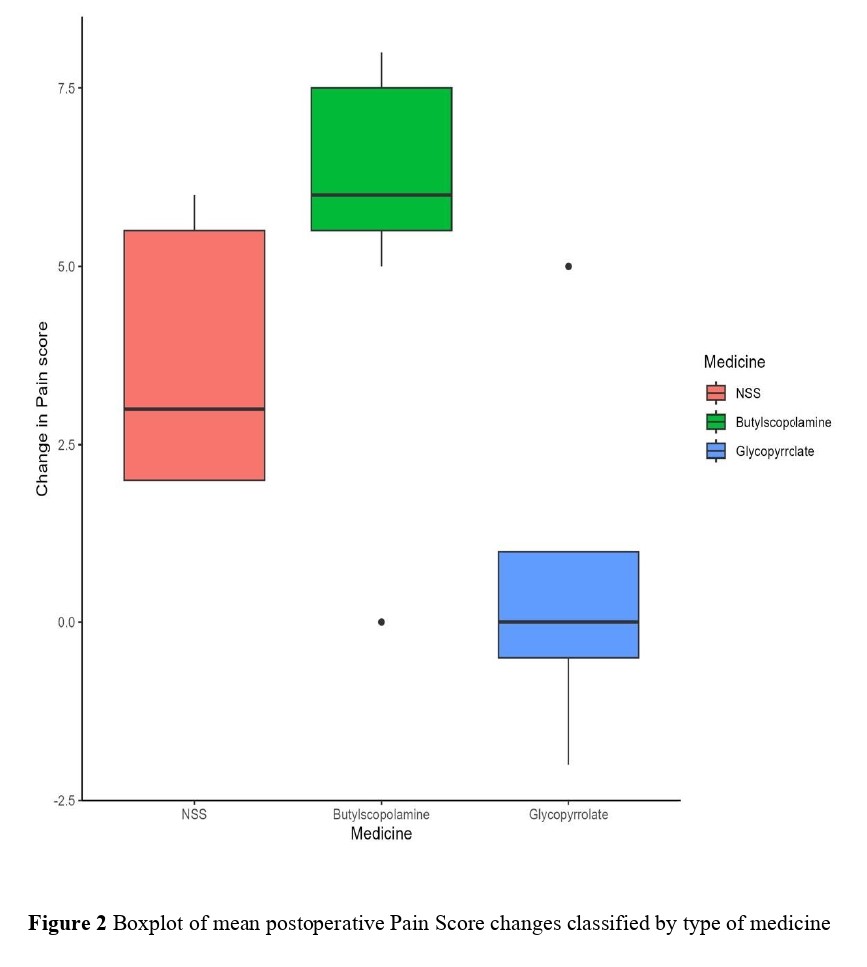
Results Result showed the mean postoperative pain score changes among glycopyrrolate (2.7), butylscopolamine (4.0), and NSS (3.4) were significantly different (p-value < 0.05). However, the proportion of patients who received opioid analgesics in the recovery room after urinary catheterization did not differ significantly across the three treatments (p-value > 0.05).
Conclusion and Recommendation In conclusion, administering glycopyrrolate intravenously before anesthesia induction relieves CRBD more effectively than butylscopolamine and NSS.
References
Anesthesia statistics at Thungsong Hospital. (2023). Anesthesia Department, Thungsong Hospital 2020-2023. Author.
Bai, Y., Wang, X., Li, X., Pu, C., Yuan, H., Tang, Y., Li, J., Wei, Q., & Han, P. (2015). Management of catheter-related bladder discomfort in patients who underwent elective surgery. Journal of Endourology, 29(6), 640 – 649. http://doi/org/10.1089/end.2014.0670
Gallanosa, A., Stevens, J.B., Hendrix, J.M., & Quick, J. (2025). Glycopyrrolate. StatPearls Publishing.
Jang, E. B., Hong, S. H., Kim, K. S., Park, S. Y., Kim, Y. T., Yoon, Y. E., & Moon, H. S. (2020).Catheter-related bladder discomfort: How can we manage it?. International Neurourology Journal, 24(4), 324 – 331. http://doi.org/10.5213/inj.2040108.054
Kim, H.-C., Lim, S.-M., Seo, H., & Park, H.-P. (2015). Effect of glycopyrrolate versus atropine coadministered with neostigmine for reversal of rocuronium on postoperative catheter-related bladder discomfort in patients undergoing transurethral resection of bladder tumor: A prospective randomized study. Journal of Anesthesia, 29(4), 538 – 544. https://doi/org/10.1007/s00540-015-2064-2
Kim, J. A., Min, J. H., Lee, H. S., Jo, H. R., Je, U. J., & Paek, J. H. (2016). Effects of glycopyrrolate premedication on preventing postoperative catheter-related bladder discomfort in patients receiving ureteroscopic removal of ureter stone. Korean Journal of Anesthesiology, 69(6), 563 – 567. https://doi/org/10.4098/kjae.2016.69.6.563
Koo, C.-H., & Ryu, J.-H. (2020). Anesthetic considerations for urologic surgeries. Korean Journal of Anesthesiology, 73(2), 92–102. https://doi.org/10.4097/kja.19437
Li, S., Song, L., Ma, Y., & Lin, X. (2018). Tramadol for the treatment of catheter-related bladder discomfort: A randomized controlled trial. BMC Anesthesiology, 18(1), 194. https://doi.org/10.1186/s12871-018-0659-5
Markopoulos, T., Katsimperis, S., Lazarou, L., Tzelves, L., Mitsogiannis, I., Papatsoris, A., Skolarikos, A., & Varkarakis, I. (2025). Catheter-related bladder discomfort: Insights into pathophysiology, clinical impact, and management. Cureus, 17(3), e81322. https://doi.org/10.7759/cureus.81322
Rath, A., & Reena. (2022). Role of pudendal nerve block for prevention of catheter-related bladder discomfort in male pediatric patients undergoing hypospadias surgery: A prospective randomized control study. Ain-Shams Journal of Anesthesiology, 14(1), 40. https://doi.org/10.1186/s42077-022-00234-1
Ren, J., Yu, T., Tian, Y., & Luo, G. (2023). Comparative effectiveness of interventions for managing urological postoperative catheter related bladder discomfort: A systematic review and network meta analysis. BMC Urology, 23, 29. https://doi.org/10.1186/s12894-023-01195-9
Sanansilp, V., Tangwiwat, S., & Raksakietisak, M. (Eds.). (2019). Acute pain management. Department of Anesthesiology [Master’s thesis]. Mahidol University.
The Royal College of Anesthesiologists of Thailand, & Thai Association for the Study of Pain. (2019). Clinical guidance for acute postoperative pain management. https://www.rcat.org/_ files/ugd/82246c_8277684e42ba483c88b44d431ccd3967.pdf
Zhang, J., & Song, S. (2025). Ultrasound guided ilioinguinal/iliohypogastric block mitigates catheter related bladder discomfort after prostate surgery: A prospective randomized controlled trial. Cureus, 17(10), e94313. https://doi.org/10.7759/cureus.94313
Downloads
Published
How to Cite
Issue
Section
License
Copyright (c) 2025 Princess of Naradhiwas University Journal

This work is licensed under a Creative Commons Attribution-NonCommercial-NoDerivatives 4.0 International License.