
Effect of Development of Patient Triage Guideline Based on the MOPH ED Triage Model for the Emergency Department of Mueang Songkhla Hospital
Keywords:
Patient triage, Ministry of Public Health Emergency Department Triage (MOPH ED), Emergency DepartmentAbstract
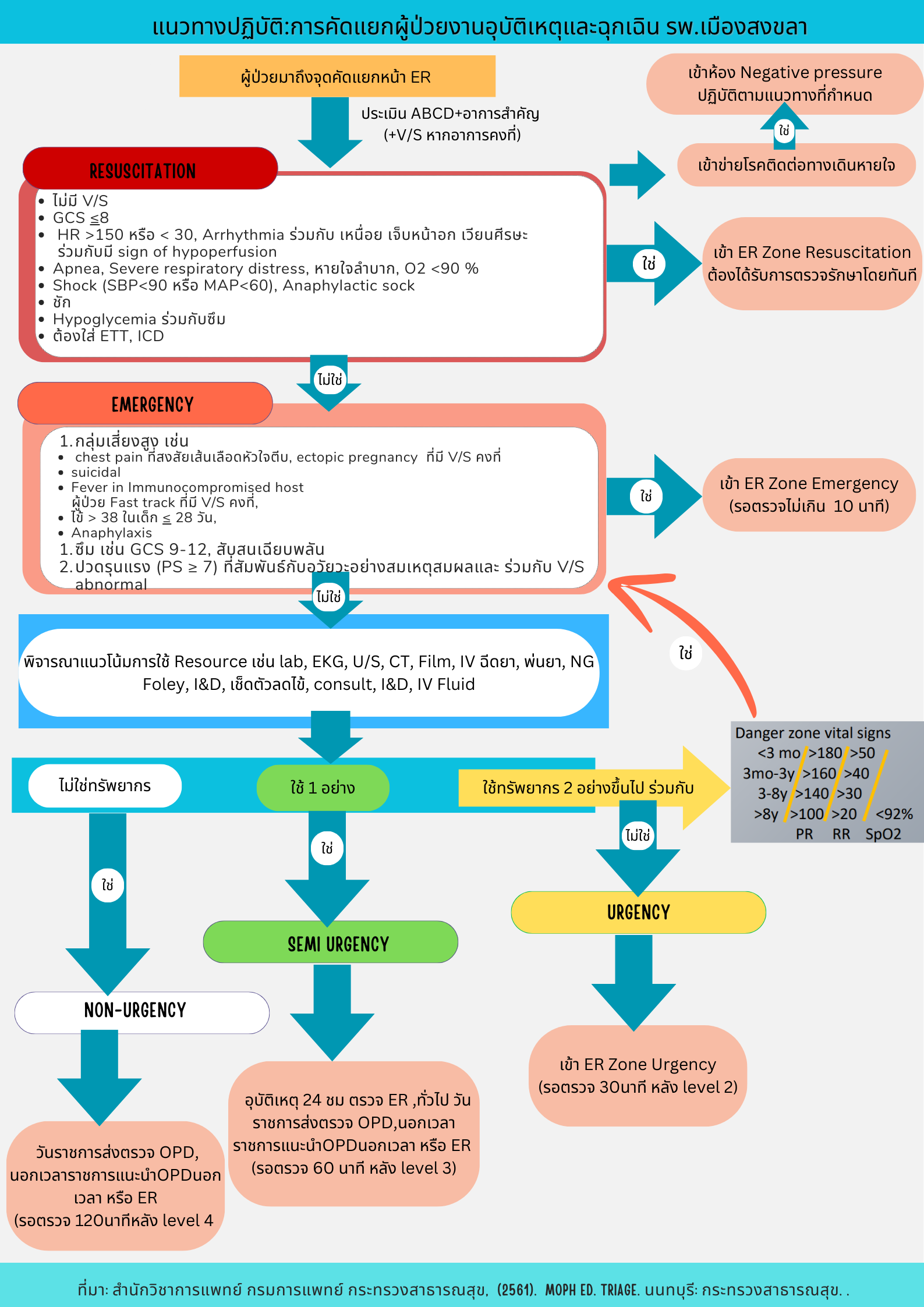
Background and Objectives Developing clear and easy-to-understand patient triage guidelines is a crucial step in effectively reducing errors and increasing the accuracy of patient triage. Therefore, this research aimed to develop patient triage guideline based on the MOPH ED Triage model and evaluate its effectiveness in improving the quality of service in the emergency department of Songkhla Hospital.
Methods This study was action research using a one-group pretest–posttest design. It was conducted in four phases: (1) Plan: Study the problem and situation before implementing the guideline from 20 medical personnel responsible for patient triage and 427 medical record officers; (2) Act: Develop the guideline and train personnel; (3) Observe: Evaluate the results after implementing the guideline from 20 personnel and 434 medical record officers. Data were analyzed using descriptive statistics and independent t-tests; (4) Reflect: Analyze the strengths, areas for improvement, and development directions of the guideline.
Results The developed guideline improved the accuracy of patient triage from 79.40% to 88.70%. Additionally, the study found a significant reduction in waiting time for all patient groups at a level of 0.05. Regarding staff satisfaction, the guideline was highly rated, particularly in terms of accuracy, practicality, and benefits to patients and the department.
Conclusion and Recommendations The study results can be used as a guideline for developing and improving patient triage guidelines in the emergency department and can effectively enhance the quality of medical services.
References
Boonyarat, S. (2021). Accuracy of patient screening system using Emergency Severity Index compared with Canadian Triage and Acuity Scale in emergency patients at Chiangrai Prachanukroh Hospital. Chiangrai Medical Journal, 13(3), 35 – 50. https://he01.tci-thaijo.org/index.php/crmjournal/article/view/245664
Cochran, W. G. (1977). Sampling techniques (3rd ed.). John Wiley & Sons.
Dainty, K.N., Seaton, B., Laupacis, A., & Schull, M.J. (2023). Emergency department triage decision-making by registered nurses: An instrument development study. Journal of Advanced Nursing, 79(3), 1015 – 1025. https://doi.org/10.1111/jan.16252Wiley Online Library+2WileyOnlineLibrary+2ResearchGate+2
Department of Medical Services. (2018). Guidelines for emergency department operations. Ministry of Public Health.
FitzGerald, G., Jelinek, G. A., Scott, D., & Gerdtz, M. F. (2020). Emergency department triage revisited. Emergency Medicine Journal, 27(2), 86 – 92. https://doi.org/10.1136/emj.077081Lippincott Journals+5MonashUniversity+5PubMed+5
Huang, Y., Hsieh, M.S., Lin, Y.T., & Lin, Y. C. (2021). Implementation of an emergency department triage system and its effect on patient flow and outcomes. Journal of Emergency Nursing, 47(2), 236 – 243. https://doi.org/10.1016/j.jen.2020.10.011
Kemmis, S., & McTaggart, R. (1988). The action research planner (3rd ed.). Deakin University Press.
Laosuksri, W., Chiwpreecha, P., Samork, N., Thaimit, Y., & Srisookkum, T. (2021). Accuracy of Thai National Triage Guideline and Trauma and Injury Severity Score (TRISS) for predicting survival outcome in emergency department injured patients. Chiang Mai Medical Journal, 60(4), 563 – 567. https://he01.tci-thaijo.org/index.php/CMMJ-MedCMJ/article/view/249133
Lee, H. C., Lee, C. C., Chen, W. K., & Chang, Y. C. (2020). Reducing waiting time in the emergency department by implementing a triage system with time-to-treatment targets. International Journal of Environmental Research and Public Health, 17(9), 3257. https://doi.org/10.3390/ijerph17093257
Manakan, P. (2022). Over-triage and under-triage in emergency care: Consequences and prevention. Thai Emergency Medicine Review, 24(4), 115–121. https://he01.tci-thaijo.org/index.php/temr/article/view/258525
Ministry of Public Health. (2023). Guidelines for patient triage in emergency departments according to the MOPH ED Triage system. Author.
Sae-Tae, P., & Nanuie, T. (2022). Communication and clarity in emergency patient triage: A case study in provincial hospitals. Journal of Healthcare Communication, 10(3), 87 – 95. https://he01.tci-thaijo.org/index.php/scnet/article/view/253260/171873
Treechomwaree, R. (2022). Challenges in using triage tools in emergency care settings. Thai Journal of Emergency and Critical Care Nursing, 9(2), 45 – 53. https://he01.tci-thaijo.org/index.php/jrhi/article/view/259455
Van Der Linden, C., Khursheed, M., & Lucas, C. (2022). Triage accuracy and patient outcomes in emergency departments: A comparative study. International Journal of Emergency Medicine, 15(1), 98 – 106. https://doi.org/10.1186/s12245-023-00479
Wang, J.Y., & Chen, L.H. (2022). Patient satisfaction in emergency departments: The impact of waiting time and triage accuracy. Healthcare, 10(5), 872. https://doi.org/10.3390/healthcare10050872
Yin, R.K. (2021). Case study research and applications: Design and methods (6th ed.). SAGE Publications.
Downloads
Published
How to Cite
Issue
Section
License
Copyright (c) 2025 Princess of Naradhiwas University Journal

This work is licensed under a Creative Commons Attribution-NonCommercial-NoDerivatives 4.0 International License.