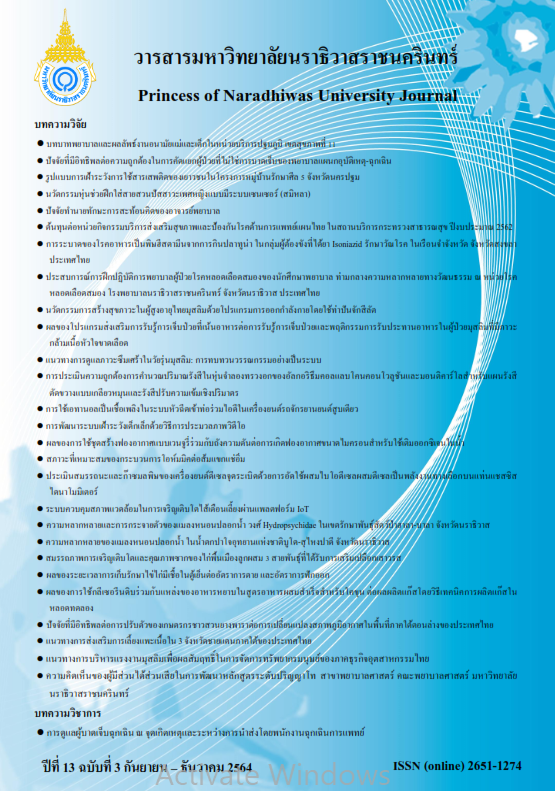
รูปแบบการเฝ้าระวังการใช้สารเสพติดของเยาวชนในโครงการหมู่บ้านรักษาศีล 5 จังหวัดนครปฐม
คำสำคัญ:
รูปแบบการเฝ้าระวัง, การใช้สารเสพติด, หมู่บ้านรักษาศีล 5, เยาวชนบทคัดย่อ
การวิจัยครั้งนี้มีวัตถุประสงค์เพื่อสร้างรูปแบบการเฝ้าระวังการใช้สารเสพติดของเยาวชนในโครงการหมู่บ้านรักษาศีล 5 จังหวัดนครปฐม ใช้วิธีการวิจัยเชิงผสมผสาน เริ่มจากการวิจัยเชิงปริมาณ เพื่อศึกษาปัจจัยที่เกี่ยวข้องกับการเฝ้าระวังการใช้สารเสพติดของเยาวชนโดยใช้แบบสอบถามในกลุ่มเยาวชน อายุ 15 - 21 ปี จำนวน 302 คน วิเคราะห์ข้อมูลด้วยสถิติ Multiple regression นำมาสู่การวิจัยเชิงคุณภาพเพื่อศึกษาสาเหตุของปัญหา และนำไปสู่การพัฒนารูปแบบ วิเคราะห์ข้อมูลด้วยวิธีสังเคราะห์แก่นสาระ และตรวจสอบข้อมูลแบบสามเส้า
ผลการศึกษา พบว่าปัจจัยที่เกี่ยวข้องกับการเฝ้าระวังการใช้สารเสพติดของเยาวชน ได้แก่ ความสามารถในการควบคุมตนเองจากการใช้สารเสพติด ด้านสุขภาพองค์รวม การรับรู้ความสามารถของตนเองในการป้องกันสารเสพติด การรับรู้ประสิทธิผลแห่งตนในการปฏิเสธการใช้สารเสพติด และรูปแบบการเฝ้าระวังการใช้สารเสพติดของเยาวชน ประกอบด้วย 2 แผนงาน คือ 1) แผนงานพัฒนาศักยภาพภายในตัวบุคคล ได้แก่ การจัดเวทีระดมความคิดเห็น ตลอดจนจัดตั้งกลุ่มแกนนำเยาวชน การจัดอบรมสร้างอาชีพ สนับสนุนเยาวชนต้นแบบด้านกีฬาและนันทนาการเพื่อสุขภาพ และสร้างการรับรู้สื่ออย่างมีวิจารณญาณ 2) แผนงานปรับสิ่งแวดล้อม ประกอบด้วย การแลกเปลี่ยนความคิดเห็นของผู้ปกครอง ผู้นำชุมชน ครู แกนนำทางศาสนา และสร้างแผนงานเฝ้าระวังในชุมชน และจัดตั้งศูนย์พัฒนาจิตสมาธิ ปัญญา ตามหลักศีล 5 ที่ตรงกับความต้องการของพื้นที่ที่สามารถแก้ปัญหาสารเสพติดได้จริง
เอกสารอ้างอิง
Bureau of Drug Prevention and Development. (2015). Conclusion of the progress of the implementation of the indicators goals according to the strategic plan of the land force over drugs. Nonthaburi: Bureau of Drug Prevention and Development. (in Thai).
Creswell, J. W. (2018). Research Design: Qualitative, Quantitative, and Mixed Methods Approaches. Thousand Oaks: Sage.
Dyer, J. H., & Nobeoka, K. (2000). Creating and managing a high- performance knowledge-Sharing network. Journal of Toyota Strategic Management, 21(3), 345-367.
Green, A., & Kreuter, L. (1999). Health Promotion Planning: An Education and Environmental Approach. Toronto: Mayfield Publishing.
Leaudnakrob, N., Sengsri, S., & Poltana, P. (2018). ICT: Information technology supported transformative learning. Journal of Boromarajonani College of Nursing, Uttaradit, 9(1), 70-80.
Nittaya, Y. (2013). Factors affecting the mathayomsuksa1students behavior of drugs prevention in schools under Loei primary educational service area. (M.Ed. Thesis in Educational). Loei Rajabhat University, Loei. (in Thai)
Office of the Narcotics Control Board. (2017). Brief history of drug addiction in 2017.Bangkok: Office of Narcotics Control Board. (in Thai)
Office of the Narcotics Control Board. (2018). Brief history of drug addiction in 2018.Bangkok: Office of Narcotics Control Board. (in Thai)
Office of the National Economic and Social Development Council. (2019). Retrieved from https://www.nesdb.go.th/main.php?filename=index.
Prachit, C. (2017). Buddha’s Doctrines with The Protection and Solution to the Narcotic’s Problems of The Youth. Journal of Philosophical Vision, 10(1), 12-27.
Salamteh, S. (2018). The development of juvenile leadership training curriculum of the Juvenile and family court for children and youth to prevent drug addiction. Journal of Humanities and Social Sciences Thonburi University, Special(12), 93-106.
Santrock, W. J. (1996). Adolescence.New York: Times mirror Higher Education.
Suthep, P. (2019). The Buddhist Doctrines to Prevent Criminal Behavior of Children and Young People in Bangkok. Journal of MBU Education, 36(2), 78-87.
Snowden, D. (2005). From atomism to networks in social system. The Learning Organization, 12(6), 552-562.
Sudarat, P. B. (2018). Mediating Role of Mindfulness on the Relationship between Stress and Substance Use in Secondary School Students. Journal of Nursing Science, 7(1), 85-106.
Tafa, M., & Baiocco, R. (2009). Addictive Behavior and family functioning during adolescence. Journal of Family Therapy, 37(1), 388-395.
Teddlie, C., & Tashakkori, A. (2009). Foundation of mixed methods research: Integrating quantitative and qualitative approaches in the social and behavioral science. Los Angeles: SAGE.
Thasingern, P. (2015). Guidelines for the cooperation building of drug prevention and solution of the community leaders in Uttaradit province. Journal of Graduate School, 10(1), 67-76.
United Nations Office on Drugs and Crime. (2018). World drug report 2018. Geneva: United Nations Office on Drugs and Crime.