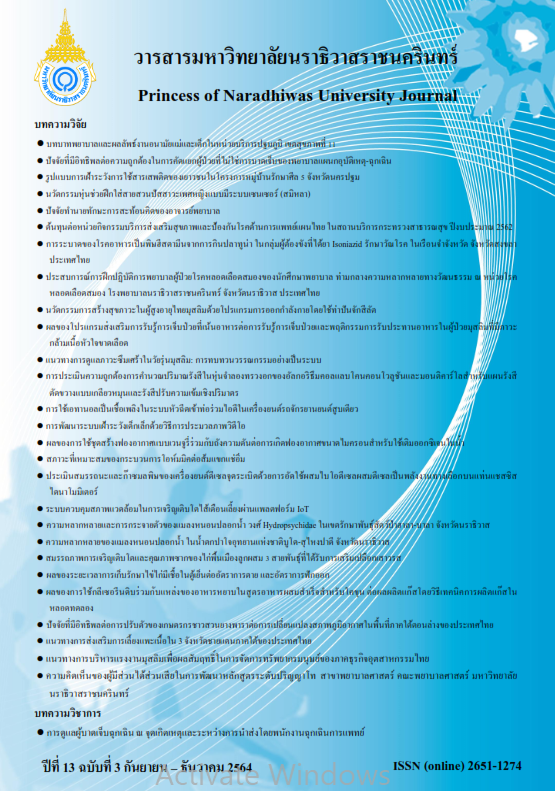
ผลของการใช้กลีเซอรีนดิบร่วมกับแหล่งของอาหารหยาบในสูตรอาหารผสมสำเร็จ สำหรับโคขุน ต่อผลผลิตแก๊สโดยวิธีเทคนิคการผลิตแก๊สในหลอดทดลอง
คำสำคัญ:
กลีเซอรีนดิบ, ผลผลิตแก๊สรวม, แก็สมีเทน, การผลิตแก๊สในหลอดทดลองบทคัดย่อ
การทดลองในครั้งนี้มีวัตถุประสงค์เพื่อศึกษาผลของการใช้กลีเซอรีนดิบร่วมกับแหล่งของอาหารหยาบ 2 แหล่งในสูตรอาหารผสมสำเร็จสำหรับโคขุน ต่อผลผลิตแก๊สสะสมและแก๊สมีเทน ในระบบ in vitro วางแผนการทดลองแบบ 2 x 4 แฟคทอเรียลในแผนการทดลองแบบสุ่มสมบูรณ์ ประกอบด้วย 2 ปัจจัย คือ ปัจจัยที่ 1 แหล่งของอาหารหยาบ คือ ฟางข้าว และหญ้าเนเปียร์ และปัจจัยที่ 2 คือ ระดับกลีเซอรีนดิบที่ระดับ 0, 6, 12 และ 18% ผลการทดลอง พบว่า แหล่งอาหารหยาบร่วมกับกลีเซอรีนดิบ ไม่มีอิทธิพลร่วมกันต่อค่าปริมาณผลผลิตแก๊สสะสมและลักษณะของการผลิตแก๊สของอาหารผสมสำเร็จ ผลการผลิตแก๊สสะสมที่ชั่วโมงต่าง ๆ ปริมาณแก๊สที่ผลิตจากส่วนที่ละลายได้ง่าย (a) ปริมาณแก๊สจากส่วนที่ถูกย่อยสลาย (b) และอัตราการผลิตแก๊ส (c) ของแต่ละกลุ่มทดลองมีค่าแตกต่างกันอย่างไม่มีนัยสำคัญทางสถิติ (P>0.05) โดยผลผลิตแก๊สสะสม ณ ชั่วโมงที่ 72 หลังจากการบ่มของอาหารผสมสำเร็จที่มีฟางข้าวและหญ้าเนเปียร์เป็นแหล่งอาหารหยาบร่วมกับกลีเซอรีนดิบที่ระดับ 0, 6, 12 และ 18% มีค่าเท่ากับ 147.5, 150.3, 145.8, 144.1, 148.2, 146.1, 146.6 และ 145.6 มล./0.5 กรัม (วัตถุแห้ง) ตามลำดับ รวมถึงค่าปริมาณแก๊สมีเทนและคาร์บอนไดออกไซน์ มีค่าใกล้เคียงกันในทุกกลุ่มทดลอง สรุปได้ว่าการใช้กลีเซอรีนดิบในสูตรอาหารที่ระดับสูงสุด 18% ไม่ส่งผลต่อปริมาณผลผลิตแก๊สและแก๊สมีเทน
เอกสารอ้างอิง
AOAC. (1995). Official Method of Analysis. Association of Official Analytical Chemists,Washington, DC, USA.
Avila, J.S, Chaves, A.V, Hernandez-Calva, L.M, Beauchemin, K.A, McGinn, S.M, Wang Y, … McAllister T.A. (2011).
Effects of replacing barley grain in feedlot diets with increasing levels of glycerol on in vitro fermentation and methane production. Animal Feed Science and Technology, 166-167, 265-268.
Blümmel, M., Makkar, H.P.S., & Becker, K. (1997). In vitro gas production: A technique revisited. Journal of Animal Physiology and Animal Nutrition, 77, 24-34.
Chanjula, P., Pakdeechanuan, P., & Wattanasit, S. (2014). Effects of Dietary Crude Glycerin Supplementation on Nutrient Digestibility, Ruminal Fermentation, Blood Metabolites, and Nitrogen Balance of Goats. Asian-Australasian Journal of Animal Sciences, 27, 365-374.
Donkin, S.S., Koser, S.L., White, H.M., Doane, P.H., & Cecava, M.J. (2009). Feeding value of glycerol as a replacement for corn grain in rations fed to lactating dairy cows. Journal of Dairy Science, 92, 5111-5119.
Dozier, W.A., Kerr, B.J., Corzo, A., Kidd, M.T., Weber, E., & Bregendals K. (2008). Apparent metabolism energy of glycerin for broiler. Poultry Science, 87, 317-32.
Ferraro, S.M., Mendoza, G.D., Miranda, L.A., & Gutierrez, C.G. (2009). In vitro gas production and ruminal fermentation of glycerol, propylene glycol and molasses. Animal. Feed Science and Technology, 154, 112-118.
Getachew, G., Robins, P.H., Depeters, E.J., & Taylor, S.J. (2003). Relationships between chemical composition, dry matter degradation and in vitro gas production of several ruminant feed. Animal Feed Science and Technology, 111, 57-71.
Goff, J. P., & Horst, R. L. (2001). Oral glycerol as an aid in the treatment of ketosis/fatty liver complex. Journal of Dairy Science, 84(Suppl. 1), 153-184.
Gunn, P.J., Neary, M.K., Lemenager R.P., & Lake, S.L. (2010). Effects of crude glycerin on performance and carcass characteristics of finishing weather lambs. Journal of Animal Science, 88, 1771-1776.
Kerr, B.J., Weber, T.E., Dozier, W.A., III, & Kidd, M.T. (2009). Digestible and metabolizable energy content of crude glycerin originating from different sources in nursery pigs. Journal of Animal Science, 87, 4042-4049.
Krueger, N.A., Anderson, R.C., Tedeschi, L.O., Callaway, T.R., Edrington, T.S., & Nisbet, D.J. (2010). Evaluation of feeding glycerol on free-fatty acid production and fermentation kinetics of mixed ruminal microbes in vitro. Short communication, Bioresource Technology, 101, 8469-8472.
Lammers, P.J., Kerr, B.J., Weber, T.E., Dozier III, W.A., Kidd, M.T., Bregendahl, K., & Honeyman, M.S. (2007). Digestible and metabolizable energy of crude glycerol for growing pigs. Journal of Animal Science, 86, 602-608.
Lee, S.Y., Lee, S.M., Cho, Y.B., Kam, D.K., Lee, S.C.,Kim, C.H., & Seo, S. (2011). Glycerol as a feed supplement for ruminants: In vitro fermentation characteristics and methane production. Animal Feed Science Technology, 166-167, 269-274.
Lopez, S., & Newbold, C.J. (2007). Chapter1: Analysis of Methane. P.1-13. In: H. P. S. Makkar and P. E. Vercoe (ed), Measuring Methane Production from Ruminantes. Springer, Netherlands.
Makkar, H.P., Blummel, M., & Becker, K. (1995). Formationof complexes between polyvinyl pyrrolidones or polyethylene glycols and tannins, and their implication in gas production and true digestibility in in vitro techniques. British Journal of Nutrition, 73, 897-913.
Meale, S.J., Chaves, A.V., Ding, S., Bush, R.D., & McAllister, T.A. (2013). Effects of crude glycerin supplementation on wool production, feeding behavior, and body condition of Merino ewes. Journal of Animal Science, 91, 878-885.
NRC. (2000). Nutrient Requirements of Beef Cattle: Seventh Revised Edition, National Academies Press, Washington, DC.
Orskov, E.R., & McDonald, I. (1979). The estimation of protein degradability in the rumen from incubation measurements weighted according to rate of passage. The Journal of Agricultural Science, 92, 499.
Parson, G.L., Shelor, M.K., & Drouillard, J.S. (2009). Performance and carcass traits of finishing heifers fed crude glycerin. Journal of Animal Science, 87, 653-657.
Thompson, J.C., & He, B.B. (2006). Characterization of crude glycerin from biodiesel production from multiple feedstocks. Applied Engineering in Agriculture, 22, 261-265.
Van Soest, P.J., Robertson J.B., & Lewis B.A. (1991). Methods for dietary fiber neutral detergent fiber and non-starch polysaccharides in relation to animal nutrition. Journal of Dairy Science, 74, 3583-3597.