
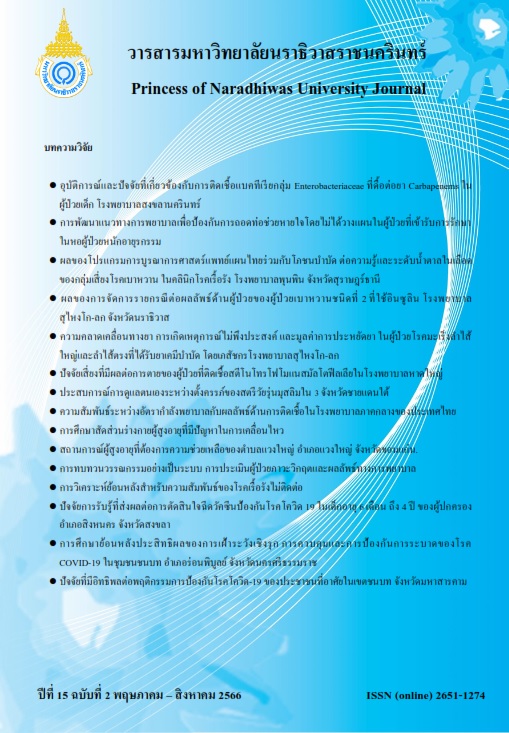
การพัฒนาแนวทางการพยาบาลเพื่อป้องกันการถอดท่อช่วยหายใจโดยไม่ได้วางแผนในผู้ป่วยที่เข้ารับการรักษาในหอผู้ป่วยหนักอายุรกรรม
คำสำคัญ:
การถอดท่อช่วยหายใจโดยไม่ได้วางแผน, แนวทางการพยาบาล, ท่อช่วยหายใจเลื่อนหลุดบทคัดย่อ
การวิจัยและพัฒนาครั้งนี้ เพื่อศึกษาสถานการณ์และสาเหตุของการเกิดท่อช่วยหายใจเลื่อนหลุด พัฒนาเป็นแนวทางการพยาบาล และศึกษาประสิทธิผลของการใช้แนวทางการพยาบาลเพื่อป้องกันการถอดท่อช่วยหายใจโดยไม่ได้วางแผน ในผู้ป่วยที่เข้ารับการรักษาในหอผู้ป่วยหนักอายุรกรรม โรงพยาบาลนราธิวาสราชนครินทร์ ดำเนินการวิจัยเป็น 3 ระยะ คือ ระยะที่ 1 ศึกษาสถานการณ์และสาเหตุของการเกิดอุบัติการณ์การถอดท่อช่วยหายใจโดยไม่ได้วางแผน โดยศึกษาจากเวชระเบียน
ระยะที่ 2 พัฒนาแนวทางการพยาบาล และระยะที่ 3 การประเมินผลการใช้แนวทางการพยาบาลที่พัฒนาขึ้น กลุ่มตัวอย่าง คือ ผู้ป่วยหนักที่ได้รับการใส่ท่อช่วยหายใจทางปาก จำนวน 30 ราย เครื่องมือที่ใช้ คือ แบบประเมินความเสี่ยงต่อการเกิดท่อช่วยหายใจเลื่อนหลุด และแนวทางการพยาบาลที่พัฒนาขึ้นจากระยะที่ 2 วิเคราะห์ข้อมูลโดยใช้สถิติเชิงพรรณนา ผลการศึกษาพบว่าอุบัติการณ์ท่อช่วยหายใจเลื่อนหลุด คิดเป็น 9.54 ครั้งต่อ 1,000 วันใส่ท่อช่วยหายใจ สาเหตุที่ทำให้ท่อช่วยหายใจเลื่อนหลุดคือ ระดับความรู้สึกตัวเปลี่ยนแปลง การผูกยึดข้อมือ และท่อช่วยหายใจไม่ได้มาตรฐาน การพัฒนาแนวทางการพยาบาลเพื่อป้องกันท่อช่วยหายใจเลื่อนหลุด ประกอบด้วยการประเมินความเสี่ยงต่อการเกิดท่อช่วยหายใจเลื่อนหลุด จำนวน 4 ข้อ และการพยาบาลจำนวน 11 ข้อ หลังใช้แนวทางการพยาบาลเพื่อป้องกันการถอดท่อช่วยหายใจโดยไม่ได้วางแผน พบอุบัติการณ์ลดลงเป็น 4.1 ครั้งต่อ 1,000 วันใส่ท่อช่วยหายใจ
ดังนั้น หน่วยงานควรส่งเสริมการใช้แนวทางการพยาบาล เพื่อให้เกิดการพัฒนาคุณภาพการดูแลผู้ป่วยให้ปลอดภัยและมีประสิทธิภาพสูงสุด
เอกสารอ้างอิง
Berkow, L., & Kanowitz, A. (2020). Unplanned extubation: A common and costly complication of airway management. Patient Safety, 3(1), 22-30.
Chaiweeradej, M., Euakit, N., & Uamtani, A. (2013). An adult who has been on a ventilator. Songklanakarin Journal of Nursing, 33(2), 31-46.
Chuthip, P. (2020). The Effect of Nursing Protocol for Prevention of Unplanned Extubation in
Medical Patients, Phattalung Hospital. Journal of Health Research and Innovation, 3(1), 31- 45.
Cui, N., Zhang, Y., Liu, Y., Zhou, Y., Sun, H., & Jin, J. (2021). Protocol for the adaptation of clinical practice guidelines for the management of physical restraints in critically ill patients. Annals of Palliative Medicine, 10(4), 4889-4896.
Dang, D., & Dearholt, S. L. (2019). Johns Hopkins nursing evidence-based practice: Model
and guidelines (Edition 2).
Dejdee, S. & Nukaew, O. (2021). Development and Effects of Empowerment Programs. on self-care behaviors in patients with substance abuse-related psychosis. Journal of Psychiatric Nursing and Mental Health, 35(1), 92-111.
Deming, W.E. (1986). Quality, Productivity and Competitive Position. Cambridge : Center for Advance Engineering, Massachusetts Institute of Technology.
Kato, M., Fauziah, W., Yamashita, T., Nishijima, S., Kima, M., Iida, M., & Pham, H. T. T. (2021). Prevalence and prevention of unplanned removal of tubes and catheters among hospitalized patients. International Journal of Caring Sciences, 14(1), 385.
Krasao, P. (2020). The Effect of Clinical Nursing Practice on the Prevention of Unplanned Endotracheal Extubation in General Medical Wards, Phrae Hospital. Journal of the Phrae Hospital, 28(1). 27-41.
Kimnarak, S., Sukhong, R., Pimdee, Y., & Jaikla, S. (2019). The effectiveness of the use of the nursing practice to prevent unplanned removal of the endotracheal tube intensive care unit Nakhon Pathom Hospital. Journal of Medicine, 38(3), 210-225.
Lapthawee, B. & Thammaraksa, T. (2015). The incidence of unplanned endotracheal tube removal of Patients admitted to hospitals in accident and emergency surgery wards 1, Thammasat Hospital honor. Thammasat University Hospital. (in Thai)
Lin, Y. P., & Wu, M. (2019). The PEST Model: A Quality Improvement Project to Reduce Self-extubation in the Intensive Care Unit. Dimensions of Critical Care Nursing, 38(4), 221-227.
Nakrit, B., Namwongprom, A., & Phakdiwong, N. (2015). Slippage of the tracheal tube. and the time of inserting the machine Rescue breathing in critically ill patients who are cared for using a guideline Evidence-Based Nursing. Kuakarun Journal, 22(1), 129-143.
Na nakorn, N., (2020). Effectiveness of Implementing Clinical Nursing Practice Guidelinesfor Prevention of Unplanned Endotracheal Extubations in Medical Intensive Care Unit, Suratthani Hospital.
Norakhun, S., Namchantra, R. & Binhosen, W. (2016). The effect of the nursing practice guideline on The incidence of endotracheal tube removal Unplanned in intubation patients. Journal of Nursing Cardiovascular Disease , 27(1), 72-83.
Pokathip, S., Salakkhum, P., Suttiprapa, T., Datawee, P., Kwanchang, P., & Sanaphrom, N. Prevalence. (2019). Risk Factor and Nursing Care of Unplanned Extubation. Health Science Journal Boromarajonani College of Nursing, 3(3), 53-67.
Rungruang, W. (2020). Toxicology of Kratom. Journal of Hospital Pharmacy , 30(2), 118-124.
Saengsri, S. (2012). Development and evaluation of nursing practice guidelines for prevention of endotracheal tube removal. Unplanned breathing in the intensive care unit Songkhla Nakarin Hospital[Thesis Master of Nursing degree]. Songkhla: Prince of University. (in Thai)
Salakkham, P., Phokthip, S., Charoensri, P., Wasombat, O., Phumthong, P., Suttason, M., … , K., & Naiyaphat, W.. (2017). Effects of the Nursing Practice Guideline. on the incidence of endotracheal tube dislocation in severely intubated patients. Journal of Nursing and Education , 10(2), 58-70.
Suliman, M. (2018). Prevalence of physical restraint among ventilated intensive care unit patients. Journal of Clinical Nursing, 27, 3490-3496.
Tanios, M., Epstein, S., Grzeskowiak, M., Nguyen, HM., Park, H., & Leo, J. (2014). Influence of sedation strategies on unplanned extubation in a mixed intensive care unit. Journal of Critical Care, 23(4), 306–315.
ไฟล์ประกอบ
เผยแพร่แล้ว
รูปแบบการอ้างอิง
ฉบับ
ประเภทบทความ
สัญญาอนุญาต
ลิขสิทธิ์ (c) 2023 วารสารมหาวิทยาลัยนราธิวาสราชนครินทร์

อนุญาตภายใต้เงื่อนไข Creative Commons Attribution-NonCommercial-NoDerivatives 4.0 International License.