
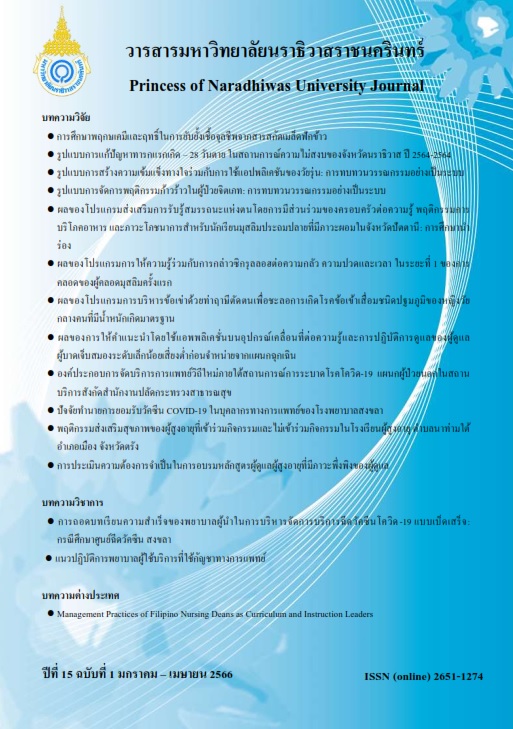
ผลของการให้คำแนะนำโดยใช้แอพพลิเคชั่นบนอุปกรณ์เคลื่อนที่ต่อความรู้และการปฏิบัติการดูแลของผู้ดูแลผู้บาดเจ็บสมองระดับเล็กน้อยเสี่ยงต่ำก่อนจำหน่ายจากแผนกฉุกเฉิน
คำสำคัญ:
การให้คำแนะนำ, แอพพลิเคชั่นบนอุปกรณ์เคลื่อนที่, การปฏิบัติการดูแลของผู้ดูแลผู้บาดเจ็บ, สมองระดับเล็กน้อยเสี่ยงต่ำ แผนกฉุกเฉินบทคัดย่อ
การวิจัยครั้งนี้เป็นการวิจัยกึ่งทดลอง มีวัตถุประสงค์เพื่อศึกษาผลของการให้คำแนะนำโดยใช้แอพพลิเคชั่นบนอุปกรณ์เคลื่อนที่ต่อความรู้และการปฏิบัติการดูแลของผู้ดูแลผู้บาดเจ็บสมองระดับเล็กน้อยเสี่ยงต่ำก่อนจำหน่ายจากแผนกฉุกเฉิน เลือกกลุ่มตัวอย่างแบบเฉพาะเจาะจง จำนวน 50 ราย
แบ่งออกเป็น 2 กลุ่ม กลุ่มละ 25 ราย คือ กลุ่มควบคุมที่ได้รับคำแนะนำตามมาตรฐานปกติและกลุ่มทดลองที่ได้รับคำแนะนำผ่านแอพพลิเคชั่นฯ เครื่องมือที่ใช้ในวิจัย ประกอบด้วย แอพพลิเคชั่นฯ แบบสอบถามความรู้และแบบสอบถามการปฏิบัติการดูแล ได้ค่าความเชื่อมั่นของคูเดอร์ ริชาร์ดสัน 20 เท่ากับ .82 และ .84 ตามลำดับ วิเคราะห์ข้อมูลโดยใช้สถิติบรรยาย สถิติทีคู่ และสถิติทีอิสระ ผลการวิจัย มีดังนี้ 1) คะแนนเฉลี่ยความรู้การดูแลของผู้ดูแลฯ ในกลุ่มทดลองหลังได้รับคำแนะนำโดยใช้แอพพลิเคชั่นฯ สูงกว่าก่อนทดลองอย่างมีนัยสำคัญทางสถิติ (t = 13.52, p < .05) 2) คะแนนเฉลี่ยความรู้การดูแลของผู้ดูแลฯ ในกลุ่มทดลอง สูงกว่ากลุ่มควบคุมอย่างมีนัยสำคัญทางสถิติ (t = 19.90, p < .05) และ 3) และคะแนนเฉลี่ยการปฏิบัติการดูแลหลังการบาดเจ็บ 24 ชั่วโมงของผู้ดูแลฯ ในกลุ่มทดลองสูงกว่ากลุ่มควบคุมที่ได้รับคำแนะนำตามมาตรฐานปกติอย่างมีนัยสำคัญทางสถิติ (t = 15.13, p < .05) ผลการศึกษาแสดงให้เห็นว่าการให้คำแนะนำโดยใช้แอพพลิเคชั่นฯ สามารถทำให้ผู้ดูแลฯ มีความรู้การดูแลผู้ป่วยได้มากขึ้น ดังนั้น พยาบาลจึงควรนำแอพพลิเคชั่นฯ บนอุปกรณ์เคลื่อนที่ไปใช้ในการให้คำแนะนำผู้ดูแลฯ เพื่อให้สามารถนำไปใช้ในการเฝ้าระวังและติดตามอาการและอาการแสดงที่เป็นอันตรายของผู้บาดเจ็บสมองระดับเล็กน้อยเสี่ยงต่ำอย่างต่อเนื่องต่อที่บ้าน
เอกสารอ้างอิง
Armitage, L.C., Kassavou, A., & Sutton, S. (2020) Do mobile device apps designed to support medication adherence demonstrate efficacy? A systematic review of randomised controlled trials, with meta-analysis. British Medical Journal, 10, 1-9.
Benferdia, Y., & Zakaria, N., H. (2014). A systematic literature review of content-based mobile health Journal of Information Systems Research and Innovation.
Brame, C.J. (2015). Effective educational videos. Retrieved Principles and guidelines for maximizing student learning from video content. Life Sciences Education. 15(4). 46-55.
Chaisongmuang, P., & Pearkao, C. (2017). Effects of first aid to sudden cardiac arrest program for high-school students in northeast Thailand. Nursing Journal of the Ministry of Public, 118-132.
Chang, H. Y., Hou, Y. P., Yeh, F. H., & Lee, S. S. (2020). The impact of an mHealth app on knowledge, skills and anxiety about dressing changes: A randomized controlled trial. Journal of advanced nursing, 76(4), 1046–1056.
Dewan, M. C., Rattani, A., Gupta, S., Baticulon, R. E., Hung, Y. C., Punchak, M., … & Park, K. B. (2018). Estimating the global incidence of traumatic brain injury. Journal of neurosurgery, 1-18.
Gagne, R. M. (2005). Principles of instructional design. Wadsworth/Thomson Learning.
Gioia, G., & Collinsin, M. (2006). Acute concussion evaluation care plan. Retrieved from https://www.cdc.gov/headsup/pdfs/providers/ACE_care_plan_ school_version_a.pdf
Hoek, A.E., Anker, S., Van Beeck, E.F., Burdorf, A., Rood, P., & Haagsma, J., A. (2020). Patient discharge Instructions in the emergency department and their effects on comprehension and recall of discharge instructions: A systematic review and meta-analysis. Annals of Emergency Medicine, 75(3), 435–444.
Karinchai, K. (2011). Factors influencing applications downloading for iPhone (Master of Science Program in Innovation and Technology Management). College of Innovation, Thammasat University. Bangkok. (in Thai)
Phuenpathom, N., & Sikitwilaikul, T. (2019). Clinical practice guidelines for traumatic brain Injury. Retrieved from http://www.neurosurgerycmu.com/files/2019/12/GPG-final-2562-compre ssed.pdf
Polit, D.F., & Beck, C.T. (2012). Nursing research, principles and methods. (9th ed.) Philadelphia, Pa., Lippincott Williams & Wilkins. Nursing Practice. (8th Edition). Philadelphia, PA., Lippincott Williams & Wilkins
Samakit, N., & Wannasitorg, A. (2018). Relationships between headache, fatigue, sleep disturbance, and performance in mild head injury patients. Journal of Nursing and Health Care, 34(2), 152–163.
Sanguansin, R. (2018). Caring for head injury patients to specific disease certification (1st). Faculty of medicine Prince of Songkhla university (in thai)
Slater, B.A., Huang, Y., & Dalawari, P. (2017). The impact of teach-back method on retention of key domains of emergency department discharge instructions. The Journal of Emergency Medicine, 53(5), e59–e65.
Somsri, S., Sukonthasarn, A., & Wangsrikhun, S. (2016). Effects of emergency department discharge planning for persons with mild traumatic brain Injury on caregivers’ knowledge and practices. Nursing Journal, 44(1). 86-98.
Suffoletto, B., Akers, A., McGinnis, K.A., Calabria, J., Wiesenfeld, H.C., & Clark, D.B. (2013).
A sex risk reduction text-message program for young adult females discharged from the emergency department. Journal of Adolescent Health, 53(3), 387-393.
Thaweekhoon, R., & Pearkao, C. (2019). Effects of a smartphone application on knowledge discharge outcome among patients with mild traumatic brain injury. Journal of the Royal Thai Army Nurses, 20(2), 272-279.
Theadom, A., Parag, V., Dowell, T., McPherson, K., Starkey, N., Barker-Collo, S., … Feigin V., L. (2016). Persistent problems 1 year after mild traumatic brain injury, a longitudinal population study in New Zealand. The British Journal of General Practice, 66(642), e16-e23.
Utaisang, A., & Pearkao, C. (2016). Factors associated with severity level of post-concussion syndrome in patients with mild traumatic brain injury. Retrieved from https://gsbooks. gs.kku.ac.th/59/ingrc2016/pdf/MMO10.pdf.
ไฟล์ประกอบ
เผยแพร่แล้ว
รูปแบบการอ้างอิง
ฉบับ
ประเภทบทความ
สัญญาอนุญาต
ลิขสิทธิ์ (c) 2023 วารสารมหาวิทยาลัยนราธิวาสราชนครินทร์

อนุญาตภายใต้เงื่อนไข Creative Commons Attribution-NonCommercial-NoDerivatives 4.0 International License.