
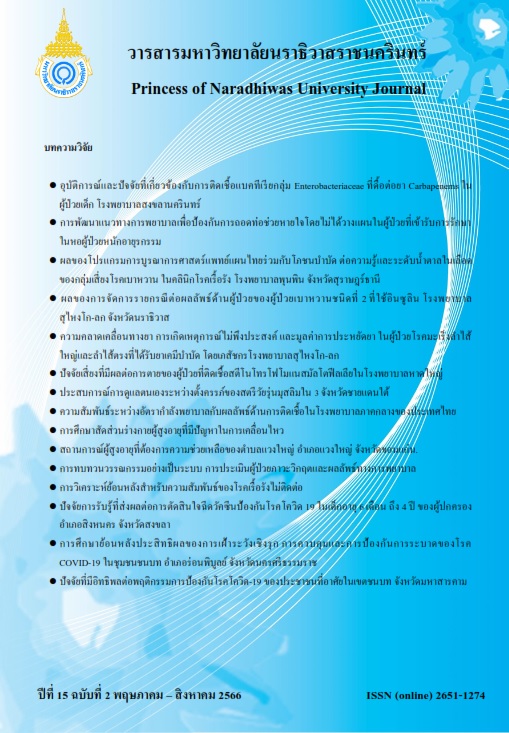
ความคลาดเคลื่อนทางยา การเกิดเหตุการณ์ไม่พึงประสงค์ และมูลค่าการประหยัดยา ในผู้ป่วยโรคมะเร็งลำไส้ใหญ่และลำไส้ตรงที่ได้รับยาเคมีบำบัด โดยเภสัชกรโรงพยาบาลสุไหงโก-ลก
คำสำคัญ:
ยาเคมีบำบัด, ความคลาดเคลื่อนทางยา, เหตุการณ์ไม่พึงประสงค์, มูลค่าการประหยัดยา, การแทรกแซงโดยเภสัชกรบทคัดย่อ
การวิจัยนี้มีวัตถุประสงค์เพื่อศึกษา ชนิด ความถี่ และลักษณะความรุนแรงของความคลาดเคลื่อนทางยา เหตุการณ์ไม่พึงประสงค์ และมูลค่าการประหยัดยาเคมีบำบัดที่ได้จากการแทรกแซงโดยเภสัชกร ในผู้ป่วยมะเร็งลำไส้ใหญ่และลำไส้ตรงที่ได้รับยาเคมีบำบัด การวิจัยนี้เป็นการศึกษา
เชิงพรรณนาแบบตัดขวาง เก็บข้อมูลผู้ป่วยที่ได้ถูกวินิจฉัยว่าเป็นโรคมะเร็งลำไส้ใหญ่และลำไส้ตรง
ที่ได้รับยาเคมีบำบัด ในโรงพยาบาลสุไหงโก-ลก 1 ปี การศึกษาเก็บข้อมูลทั่วไป ข้อมูลความคลาดเคลื่อนทางยา (Medication Error: MEs) โดยใช้เกณฑ์ของ NCC MERP เหตุการณ์ไม่พึงประสงค์ (Adverse Drug Events: ADEs) ตามเกณฑ์ CTCAE version 5.0 และมูลค่าการประหยัดจากความคลาดเคลื่อนทางยาที่ป้องกันได้โดยเภสัชกร
ผลการวิจัย พบว่า ผู้ป่วยมะเร็งลำไส้ใหญ่และลำไส้ตรงที่ได้รับยาเคมีบำบัด จำนวน 20 ราย ส่วนใหญ่ได้รับยาเคมีบำบัด สูตร FOLFOX จากจำนวนใบสั่งยาเคมีบำบัดทั้งหมด 98 ใบ ประกอบด้วยยาเคมีบำบัด 1,225 รายการ พบจำนวน MEs ในใบสั่งยา 35 ใบ (ร้อยละ 35.71) หรือรายการยาเคมีบำบัด 196 รายการ (ร้อยละ 16.00) MEs ส่วนใหญ่พบขั้นตอนสั่งใช้ยามากที่สุด ระดับความรุนแรง MEs พบในระดับ B และ C ในขณะที่ ADEs ส่วนใหญ่ที่พบ คือ คลื่นไส้ (ร้อยละ 46.94) และ อ่อนเพลีย (ร้อยละ 33.67)สำหรับมูลค่าการประหยัดยาเคมีบำบัดจากการแทรกแซงโดยเภสัชกรที่ไม่เกิดการเตรียมยาเกิดขึ้น คิดเป็นมูลค่า 109,086.40 บาท ดังนั้น บทบาทเภสัชกรหน่วยเตรียมยาเคมีบำบัด นอกจากเตรียมยาให้ผู้ป่วย การค้นหา และแก้ไขปัญหา ADEs และ MEs ที่ส่งผลให้ผู้ป่วยได้รับยาเคมีบำบัดอย่างถูกต้อง เหมาะสม ปลอดภัย และสามารถช่วยประหยัดมูลค่ายาเคมีบำบัดที่เกิดจากความคลาดเคลื่อนทางยาจากการสั่งใช้ยา
เอกสารอ้างอิง
Agency for Healthcare Research and Quality. (2001). National coordinating council for medication error reporting and prevention. Retrieved August 9, 2021 from: https://www.nccmerp.org /taxonomy-medication-errors.
Altun, I., & Sonkaya, A. (2018). The most common side effects experienced by patients were eceiving first cycle of chemotherapy. Iran Journal of Public Health, 47(8), 1218-1219.
Ashokkumar, R., Srinivasamurthy, S., Kelly, J. J., Howard, S. C., Parasuraman, S., & Uppugunduri, C. R. (2018). Frequency of chemotherapy medication errors: A systematic review. Journal of Pharmacology and Pharmacotherapeutics, 9(2), 86-91.
Aslam, M. S., Naveed, S., Ahmed, A., Abbas, Z., Gull, I., & Athar, M. A. (2014). Side effects of chemotherapy in cancer patients and evaluation of patients opinion about starvation based differential chemotherapy. Journal of Cancer Therapy, 5(8), 1-6.
Belachew, S. A., Erku, D. A., Mekuria, A. B., & Gebresillassie, B. M. (2016). Pattern of chemotherapy-related adverse effects among adult cancer patients treated at Gondar University Referral Hospital, Ethiopia: A cross-sectional study. Drug, Healthcare and Patient Safety, 8, 83-90.
Bray, F., Ferlay, J., Soerjomataram, I., Siegel, R. L., Torre, L. A., & Jemal, A. (2018). Global cancer statistics 2018: GLOBOCAN estimates of incidence and mortality worldwide for 36 cancers in 185 countries. CA: A Cancer Journal for Clinicians, 68(6), 394–424.
Centers for Disease Control and Prevention. (2021). U.S. cancer statistics data visualizations tool, based on 2021 submission data (1999-2019). Atlanta, GA: U.S. Department of Health and Human Services, Centers for Disease Control and Prevention and National Cancer Institute; Retrieved June 22, 2022 from http://www.cdc.gov/cancer/dataviz.
Chan, H. K., & Ismail, S. (2014). Side effects of chemotherapy among cancer patients in a Malaysian General Hospital: Experiences, perceptions and informational needs from clinical pharmacists. Asian Pacific Journal of Cancer Prevention, 15(13), 5305-5309.
Choorassamee, J. (2019). Medication errors and adverse drug events in patients receiving antineoplastic agents. Thai Journal of Pharmacy Practice, 11(4), 744-753.
Han, J. M., Ah, Y. M., Suh, S. Y., Jung, S. H., Hahn, H. J., Im, S. A., & Lee, J. Y. (2016). Clinical and economic impact of pharmacists’ intervention in a large volume chemotherapy preparation unit. International Journal of Clinical Pharmacy, 38(5), 1124-1132.
Katanyoo, K. (2009). Nausea and vomiting from radiotherapy and chemotherapy. Journal of Thai Society of Therapeutic Radiology and Oncology, 15(1), 73-84.
Karpa, K. D., Lewis, P. R., & Felix, T. M. (2015). Adverse effects of common drugs: General concepts. FP Essentials, 436, 11-16.
Knez, L., Laaksonen, R., & Duggan, C. (2010). Evaluation of clinical interventions made by pharmacists in chemotherapy preparation. Radiology and Oncology, 44(4), 249-256.
Kreethathorn, R., & Praputbut, S. (2021). Prevention system development of chemotherapy medication errors in chemotherapeutic mixing unit in Rajavithi Hospital. Thai Food and Drug Journal, 28(1), 22-34.
National Coordinating Council for Medication Error Report and Prevention [NCC MERP]. [n.d.]. About Medical error. Retrieved August 25, 2022 from http://www.nccmerp.org/ aboutmederro r.htm.
O’Connell, J. B., Maggard, M. A., & Ko, C. Y. (2004). Colon cancer survival rates with the new American Joint Committee on cancer sixth edition staging. Journal of the National Cancer Institute, 96(19), 1420-1425.
Ranchon, F., Salles, G., Späth, H. M., Schwiertz, V., Vantard, N., Parat, S., ... Rioufol, C. (2011). Chemotherapeutic errors in hospitalised cancer patients: Attributable damage and extra costs. BMC Cancer, 11(1), 1-10.
Salehifar, E., Gheibi, S., Janbabaei, G., & Mousavi, K. (2016). Adverse effects of chemotherapy regimens used in colorectal cancer patients in a referral cancer center in North of Iran, 2008-2014. Journal of Pharmaceutical Care, 4(1-2), 9-13.
Saransate, R. (2009). Systematic approach to prevent chemotherapy medication errors in Songklanagarind Hospital. Songklanagarind Medical Journal, 27(5), 415-427.
Thanomsakcharoen, J., Niamhun, N., Sirichanchuen, B., & Chewaskulyong, B. (2021). Medication errors and clinical outcomes in patients receiving chemotherapy at a tertiary hospital: Retrospective descriptive study. Thai Journal of Pharmacy Practice, 13(2), 538-546.
Tungjaroen, D, Rungsiyaphornrat, U, & Phisetkul, C. (2005). Chemotherapy error in cancerous patients. Thai Journal of Hospital Pharmacy, 15, 246-253.
U.S. Department of Health and Human Services. (2017). Common Terminology Criteria for Adverse Events (CTCAE) version 5.0. National Institutes of Health National Cancer Institute. Retrieved August 25, 2022, from https://ctep.cancer.gov/protocoldevelopment/electronic_ applications/docs/CTCAE_v5_Quick_Reference_5x7.pdf.
Vorasin, P., Tangsitchanakul, J., Thongthieang, l., & Subongkot, S. (2021). Clinical outcomes and cost saving of oncology pharmacy interventions on cancer patient care by pharmacists. Isan Journal of Pharmaceutical Sciences, 17(4), 88-97.
Wong, S. W., & Gray, E. S. (1999). Clinical pharmacy services in oncology clinics. Journal of Oncology Pharmacy Practice, 5(1), 49-54.
ไฟล์ประกอบ
เผยแพร่แล้ว
รูปแบบการอ้างอิง
ฉบับ
ประเภทบทความ
สัญญาอนุญาต
ลิขสิทธิ์ (c) 2023 วารสารมหาวิทยาลัยนราธิวาสราชนครินทร์

อนุญาตภายใต้เงื่อนไข Creative Commons Attribution-NonCommercial-NoDerivatives 4.0 International License.