
ปัจจัยที่มีผลต่อระดับของยาฟินัยโทอินในเลือดของเด็กที่เป็นลมชัก: การศึกษาแบบย้อนหลัง
ปวลี เนียมถาวร
คำสำคัญ:
ระดับยาฟินัยโทอิน, เด็ก, ฟินัยโทอิน, โรคลมชักบทคัดย่อ
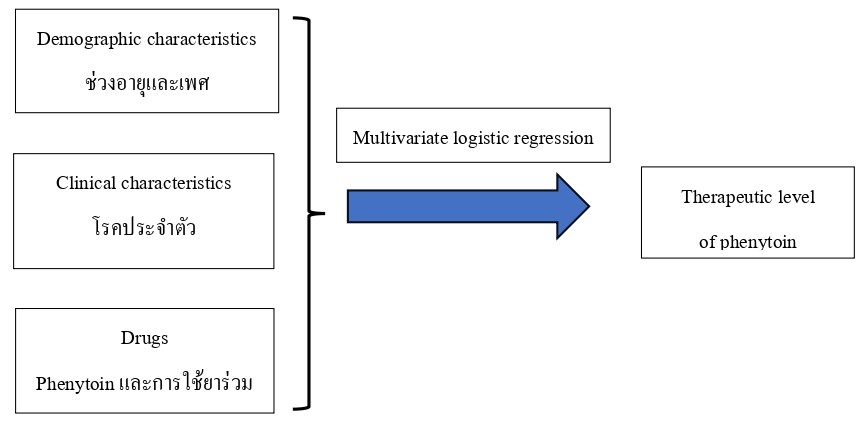
ยา phenytoin เป็นยากันชักที่มีช่วงการรักษาค่อนข้างแคบและในผู้ป่วยเด็กระดับยามักไม่อยู่ในช่วงการรักษาส่งผลต่อการรักษาโรคลมชักจึงมีความจำเป็นอย่างยิ่งในการศึกษาปัจจัยที่อาจส่งผลต่อระดับยาในเลือด งานวิจัยนี้จึงทำขึ้นเพื่อศึกษาปัจจัยที่มีผลต่อระดับยาฟินัยโทอินในเลือดของผู้ป่วยเด็กที่เป็นโรคลมชักอายุ 1 เดือน ถึง 18 ปี ที่ได้รับการเข้ารักษาในที่โรงพยาบาลระดับตติยภูมิแห่งหนึ่งระหว่างปี พ.ศ. 2557 - 2561 เป็นการศึกษาแบบ cross-sectional study โดยเก็บข้อมูลจากฐานข้อมูลอิเล็กทรอนิกส์และวิเคราะห์ความสัมพันธ์ของตัวแปรด้วย Multivariate logistic regression ผลการศึกษามีผู้ป่วยที่ได้รับยาทั้งหมด 275 คน พบว่าผู้ป่วย 59 คนที่ได้รับการตรวจวัดระดับยานับเป็นจำนวนการตรวจวัดระดับยา 107 ครั้ง และพบว่า เพศ กลุ่มอายุ การมีโรคร่วม และการใช้ยาที่มีค่าการจับโปรตีนสูงร่วมมีความสัมพันธ์กับระดับยาในเลือดอย่างมีนัยสำคัญทางสถิติ (p < 0.05) โดยเพศชาย (OR = 1.65) ผู้ป่วยกลุ่มทารก (OR = 2.34) มีโรคร่วม (OR = 144.40) และการใช้ยาที่มีค่าการจับโปรตีนสูงร่วม(OR = 1.28) เป็นปัจจัยที่อาจส่งผลให้ระดับยาไม่อยู่ในช่วงการรักษา อย่างไรก็ตามผู้ป่วยในกลุ่มเด็กเล็กเป็นกลุ่มที่มีระดับยาอยู่ในช่วงการรักษาได้ดี เมื่อเทียบกับกลุ่มวัยรุ่น สรุปได้ว่าปัจจัยที่พึงคำนึงถึงเมื่อสั่งใช้ยาphenytoin ได้แก่ เพศ กลุ่มอายุ โรคร่วม และการใช้ยาที่มีค่าการจับโปรตีนสูงร่วม เพื่อให้การใช้ยา phenytoin ในผู้ป่วยเด็กมีประสิทธิภาพและความปลอดภัย
เอกสารอ้างอิง
Garofalo, E. (2007). Clinical Development of Antiepileptic Drugs for Children. Neurotherapeutics, 4(1), 70 - 74.
Houghton, G.W., Richens, A., & Leighton, M. (1975). Effect of age, height, weight and sex on serum phenytoin concentration in epileptic patients. British Journal of Clinical Pharmacology, 2(3), 251 - 256. DOI:10.1111/j.1365-2125.1975.tb01583.x
Ismail, R., Rahman, A., & Chand, P. (1994). Pharmacokinetics of phenytoin in routine clinic patients in Malaysia. Journal of clinical pharmacy and therapeutics, 19(4), 245 - 248.
Jun, H., Rong, Y., Yih, C., Ho, J., Cheng, W., & Kiang, T. K. (2020). Comparisons of Four Protein-Binding Models Characterizing the Pharmacokinetics of Unbound Phenytoin in Adult Patients Using Non-Linear Mixed-Effects Modeling. Drugs in R&D, 20(4), 343 - 358.
Karaźniewicz-Łada, M., Główka, A.K., Mikulska, A.A., Główka, F.K., (2021). Pharmacokinetic Drug–Drug Interactions among Antiepileptic Drugs, Including CBD, Drugs Used to Treat COVID-19 and Nutrients. International Journal of Molecular Sciences. 22(17), 9582. DOI:10.3390/ijms22179582
Karol, M.D., Locke, C.S., & Cavanaugh, J.H. (1999). Lack of pharmacokinetic interaction between lansoprazole and intravenously administered phenytoin. The Journal of Clinical Pharmacology, 39(12), 1283 - 1289.
Kutt, H. (1975). Interactions of antiepileptic drugs. Epilepsia, 16(2), 393 - 402.
Marano, M., Nicoletti, F., Pro, S., Goffredo, B., Cecchetti, C., Piervincenzi, E., . . . Cocciadiferro, D. (2020). Phenytoin intoxication associated with omeprazole administration in a child with defective CYP2C9. European journal of clinical pharmacology, 76, 731 - 732.
McDaniel, C.E., Jennings, R., Schroeder, A.R., Paciorkowski, N., Hofmann, M., & Leyenaar, J. (2019). Aligning inpatient pediatric research with settings of care: a call to action. Pediatrics, 143(5), e20182648. DOI:10.1542/peds.2018-2648. PMID: 31018987.
Mekloy, L., & Treyaprasert, W. (2022). Population pharmacokinetics of phenytoin in epileptic children and dosage regimens using Monte Carlo simulation. The Thai Journal of Pharmaceutical Sciences, 46(2), 208 - 215.
Methaset, K., Sathirakul, K., Limpisood, S., Kulsirirat, T., Leethochawalit, S., Chulsom, N., . . . Rukthong, P. (2019). Prediction of phenytoin concentration using STELLATM as a pharmacokinetic modeling program. Isan Journal of Pharmaceutical Sciences, 15(2), 44 - 50.
Mir, S.A. (2019). Effect of age and sex on serum phenytoin concentration in epileptic patients: experience from therapeutic drug monitoring. International Journal of Basic & Clinical Pharmacology, 8(8), 1717 – 1721. DOI: 10.18203/2319-2003.ijbcp20193169
Murphy, A., & Wilbur, K. (2003). Phenytoin–Diazepam Interaction. Annals of Pharmacotherapy. 37(5), 659 - 663. DOI:10.1345/aph.1C413
Patsalos, P.N., Spencer, E.P., & Berry, D. J. (2018). Therapeutic Drug Monitoring of Antiepileptic Drugs in Epilepsy: A 2018 Update. Therapeutic Drug Monitoring, 40(5), 526 - 548. DOI:10.1097/ftd.0000000000000546
Paul, H.A., Robinson, J.L., & Sadrzadeh, S.H. (2020). Free versus total phenytoin measurements—a case study of phenytoin toxicity Toxicology Cases for the Clinical and Forensic Laboratory, 131-133, Academic Press.
Rane, A., & Wilson, J.T. (1976). Clinical pharmacokinetics in infants and children. Clinical Pharmacokinetics, 1, 2 - 24. DOI: 10.2165/00003088-197601010-00002. PMID: 1017153.
Srivastava, K., Bhartiya, S., Gavli, V., Patil, R., & Rajadhyaksha, S. (2020). Efficacy, Tolerability and Serum Phenytoin Levels after Intravenous Fosphenytoin Loading Dose in Children with Status Epilepticus. Indian Pediatr, 57(3), 218 - 221.
Stiles-Shields, C., Plevinsky, J. M., Psihogios, A. M., & Holmbeck, G. N. (2020). Considerations and future directions for conducting clinical research with pediatric populations during the COVID-19 pandemic. Journal of Pediatric Psychology, 45(7), 720-724.
Suzuki, Y., Mimaki, T., Cox, S., Koepke, J., & Hayes, J. (1994). Phenytoin Age-Dose-Concentration Relationship in Children. Therapeutic Drug Monitoring, 16(2), 145 - 150.
van Dijkman, S.C., Rauwé, W.M., Danhof, M., & Della Pasqua, O. (2018). Pharmacokinetic interactions and dosing rationale for antiepileptic drugs in adults and children. British Journal of Clinical Pharmacology, 84(1), 97 - 111.
Verrotti, A., Iapadre, G., Di Donato, G., Di Francesco, L., Zagaroli, L., Matricardi, S., . . . Iezzi, M. L. (2019). Pharmacokinetic considerations for anti-epileptic drugs in children. Expert Opinion on Drug Metabolism & Toxicology, 15(3), 199 - 211.DOI:10.1080/17425255.2019.1575361
Wisuttiwong, P. (2007). Pharmacokinetic parameters of phenytoin in Thai epileptic children. Chulalongkorn University. (in Thai).
Wolf, G., McClain, C., Zurakowski, D., Dodson, B., & McManus, M. L. (2006). Total phenytoin concentrations do not accurately predict free phenytoin concentrations in critically ill children. Pediatric Critical Care Medicine, 7(5), 505.
ดาวน์โหลด
เผยแพร่แล้ว
รูปแบบการอ้างอิง
ฉบับ
ประเภทบทความ
สัญญาอนุญาต
ลิขสิทธิ์ (c) 2024 วารสารมหาวิทยาลัยนราธิวาสราชนครินทร์

อนุญาตภายใต้เงื่อนไข Creative Commons Attribution-NonCommercial-NoDerivatives 4.0 International License.