
ผลของโปรแกรมส่งเสริมการจัดการตนเองด้วยการบริการพยาบาลทางไกลในผู้ต้องขัง ที่ติดเชื้อไวรัสตับอักเสบ เรือนจำกลาง จังหวัดอุดรธานี
คำสำคัญ:
การบริการพยาบาลทางไกล, ผู้ต้องขัง, โรคไวรัสตับอักเสบบทคัดย่อ
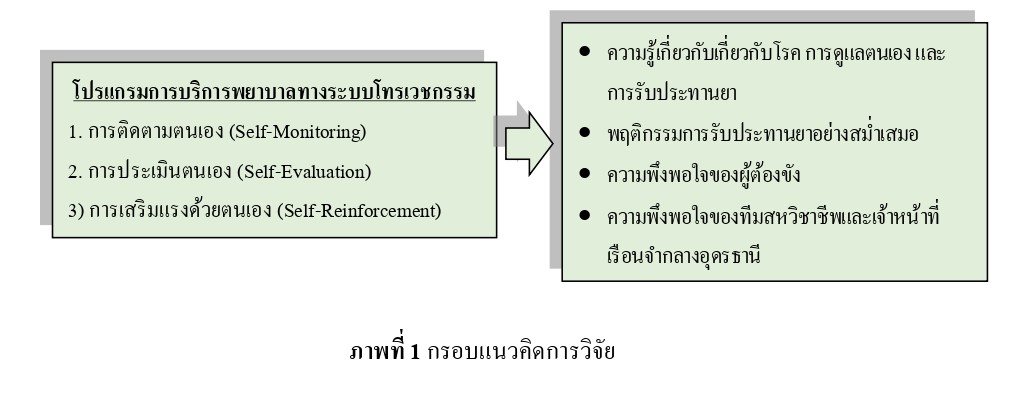
การวิจัยครั้งนี้เป็นการวิจัยกึ่งทดลองกลุ่มเดียวแบบวัดผลก่อนหลัง มีวัตถุประสงค์เพื่อเปรียบเทียบคะแนนเฉลี่ยความรู้และพฤติกรรมการรับประทานยาอย่างสม่ำเสมอของผู้ต้องขังที่ติดเชื้อไวรัสตับอักเสบบีและ / หรือซีระหว่างก่อนและหลังเข้าร่วมโปรแกรม และศึกษาความพึงพอใจของผู้ต้องขัง ทีมสหวิชาชีพและเจ้าหน้าที่เรือนจำกลางอุดรธานีต่อการใช้โปรแกรม กลุ่มตัวอย่างคือ 1) ผู้ต้องขังที่ติดเชื้อไวรัสตับอักเสบบีและ/หรือซี ที่คัดเลือกแบบเจาะจงตามเกณฑ์ที่กำหนดจำนวน 217 ราย และ 2) ทีมสหวิชาชีพและเจ้าหน้าที่เรือนจำกลางอุดรธานี จำนวน 30 ราย เครื่องมือวิจัยประกอบด้วย 1) เครื่องมือที่ใช้ในการทดลอง คือ โปรแกรมส่งเสริมการจัดการตนเองด้วยการบริการพยาบาลทางไกลในผู้ต้องขังที่ติดเชื้อไวรัสตับอักเสบบีและหรือซี และ 2) เครื่องมือที่ใช้รวบรวมข้อมูล คือ แบบสอบถามข้อมูลส่วนบุคคล แบบวัดความรู้ แบบวัดพฤติกรรมการรับประทานยาอย่างสม่ำเสมอ แบบสอบถามความพึงพอใจของผู้ต้องขัง และผู้ให้บริการและทีมสหวิชาชีพ วิเคราะห์ข้อมูลด้วยสถิติพรรณนา และสถิติทดสอบทีแบบจับคู่ ผลการวิจัยพบว่า ภายหลังเข้าร่วมโปรแกรม กลุ่มตัวอย่างมีคะแนนเฉลี่ยความรู้ (mean = 5.03, S.D. = 0.30) และคะแนนเฉลี่ยพฤติกรรมการรับประทานยาอย่างสม่ำเสมอเพิ่มขึ้น (mean = 7.18, S.D. = 0.76) และสูงกว่าก่อนเข้าร่วมโปรแกรมอย่างมีนัยสำคัญทางสถิติ (p < 0.001) นอกจากนี้ยังพบว่าผู้ต้องขัง และทีมสหวิชาชีพและเจ้าหน้าที่เรือนจำกลางอุดรธานี
มีคะแนนความพึงพอใจโดยรวมต่อโปรแกรมในระดับมากที่สุด การวิจัยครั้งนี้แสดงให้เห็นว่าโปรแกรมส่งเสริมการจัดการตนเองด้วยการบริการพยาบาลทางไกลนี้ สามารถส่งเสริมให้ผู้ต้องขังมีความรู้และ
มีพฤติกรรมการรับประทานยาอย่างสม่ำเสมอเพิ่มขึ้น อย่างไรก็ตาม ควรมีการติดตามผลอย่างต่อเนื่อง และนำไปประยุกต์ใช้ในการดูแลผู้ต้องขังที่มีปัญหาสุขภาพอื่น ๆ ในเรือนจำ
เอกสารอ้างอิง
Achenbach, S. J. (2020). Telemedicine: benefits, challenges, and its great potential. Health Law and Policy Brief, 14(1), 2. https://digitalcommons.wcl.american.edu/hlp/vol14/iss1/2
Agastiya, I. M. C., Kurianto, E., Akalili, H., & Wicaksana, A. L. (2022). The impact of telehealth on self-management of patients with type 2 diabetes: A systematic review on interventional studies. Diabetes & Metabolic Syndrome: Clinical Research & Reviews, 16(5), 102485. https://doi.org/10.1016/j.dsx.2022.102485
Alqahtani, S. A., & Colombo, M. (2020). Viral hepatitis as a risk factor for the development of hepatocellular carcinoma. Hepatoma Research, 6(58), 1 - 18. https://www.oaepublish.com/ articles/2394-5079.2020.49
Andersen, R., & Aday, L. A. (1978). Access to medical care in the US: Realized and potential. Medical Care, 16(7), 533 - 546. http://doi.org/10.1097/00005650-197807000-00001
Cox, A. L., El-Sayed, M. H., Kao, J.-H., Lazarus, J. V., Lemoine, M., Lok, A. S., & Zoulim, F. (2020). Progress towards elimination goals for viral hepatitis. Nature Reviews Gastroenterology & Hepatology, 17(9), 533 - 542. http://doi.org/10.1038/s41575-020-0332-6
de Mattos, Â. Z., Debes, J. D., Boonstra, A., Yang, J.-D., Balderramo, D. C., Sartori, G. D., & de Mattos, A. A. (2021). Current impact of viral hepatitis on liver cancer development: The challenge remains. World Journal of Gastroenterology, 27(24), 3556 - 3567. http://doi.org/10. 3748/wjg.v27.i24.3556
Department of Disease Control. (2021, November 12). Disease control, accelerate building of knowledge about “Hepatitis B” is a silent danger that should not be overlooked, Hoping to end it within 9 years. https://ddc.moph.go.th/brc/news.php?news=21693&deptcode=brc& news_views=3235
Division of AIDS and STIs. (2021, July 27). Campaign idea for Hepatitis Day 2021: Hepatitis can't wait. https://www.facebook.com/photo?fbid=2978581039058328& set=pcb.2978582089058223
Flodren, G., Rachas, A., Farmer, A. J., Inzitari, M., & Shepperd, S. (2015, September 7). Interactive telemedicine: effects on professional practice and health care outcomes. Cochranelibrary.
https://www.cochranelibrary.com/cdsr/doi/10.1002/14651858.CD002098.pub2/full#CD002098-abs-0001
Ju, H. H. (2020). Using telehealth for diabetes self-management in underserved populations. The Nurse Practitioner, 45(11), 26-33. http://doi.org/10.1097/01.NPR.0000718492.44183.87
Kanfer, F. H., & Gaelick-Buys, L. (1991). Self-management methods. Pergamon Press.
Ministry of Justice. (2022). Pansuk, 2nd anniversary of the Royal Pansuk, doing good deeds for the nation, religion, and king. B.S.C. Limited.
Mohammed, H. M., & El-sol, A. E. (2020). Tele-nursing: Opportunities for nurses to shape their profession’s future. International Journal of Novel Research in Healthcare and Nursing, 7(3), 660 - 676. https://www.researchgate.net/publication/347927551_Tele-Nursing_ Opportunities_for_Nurses_to_Shape_their_Profession's_Future#full-text
Morisky, D. E., Green, L. W., & Levine, D. M. (1986). Concurrent and predictive validity of a self-reported measure of medication adherence. Medical Care, 24(1), 67 - 74. http://doi.org/10. 1097/00005650-198601000-00007
Negro, F. (2021). Residual risk of liver disease after hepatitis C virus eradication. Journal of Hepatology, 74(4), 952 - 963. http://doi.org/10.1016/j.jhep.2020.11.040
Osorio-Calle, Y. P., SebastiÃ, K. J., & Meneses-La-Riva, M. n. E. (2021). Systematic review: Tele-nursing a universal access to care for oncology patients. Journal of Ners and Midwifery, 8(3), 393 - 400. http://ojs.phb.ac.id/index.php/jnk/article/view/703
Piscesiana, E., & Afriyani, T. (2020). The effect of tele-nursing on preventing re-admission among patients with heart failure: A literature review. International Journal of Nursing and Health Services (IJNHS), 3(2), 251 - 260. https://doi.org/10.35654/ijnhs.v3i2.315
Polit, D. F., Beck, C. T., & Owen, S. V. (2007). Is the CVI an acceptable indicator of content validity? Appraisal and recommendations. Research in Nursing & Health, 30(4), 459 - 467. https://doi.org/10.1002/nur.20199
Razavi, H. (2020). Global epidemiology of viral hepatitis. Gastroenterol Clinics of North American, 49(2), 179 - 189. http://doi.org/10.1016/j.gtc.2020.01.001.
Sriprasert, K., Aungwattana, S., & Tamdee, D. (2023). The effect of a tele-nursing-based self-management program on health behavior of persons with uncontrolled diabetes mellitus in a community. Nursing Journal, 50(3), 99 - 115. https://he02.tci-thaijo.org/index.php/cmunursing /article/view/262506/181139
Tangkitwanit, P., Avihingsanon, A., Hanpariporn, W., Jiewchuephan, K., Lertpiriyasuwat, C., Rosa, D., Chandrathaniwat, K., & Bunwiriya, S. (2021). Digital registration to track testing and treatment of people infected with hepatitis in government hospitals under the Ministry of Public Health. http://www.correct.go.th/infosaraban64/letter/filepdf/ 1621840785.pdf
Tanwandee, T., Piratvisuth, T., Phornphutkul, K., Mairiang, P., Permpikul, P., & Poovorawan, Y. (2006). Risk factors of hepatitis C virus infection in blood donors in Thailand: A multicenter case-control study. Journal of the Medical Association of Thailand, 89(Suppl. 5), S79 - S83. https://www.thaiscience.info/journals/Article/JMAT/10401732.pdf
Tian, E. J., Venugopalan, S., Kumar, S., & Beard, M. (2021). The impacts of and outcomes from telehealth delivered in prisons: A systematic review. PLoS One, 16(5), e0251840. https://doi.org/10.1371/journal.pone.0251840
Wadkar, S. K., Singh, K., Chakravarty, R., & Argade, S. D. (2016). Assessing the reliability of attitude scale by Cronbach's alpha. Journal of Global Communication, 9(2), 113 - 117. http://doi.org/10.5958/0976-2442.2016.00019.7
World Hepatitis Alliance. (2022, May 21). World Hepatitis Summit 2022- Dates announcement. https://www.worldhepatitisalliance.org/news/world-hepatitis-summit-2022-dates-announcement
ดาวน์โหลด
เผยแพร่แล้ว
รูปแบบการอ้างอิง
ฉบับ
ประเภทบทความ
สัญญาอนุญาต
ลิขสิทธิ์ (c) 2024 วารสารมหาวิทยาลัยนราธิวาสราชนครินทร์

อนุญาตภายใต้เงื่อนไข Creative Commons Attribution-NonCommercial-NoDerivatives 4.0 International License.