
ความอยู่ดีมีสุขและปัจจัยที่สัมพันธ์กับความอยู่ดีมีสุขของผู้สูงอายุ ในครอบครัวข้ามรุ่นในชนบทอีสาน
คำสำคัญ:
ความอยู่ดีมีสุข, ผู้สูงอายุ, ครอบครัวข้ามรุ่นบทคัดย่อ
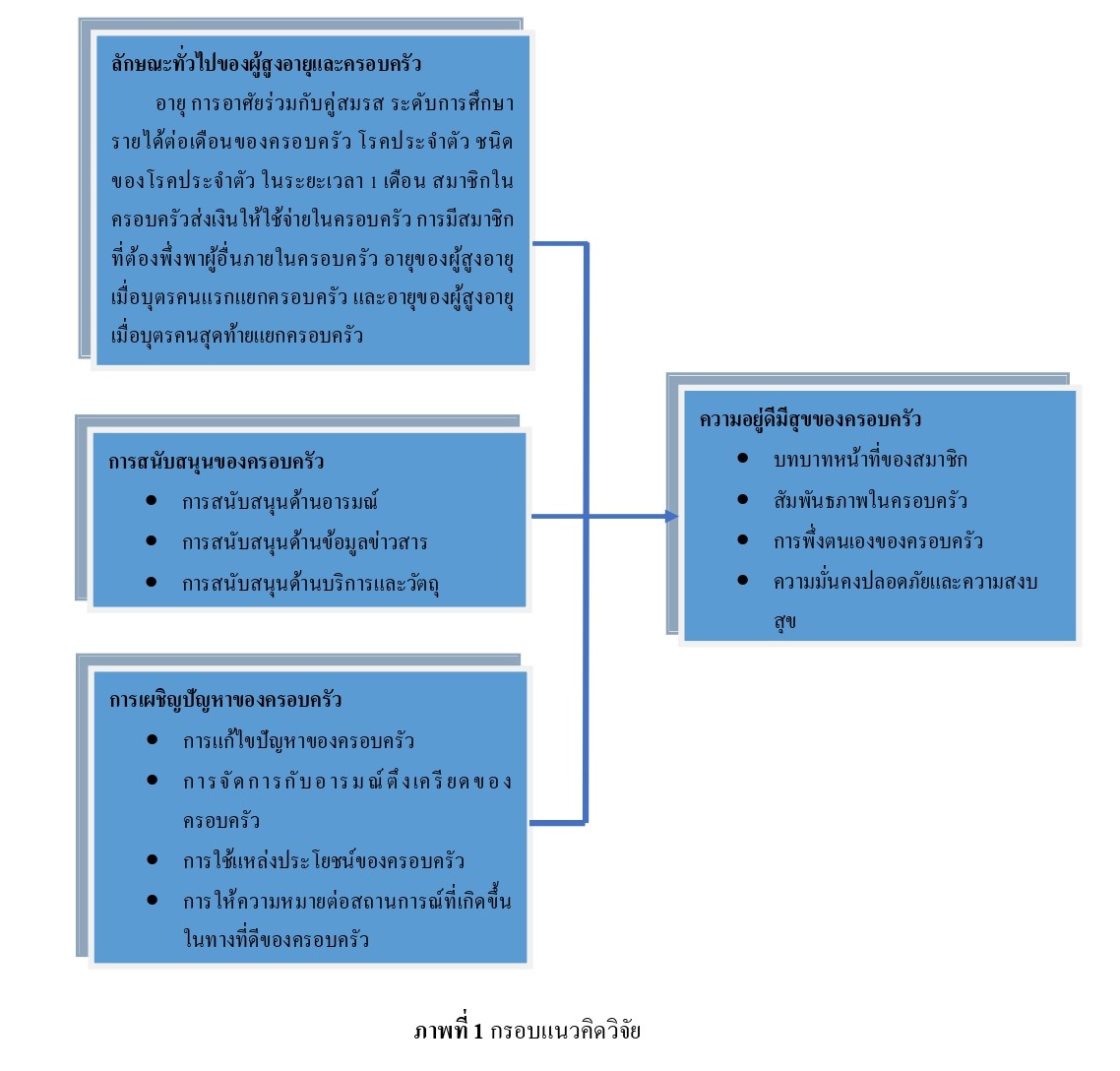
การวิจัยครั้งนี้เป็นการศึกษาเชิงพรรณนาแบบวิเคราะห์ (Analytical descriptive study)
มีวัตถุประสงค์เพื่อศึกษาความอยู่ดีมีสุขและปัจจัยที่สัมพันธ์กับความอยู่ดีมีสุขของผู้สูงอายุในครอบครัวข้ามรุ่น จังหวัดมหาสารคาม กลุ่มตัวอย่าง คือ ผู้ที่มีอายุตั้งแต่ 60 ปีขึ้นไป ที่อาศัยกับครอบครัวในจังหวัดมหาสารคาม จำนวน 330 ราย คัดเลือกโดยวิธีการสุ่มอย่างเป็นระบบ เครื่องมือวิจัย ประกอบด้วย
1) แบบบันทึกข้อมูลทั่วไปของผู้สูงอายุและครอบครัว 2) แบบวัดการสนับสนุนของครอบครัว
(CVI = 0.82, Cronbach’s alpha coefficient = 0.96) 3) แบบวัดการเผชิญปัญหาของครอบครัว
(CVI = 0.93, Cronbach’s alpha coefficient = 0.90) และ 4) แบบวัดความอยู่ดีมีสุขของครอบครัว (CVI = 0.98, KR-20 = 0.94) วิเคราะห์ข้อมูลด้วยสถิติพรรณนาและสถิติวิเคราะห์แบบตัวแปรพหุ กำหนดระดับนัยสำคัญทางสถิติที่ 0.05 ผลการวิจัย พบว่า ความอยู่ดีมีสุขของผู้สูงอายุในครอบครัวข้ามรุ่นโดยรวมอยู่ในระดับสูง (ร้อยละ 98.18, 95 % CI = 96.26 – 99.26) โดยพบว่า ผู้สูงอายุที่ได้รับการสนับสนุนจากครอบครัวในระดับสูง (AOR = 2.41; 95 % CI = 1.27 - 3.06) และมีการเผชิญปัญหาของครอบครัวที่ดี (AOR = 1.22 95 % CI = 1.01 – 2.05) เป็นปัจจัยส่งเสริมความอยู่ดีมีสุขของผู้สูงอายุในครอบครัวข้ามรุ่นอย่างมีนัยสำคัญทางสถิติ อย่างไรก็ตามไม่พบความสัมพันธ์ของลักษณะทั่วไปของผู้สูงอายุและครอบครัวกับความอยู่ดีมีสุข การศึกษาครั้งนี้ได้แสดงให้เห็นถึงความสำคัญของการที่ผู้สูงอายุที่ได้รับการสนับสนุนจากครอบครัวและการเผชิญปัญหาที่มีประสิทธิภาพเป็นสิ่งที่เสริมสร้างความอยู่ดีมีสุขของผู้สูงอายุในครอบครัว ข้อมูลเหล่านี้สามารถนำไปใช้ในการวางแผนและพัฒนานโยบายเพื่อการพยาบาล การส่งเสริมสุขภาพและคุณภาพชีวิตของผู้สูงอายุในชุมชนต่อไป
เอกสารอ้างอิง
Abramson, J. H. (2011). WinPepi updated: Computer programs for epidemiologists and their teaching potential. Epidemiologic Perspectives & Innovations, 8(1), 1 - 9. https://epi-perspectives. biomedcentral.com/articles/10.1186/1742-5573-8-1
An, U., Park, H. G., Han, D. E., & Kim, Y. H. (2022). Emotional Suppression and Psychological Well-Being in Marriage: The Role of Regulatory Focus and Spousal Behavior. International journal of environmental research and public health, 19(2), 973. https://doi.org/10.3390 /ijerph19020973
Dahlberg, L., McKee, K. J., Frank, A., & Naseer, M. (2022). A systematic review of longitudinal risk factors for loneliness in older adults. Aging & Mental Health, 26(2), 225 - 249. https://doi. org/10.1080/13607863.2020.1746747
Dolbin-MacNab, M. L., & Yancura, L. A. (2018). International Perspectives on Grandparents Raising Grandchildren: Contextual Considerations for Advancing Global Discourse. International journal of aging & human development, 86(1), 3 – 33. https://doi.org/10.1177/00914150166 89565
Ermer, A. E., & Proulx, C. M. (2020). Social support and well-being among older adult married couples: A dyadic perspective. Journal of Social and Personal Relationships, 37(4), 1073 -1091. https://doi.org/10.1177/0265407520907145
Friedman, M. M. (1998). Family nursing: Research, Theory, & Practice (5th ed.). Prentice Hall.
Fu, L., Wang, Y., & He, L. (2020). Factors Associated with the Psychological Health of Caregiving Older Parents and Support from Their Grown Children: Results from the China Health and Retirement Longitudinal Study. International journal of environmental research and public health, 17(2), 556. https://doi.org/10.3390/ijerph17020556
Garatachea, N., Molinero, O., Martínez-García, R., Jiménez-Jiménez, R., González-Gallego, J., & Márquez, S. (2009). Feelings of wellbeing in elderly people: relationship to physical activity and physical function. Archives of gerontology and geriatrics, 48(3), 306 – 312. https://doi.org/ 10.1016/j.archger.2008.02.010
Gwenzi, G. D. (2023). A study on family meanings. In Rethinking the meaning of family for adolescents and youth in Zimbabwe’s child welfare institutions. Springer International Publishing.
Hongthai, K., & Jongudomkarn, D. (2020). Older person who raising teenage grandchildren in the present age. Journal of Nursing Science & Health, 43(4), 97 - 109. https://he01.tci-thaijo.org/ index.php/nah /article/view/244530
Hongthai, K., & Jongudomkarn, D. (2021). A phenomenological study on older persons as a breadwinner of A skipped-generation family: day by day coping journey in Thai context. International journal of qualitative studies on health and well-being, 16(1), 1967260. https://doi.org/10.1080/ 17482631.2021.1967260
House, J. S. (1987). Social support and social structure. Sociological Forum, 2(1), 135 - 146. https://doi.org/10.1007/BF01112940
Ingersoll-Dayton, B., Tangchonlatip, K., & Punpuing, S. (2020). A confluence of worries: Grandparents in skipped-generation households in Thailand. Journal of Family Issues, 41(2), 135 - 157. https://doi.org/10.1177/0192513X19878897
Jongudomkarn, D., Phuphaibul, R., Kamhom, R., & Dejakupatra, C. (2017). Thai families’ perceptions of family well-being: A qualitative study. Journal of Nursing Science and Health, 40(1), 14-29. https://doi.org/10.14456/jnsh.2017.4
Jongudomkarn, D., Phuphaibul, R., & Neamsup, T. (2019). Isan family well-being: Suffering and happiness on poverty. Journal of Nursing Science & Health, 42 (2), 62 – 73. http://he01.tci- thaijo.org/index.php/nah/article/view/244530
Kapur, R. (2022). Understanding the meaning and significance of family. Indian Journal of Social Science and Literature, 1(4), 34 - 39. https://doi.org/10.54105/ijssl.B1094.061422
Kim, E. S., Delaney, S. W., Tay, L., Chen, Y., Diener, E. D., & Vanderweele, T. J. (2021). Life satisfaction and subsequent physical, behavioral, and psychosocial health in older adults. The Milbank Quarterly, 99(1), 209 - 239. https://doi.org/10.1111/1468-0009.12514
Kumhom, R., Portawin, T., & Phuphaibul, R. (2020). Thai Family Well-being Based on Family Life Cycle: South RegionofThailand. Journal of Social Work, 28(2), 24 - 59. https://so04.tci-thaijo.org/index.php/swjournal/article/view/240115
Mc Cubbin, H. I., Balling, K., Possin, P., Frierdich, S., & Bryne, B. (2002). Family resiliency in childhood cancer. Family Relations, 51, 103 - 111. https://doi.org/10.1111/j.1741-3729.2002. 00103.x
Photichai, P., & Luvira, V. (2022). Family types and parenting styles for infants in Khon Kaen Province. Journal of Education and Health Promotion, 11(1), 319. https://doi.org/10.4103/ jehp.jehp_691_21
Photichai, P., & Luvira, V. (2023). The impact of a skipped-generation family structure on early child development in Khon Kaen Province: A prospective cohort study. Scientific Reports, 13(1), 16897. https://doi.org/10.1038/s41598-023-41821-5
Phuphaibul, R., Kumhom, R., Jongudomkarn, D., Wacharasin, C., Neamsup, T., & Dachakup, J. (2019). Integrative Thai family study based on family life cycle. Putcharaporn Putamonton Nachonpratum.
Punpuing, S., Ingersoll-Dayton, B., Tangchonlatip, K., & Hutaphad, W. (2022). Psychological functioning and living arrangements among older Thai people. Journal of Population Ageing, 15(1), 193 - 216. https://doi.org/10.1007/s12062-021-09353-0
Samutachak, B., Kamsuwan, K., & Nitnara, P. (2018, May 5). Caring for fragile families in situations of changing demographic and social structures: a complete research report. Thailand Science Research and Innovation. https://www.dl.parliament. go.th/handle/20.500.13072/ 563856
Samutachak, B., Kanchanachitra, M., Rittirong, J., & Katwongsa, P. (2016, February 23) The well-being of Thai families: a complete research report. Thailand Science Research and Innovation. https://ipsr.mahidol.ac.th/wp-content/uploads/2022/03/Report-File-555.pdf
Settersten, R. A. (2017). Some Things I Have Learned About Aging by Studying the Life Course. Innovation in aging, 1(2), igx014. https://doi.org/10.1093/geroni/igx014
Silverstein, M., & Giarrusso, R. (2010). Aging and Family Life: A Decade Review. Journal of marriage and the family, 72(5), 1039 – 1058. https://doi.org/10.1111/j.1741-3737.2010.007 49.x
Spitzer, N., Segel-Karpas, D., & Palgi, Y. (2022). Close social relationships and loneliness: the role of subjective age. International psychogeriatrics, 34(7), 651 – 655. https://doi.org/10.1017/ S10416102 19001790
Somboon, S., Somanusorn, S., & Sumgern, C. (2018). Factors related to healthy aging among elderly. Kuakarun Journal of Nursing, 25(1), 141 – 153. https://he01.tci-thaijo.org/index.php /kcn/article/view/131929
Sürücü, L., & Maslakci, A. (2020). Validity and reliability in quantitative research. Business &Management Studies: An International Journal, 8(3), 2694 - 2726. http://dx.doi.org/10. 15295/bmij.v8i3.1540
Tangchonlatip, K., Ingersoll-Dayton, B., & Punpuing, S. (2021). Conflict in skipped generation households in Thailand. The International Journal of Aging and Human Development, 92(1), 3 - 21. https://doi.org/10.1177/0091415020918923
Thanakwang, K. (2015). Family support, anticipated support, negative interaction, and psychological well-being of older parents in Thailand. Psychogeriatrics: the official journal of the Japanese Psychogeriatric Society, 15(3), 171 – 178. https://doi.org/10.1111/psyg.12107
Thonglor, R., Nakamura, K., & Seino, K. (2022). Sociodemographic characteristics and functional health among Thai older adults in skipped generation households. Health & Social Care in the Community, 30(6), e5213-e5222. https://doi.org/10.1111/hsc.13809
Xie, H., & Lu, S. (2022). The association between physical performance and subjective wellbeing in Chinese older adults: A cross-sectional study. Frontiers in public health, 10, 965460. https://doi.org/10.3389/fpubh.2022.965460
Yancura, L. A., Piper, J. L., Wallace, H. S., & Berry, A. A. (2020). How does research inform work with multigenerational and skipped generation households in rural areas? In Forum for Family and Consumer Issues, 23(1), 1 - 15. https://www.theforumjournal.org/2021/03/01 /how-does-research-inform-work-with-multigenerational-and-skipped-generation-households -in-rural-areas/
Yang, J., Li, Z., Zhang, J., & Zang, Z. (2024). The impact of basic pension for urban and rural residents on the subjective well-being of the older adult in Chinese rural areas. Frontiers in public health, 12, 1394688. https://doi.org/10.3389/fpubh.2024.1394688
ดาวน์โหลด
เผยแพร่แล้ว
รูปแบบการอ้างอิง
ฉบับ
ประเภทบทความ
สัญญาอนุญาต
ลิขสิทธิ์ (c) 2024 วารสารมหาวิทยาลัยนราธิวาสราชนครินทร์

อนุญาตภายใต้เงื่อนไข Creative Commons Attribution-NonCommercial-NoDerivatives 4.0 International License.