ผลของการให้คำปรึกษากลุ่มแบบเสริมสร้างแรงจูงใจต่อการรับรู้ความสามารถแห่งตนและการเลิกสูบบุหรี่ของผู้ป่วยโรคจิตจากสารเสพติด
คำสำคัญ:
การให้คำปรึกษากลุ่มเสริมสร้างแรงจูงใจ, การรับรู้ความสามารถแห่งตน, การเลิกบุหรี่, ผู้ป่วยโรคจิตจากสารเสพติดบทคัดย่อ
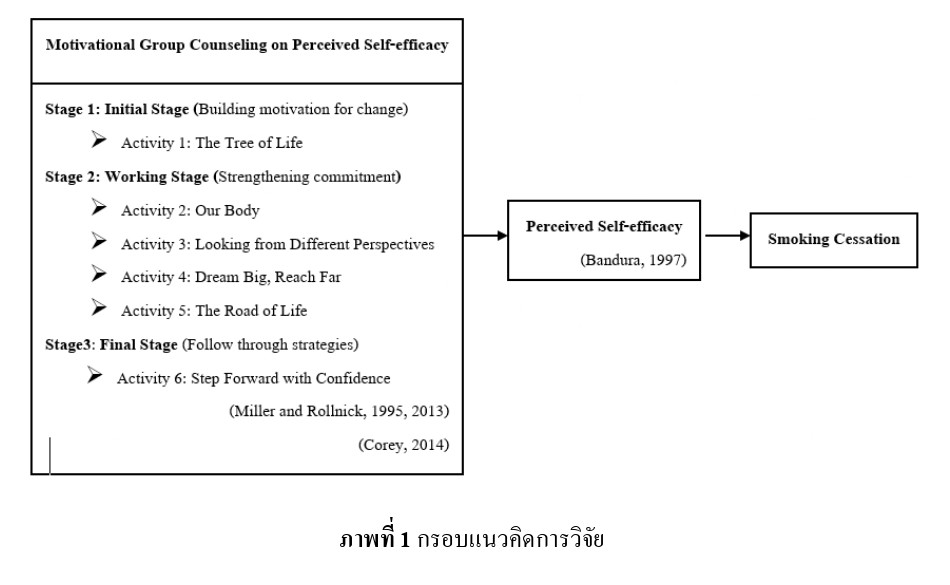
การวิจัยกึ่งทดลอง มีวัตถุประสงค์เพื่อเปรียบเทียบระดับคะแนนการรับรู้ความสามารถแห่งตนในการเลิกสูบบุหรี่และสัดส่วนจำนวนผู้เลิกสูบบุหรี่ ระหว่างกลุ่มทดลองและกลุ่มควบคุม กลุ่มตัวอย่าง คือ ผู้ป่วยโรคจิตจากสารเสพติดและมีโรคร่วมติดบุหรี่ จำนวน 30 คน จับคู่รายบุคคล (Matched subjects) เข้ากลุ่มควบคุมและกลุ่มทดลอง กลุ่มละ 15 คน กลุ่มควบคุมได้รับการดูแลแบบปกติ และกลุ่มทดลองได้รับการดูแลแบบปกติร่วมกับการให้คำปรึกษาแบบเสริมสร้างแรงจูงใจในการเลิกบุหรี่ เครื่องมือที่ใช้ในการวิจัย ประกอบด้วย 1)โปรแกรมการให้คำปรึกษาแบบเสริมสร้างแรงจูงใจในการเลิกบุหรี่ 2) แบบสอบถามข้อมูลทั่วไป 3) แบบประเมินการรับรู้ความสามารถแห่งตนในการเลิกบุหรี่ มีค่าความเที่ยงตรงตามเนื้อหา เท่ากับ 0.67 - 1.00 และค่าสัมประสิทธิ์แอลฟาของครอนบาค เท่ากับ .84 และ 4) แบบสอบถามเกี่ยวกับการเลิกบุหรี่ วิเคราะห์ข้อมูลสถิติเชิงพรรณนา เปรียบเทียบข้อมูลด้วย สถิติ paired t-test สถิติ independent t-test และสถิติ fisher’s exact test
ผลการวิจัย พบว่ากลุ่มทดลอง มีค่าเฉลี่ยคะแนนการรับรู้ความสามารถแห่งตนในการเลิกสูบบุหรี่หลังให้คำปรึกษากลุ่มสูงกว่ากลุ่มควบคุมอย่างมีนัยสำคัญทางสถิติ (p < .05) เมื่อเปรียบเทียบภายในกลุ่มทดลอง พบว่าค่าเฉลี่ยคะแนนการรับรู้ความสามารถแห่งตนในการเลิกสูบบุหรี่ หลังทดลองสูงกว่าก่อนทดลองอย่างมีนัยสำคัญทางสถิติ (p < .001) และระยะติดตาม 1 เดือนสัดส่วนจำนวนผู้เลิกบุหรี่ในกลุ่มทดลองมีสัดส่วนจำนวนผู้เลิกสูบบุหรี่ สูงกว่ากลุ่มควบคุมอย่างมีนัยสำคัญทางสถิติ
(p < .05)
เอกสารอ้างอิง
Bandura, A. (1997). Self-Efficacy: The Exercise of Control. W.H. Freeman and Company.
Bentley, T.G.K., D’Andrea-Penna, G., Rakic, M., Arce, N., LaFaille, M., Berman, R., Cooley, K., & Sprimont, P. (2023). Breathing Practices for Stress and Anxiety Reduction: Conceptual Framework of Implementation Guidelines Based on a Systematic Review of the Published Literature. Brain Sciences, 13, 1612. https://doi.org/10.3390/ brainsci13121612
Booniam, S., Kingkan, K., Kanenok, S., & Kansai, P. (2024). Prevalence and Factors Associated with Nicotine Dependence in Schizophrenic Patients at Sukhothai Hospital. Academic Psychiatry and Psychology Journal, 40(2), 1 - 12. https://he01.tci-thaijo.org/index.php/APPJ/article /view/ 270543/183794
Campion, J., Johnston, G., Shiers, D., & Chew-Graham, C. (2023). Why should we prioritise smoking cessation for people with mental health conditions? Journal of General Practice, 73(731), 251 - 253. https://doi.org/10.3399/bjgp23X732921
Chaibubpha, J., Hengudomsub, P., & Vatanasin, D. (2018). The Effects of Motivational Enhancement Program on Smoking Cessation of Perceived Self-Efficacy and Behaviors Among Male Clients. The journal of faculty of Nursing Burapha University, 26(4), 10 - 20. https://ojs.lib.buu.ac.th/index.php/nursing/article/view/5710
Corey, G. (2014). Theory and practice of group counseling (9th ed.). Tomson Brooks/Cole.
Gallus, S., Cresci, C., Rigamonti, V., Lugo, A., Bagnardi, V., Fanucchi, T., Cirone, D., Ciaccheri., A., & Cardellicchio, S. (2023). Self-efficacy in predicting smoking cessation: A prospective study in Italy. Tobacco Prevention & Cessation, 9(April), 15. https://doi.org/10.18332/tpc/162942
ICD 10 Data.com. (2025). ICD-10-CM Codes. https://www.icd10data.com/ICD10CM/Codes
Johnston, J., Xia, J., Kristina Yau, M.T., Ching-Chieh Wang, J., Chizimuzo, T.C., & Khara, M. (2021). The Impact of Psychiatric Disorder Diagnosis on Motivation to Quit and Stage of Change Among Patients at a Hospital-Based Outpatient Smoking Cessation Clinic. Journal of Dual Diagnosis, 17(2), 113- 123. https://doi.org/10.1080/15504263.2021.1881684.
Kotana, P., Keadmongkol, P., Rawiworrakul, T., & Amnatsatsue, K. (2022). Effects of a self-efficacy enhancement program on smoking cessation behaviors of patients at risk of cardiovascular diseases. Journal of Public Health Nursing, 36(1), 1 - 15. https://he01.tci-thaijo.org/index.php /phn/article/view/253118
Lien, L., Bolstad, I., & Bramness, J.G. (2021). Smoking among inpatients in treatment for substance use disorders: prevalence and effect on mental health and quality of life. BMC Psychiatry, 21(244), 1 - 9. https://doi.org/10.1186/s12888-021-03252-9
Maia, B.M., Martins, P.M., & Figueiredo-Braga, M. (2025). Outcomes and Challenges of Motivational Interviewing in Dual Diagnosis Treatment—A Systematic Review. Journal of Dual Diagnosis, 21(1), 56 – 69. https://doi.org/10.1080/15504263.2024.2434218
Makmai, W., Preechawong, S., & Treenai, S. (2019). Effect of Promoting Smoking Cessation Program for Parents to Reduce Secondhand Smoke Exposure in Pediatric Patients with Asthma. Nursing Journal, 46(2), 59 - 69. https://he02.tci-thaijo.org/index.php/cmunursing/ article/view/197104
Miller, W.R., & Rollnick, S. (1995). Motivational enhancement therapy with drug abusers.
Department of Psychology and Center on Alcoholism, Substance Abuse, and Addictions (CASAA). The University of New Mexico.
Miller, W.R., & Rollnick, S. (2013). Motivational interviewing: Helping people change (3rded.). Guilford Press.
Nerikool, W., & Urthis, P. (2017). Effects of Behavioral Change Counseling Integrated with Exercise Intervention on Cigarette Craving and Smoking Behavior of Schizophrenic with Nicotine Dependence Patients. The Journal of Psychiatric Nursing and Mental Health, 31(3), 84 - 96. https://he02.tci-thaijo.org/index.php/JPNMH/article/view/110112.
Plever, S., Kisely, S.R., Bonevski, B., Siskind, D., Guillaumier, A., McCarter, K., & Gartner, C.E. (2024). Interventions for smoking cessation in inpatient psychiatry settings. Cochrane Database of Systematic Reviews. https://doi:10.1002/14651858.CD015934.
Polit, D.F., & Beck, C.T. (2006). The Content Validity Index: Are You Sure You Know What's Being Reported? Critique and Recommendations. Research in Nursing & Health, 29, 489 - 497. https://doi.org/10.1002/nur.20147
Rajani, N.B., Mastellos, N., & Filippidis, F.T. (2021). Self-Efficacy and Motivation to Quit of Smokers Seeking to Quit: Quantitative Assessment of Smoking Cessation Mobile Apps. JMIR mHealth uHealth, 9(4), e25030. https://doi:10.2196/25030
Saengcharnchai, P. (2022). Handbook of Addiction Psychiatry. Thai Society for Addiction Psychiatry.
Sanitwong Na Ayuttaya, K., Phuphet, K., Tejavanija, N., & Wannawilai, P. (2020). Factors Related to Smoking Behaviors among Psychiatric Inpatients: A Study from Songkhla Ratchanakarindra Psychiatric Hospital. The Southern College Network Journal of Nursing and Public Health, 7(1), 126 - 140. https://he01.tci-thaijo.org/index.php/scnet/article/view/221542/161952
Songkhla Ratchanakarindra Psychiatric Hospital. (2024). Statistics of patients diagnosed with diseases according to ICD10 criteria: F10.5-F19.5, fiscal year 2021-2023. Author.
Wadkar, S.K., Singh, K., Chakravarty, R., & Argade, S.D. (2016). Assessing the reliability of attitude scale by Cronbach's alpha. Journal of Global Communication, 9(2), 113 - 117. http://doi.org/ 10.5958/0976-2442.2016.00019.7
World Health Organization. (2023). WHO report on the global tobacco epidemic, 2023: Protect people from tobacco smoke. https://iris.who.int/bitstream/handle/10665/372043/97892400 77164-eng.pdf
Yang, X., Zhang, L., Lin, H., Lin, H., Cao, W., & Chang, C. (2023). Psychiatric symptoms and intentions to quit smoking: How regularity and volume of cigarette consumption moderate the relationship. Tobacco Induced Diseases, 21(June), 78. https://doi.org/10.18332/tid/163258
ไฟล์ประกอบ
เผยแพร่แล้ว
รูปแบบการอ้างอิง
ฉบับ
ประเภทบทความ
สัญญาอนุญาต
ลิขสิทธิ์ (c) 2025 วารสารมหาวิทยาลัยนราธิวาสราชนครินทร์

อนุญาตภายใต้เงื่อนไข Creative Commons Attribution-NonCommercial-NoDerivatives 4.0 International License.