
ปัจจัยแรงจูงใจในการป้องกันโรคที่มีอิทธิพลต่อการรับบริการฉีดวัคซีนป้องกันโรคโควิด - 19 เข็มกระตุ้นในผู้สูงอายุที่ป่วยโรคเรื้อรัง ในเขตภาคตะวันออกเฉียงเหนือ ประเทศไทย
คำสำคัญ:
แรงจูงใจ, วัคซีนโควิด - 19 เข็มกระตุ้น, ผู้สูงอายุบทคัดย่อ
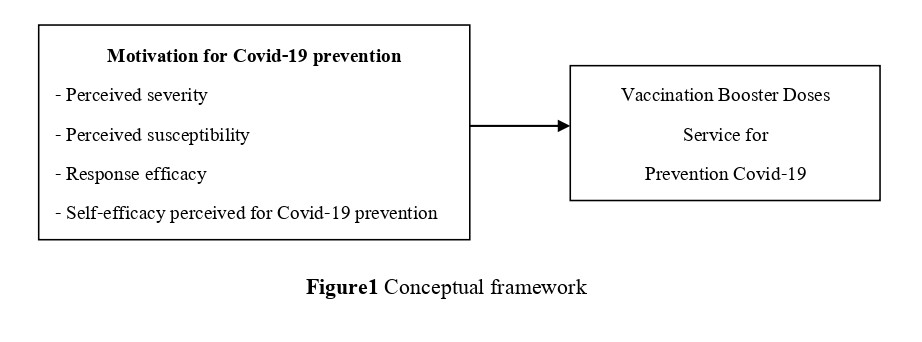
ความเป็นมาและวัตถุประสงค์ โรคติดเชื้อไวรัสโคโรนา 2019 (โควิด - 19) ซึ่งมีอัตราการแพร่ระบาดและอัตราการเสียชีวิตในระดับสูง ได้กลายเป็นประเด็นท้าทายด้านสาธารณสุขและสังคมที่สำคัญในระดับโลก เพื่อลดความรุนแรงของปัญหาดังกล่าว วัคซีนป้องกันโควิด - 19 จึงได้รับการพัฒนาขึ้น โดยในระยะแรกของการแพร่ระบาด วัคซีนได้รับการออกแบบจากสายพันธุ์ดั้งเดิม และมีการให้วัคซีนในรูปแบบสองเข็ม เพื่อกระตุ้นภูมิคุ้มกันเบื้องต้น อย่างไรก็ตาม พบว่ามีการติดเชื้อหลังได้รับวัคซีนครบโดสเกิดขึ้นได้บ่อยครั้ง ซึ่งสาเหตุหลักเกิดจากระดับภูมิคุ้มกันที่ลดลงเมื่อเวลาผ่านไป ส่งผลให้การได้รับวัคซีนเข็มกระตุ้นมีความจำเป็นอย่างยิ่งในการเสริมสร้างภูมิคุ้มกันให้มีประสิทธิภาพอย่างต่อเนื่อง การศึกษาเชิงวิเคราะห์ภาคตัดขวางครั้งนี้มีวัตถุประสงค์เพื่อ 1) ศึกษาระดับแรงจูงใจในการป้องกันโรคโควิด - 19 และ 2) ปัจจัยแรงจูงใจในการป้องกันโรคที่มีอิทธิพลต่อการรับบริการฉีดวัคซีนป้องกันโรคโควิด - 19 เข็มกระตุ้นในผู้สูงอายุที่ป่วยโรคเรื้อรัง ในเขตภาคตะวันออกเฉียงเหนือ ประเทศไทย
วิธีการวิจัย กลุ่มตัวอย่าง จำนวน 441 คน ใช้วิธีการสุ่มตัวอย่างแบบแบ่งชั้นภูมิ เครื่องมือที่ใช้ในการวิจัยผ่านการตรวจสอบจากผู้เชี่ยวชาญ 3 ท่าน มีค่าความสอดคล้องระหว่างข้อคำถามกับวัตถุประสงค์ระหว่าง 0.67 – 1.00 และค่าความเชื่อมั่นสัมประสิทธิ์แอลฟ่าของครอนบาคทั้งฉบับ เท่ากับ 0.86 วิเคราะห์ข้อมูลด้วยสถิติเชิงพรรณนา และการถดถอยเชิงเส้นพหุคูณ
ผลการวิจัย พบว่า 1)ระดับแรงจูงใจในการป้องกันโรคโควิด - 19 ภาพรวม อยู่ในระดับสูง (Mean = 4.18, S.D. = .04) 2) ปัจจัยแรงจูงใจในการป้องกันโรคที่มีอิทธิพลต่อการรับบริการฉีดวัคซีนป้องกัน
โรคโควิด - 19 เข็มกระตุ้นในผู้สูงอายุที่ป่วยโรคเรื้อรัง คือ การรับรู้ความสามารถตนเองต่อการป้องกันโรคโควิด - 19 โดยสามารถทำนายได้ร้อยละ 26.40 (Beta = 0.36, p-value < .00)
สรุปและข้อเสนอแนะ จากผลการศึกษาครั้งนี้ บุคลากรทางสุขภาพที่เกี่ยวข้องกับการบริการฉีดวัคซีนโควิด - 19 สามารถนำไปใช้วางแผนส่งเสริมการรับรู้ความสามารถในผู้สูงอายุที่ป่วยโรคเรื้อรังเพื่อป้องกันโรคโควิด – 19 เพื่อให้ผู้สูงอายุที่ป่วยด้วยโรคเรื้อรังตระหนักถึงความจำเป็นและรับบริการฉีดวัคซีนโควิด - 19 เข็มกระตุ้น
เอกสารอ้างอิง
Albatineh, A.N., Dalvand, P., Aslani, M., Saritas, S., Baghi, V., & Gheshlagh, R.G. (2022). Prevalence and factors associated with COVID-19 vaccine acceptance among the general population in Asadabad, Iran: a cross-sectional study. Tropical Medicine and Health,
, 59. https://tropmedhealth.biomedcentral.com/articles/10.1186/s41182-022-00453-0
Alimohamadi, Y., Hosamirudsari, H., Hesari, E., & Sepandi, M. (2022). Global COVID-19 vaccine acceptance rate: a systematic review and meta-analysis. Z Gesundh Wiss, 26, 1-13. https://pubmed.ncbi.nlm.nih.gov/36188446/
Ansari-Moghaddam, A., Seraji, M., Sharafi, Z., Mohammadi, M., & Okati-Aliabad, H. (2021). The protection motivation theory for predict intention of COVID-19 vaccination in Iran: a structural equation modelling approach. BMC Public Health, 21, 1165. https://bmcpublichealth. biomedcentral.com/articles/10.1186/s12889-021-11134-8
Ausaniyaphon, C., Photjanart, S., & Siriyupa, S. (2023). Predictors of Preventive Behaviors for Coronavirus Disease 2019 Among Early. Adolescents, 6(1), 82 - 96. https://ir.buu.ac.th/ dspace/handle/1513/782
Best, J.W. (1981). Research in Education (4th ed.). Prentice Hall.
Bloom, B.S., Hastings, J.T., & Madaus, G.F. (1971). Handbook on formative and summative evaluation of student learning. McGraw-Hill.
Carlsen, A., Huang, P., Levitt, Z., & Wood, D. (2021). Coronavirus by the numbers: how is the COVID-19 vaccination campaign going in your state?. https://www.npr.org/sections/health-shots/2021/01/28/960901166/how-is-the-covid-19-vaccination-campaign-going-in-your-state
Cochran, W.G. (1977). Sampling techniques (3rd ed.). John Wiley & So ns.
DeFleur, M.L., & Ball-Rokeach, S. (1970). Theories of mass communication (2nd ed.). Mckay Co.
Department of Disease Control. (2024, December 20). COVID-19. https://ddc.moph.go.th/viralp neumonia/faq_more.php
Finney Rutten, L.J., Zhu, X., Leppin, A.L., Ridgeway, J.L., Swift, M.D., & Griffin, J.M. (2021). Evidence-based strategies for clinical organizations to address COVID-19 vaccine hesitancy. Mayo Clin Proc, 96(3), 699 – 707. https://pmc.ncbi.nlm.nih.gov/articles/PMC7772995/
Fisher, W., Fisher, J., & Harman, J. (2003). The Information–Motivation– Behavioral Skills Model: A
general social psychological approach to understanding and promoting health behavior.
Social psychological foundations of health and illness, 22(4), 82 - 106. https://doi.org/10.1002/ 9780470753552.ch4
Hair, J.F., Black, W.C., Babin, B.J., & Andeson, R.E. (2019). Multivariate data analysis. EMEA.
Luo, Y., Yao, L., Zhou, L., Yuan, F., & Zhong, X. (2022). Factors influencing health behaviours during the coronavirus disease 2019 outbreak in China: an extended information-motivation-behaviour skills model. Public Health, 185, 298 - 305. https://doi.org/10.1016/j.puhe.2020. 06.057
Paul, K.T., Zimmermann, B.M., Corsico, P., Fiske, A., Geiger, S., Johnson, S., Kuiper, J.M.L., Lievevrouw, E., Marelli, L., Prainsack, B., Spahl, W., & Hoyweghen, I.V. (2022). Anticipating hopes, fears and expectations towards COVID-19 vaccines: A qualitative interview study in seven European countries. SSM - Qualitative Research in Health, 2, 100035. https://doi.org/10.1016/j.ssmqr.2021.100035
Prentice-Dunn, S., & Roger, R.W. (1986). Protection motivation theory and preventive health: Beyond health belief model. Health Education Research, 1(3), 153 - 161. https://www.jstor.org/stable/45109745
Regan, J.J., Moulia, D.L., Link-Gelles, R., Godfrey, M., Mak, J., & Najdowski, M. (2023). Use of update COVID-19 vaccines 2023-2024 formula for person aged ≥6 months: Recommendations of the advisory committee on immunization practices-United State, September 2023. Morbidity and Mortality Weekly Report, 72(42), 1140 - 1146. https://pubmed.ncbi. nlm.nih.gov/37856366/
Ronald, W. R. (1975). A Protection Motivation Theory of Fear Appeals and Attitude Change1. The Journal of Psychology, 91(1), 93 - 114. https://doi.org/10.1080/00223980.1975.9915803
Roy, D.N., Biswas, M., Islam, E., &Azam, M.S. (2022)(a). Potential factors influencing COVID-19 vaccine acceptance and hesitancy: A systematic review. PLoS ONE .2022, 17(3), e0265496. http://doi.org/10.1371/journal.pone.0265496
Roy, D.N., Hossen, M.M., Ferdiousi, N., &Azam, M.S. (2022)(b). Potential factors influencing COVID-19 vaccine acceptance and hesitancy among Bangladeshi people: a cross-sectional study. Virus disease, 33(3), 251 - 60. https://pubmed.ncbi.nlm.nih.gov/35992094/
Steffens, M.S., Bullivant, B., Bolsewicz, K., King, C., &Beard, F. (2022). Factors Influencing COVID-19 Vaccine Acceptance in High Income Countries Prior to Vaccine Approval and Rollout: A Narrative Review. International Journal of Public Health, 67, 1604221. http://doi.org/10.3389/ijph.2022.1604221
Thabtrai, K., Premsane, j., Khamkue, B., Sopon, S., & Saleeon, T. (2022). Perception and Behavior of Village Health Volunteers in the Prevention of Coronavirus Disease 2019 (COVID-19) KhuanKhanun Sub-District, KhuanKhanun District, Phatthalung Province. Thaksin University Online Journal, 1(1), 1-9. https://www.thaiscience.info/view_content.asp?id=10996876
World Health Organization. (2020, January 10). Overview of public health and social measures in the context of COVID-19. https://www.who.int.https://iris.who.int/bitstream/handle/10665/ 332115/WHO-2019-nCoV-PHSM_Overview-2020.1-eng.pdf?sequence=1%26isAllowed=y
World Health Organization. (2022, February 19). Ten Health Issue WHO will Tackle This Year. https://www.who.int/news-room/spotlight/ten-threats-to-global-health-in-2019
Xiong, S., Jiang, H-D-C., & Yi, H. (2019). Research progress on the influencing factors for vaccine hesitancy. Preventive Medicine, 31(11), 1120 - 1123. http://doi.org/10.19485/j.cnki.issn 2096-5087.2019.11.010
Yanto, T.A., Lugito, N.P.H., Hwei, L.R.Y., Virliani, C., & Octavius, G.S. (2022). Prevalence and determinants of COVID-19 vaccine acceptance in South East Asia: a systematic review and meta-analysis of 1,166,275 respondents. Tropical Medicine and Infectious Disease, 7(11), 361. https://pubmed.ncbi.nlm.nih.gov/36355903/
Yuangngoen, P. (2023). Causal factors affecting the decision to receive Colona virus (COVID-19) booster dose of people at Kamphaeng Saen hospital. Journal of Preventive Medicine Association of Thailand, 11(1), 129 - 145. https://he01.tci-thaijo.org/index.php/JPMAT/ article/view/260389/177565
ดาวน์โหลด
เผยแพร่แล้ว
รูปแบบการอ้างอิง
ฉบับ
ประเภทบทความ
สัญญาอนุญาต
ลิขสิทธิ์ (c) 2025 วารสารมหาวิทยาลัยนราธิวาสราชนครินทร์

อนุญาตภายใต้เงื่อนไข Creative Commons Attribution-NonCommercial-NoDerivatives 4.0 International License.