
การพัฒนารูปแบบการจัดการทางการพยาบาลผู้ป่วยบาดเจ็บ เครือข่ายจังหวัดมหาสารคาม
คำสำคัญ:
รูปแบบการจัดการทางการพยาบาล, ผู้ป่วยบาดเจ็บ, เครือข่ายบทคัดย่อ
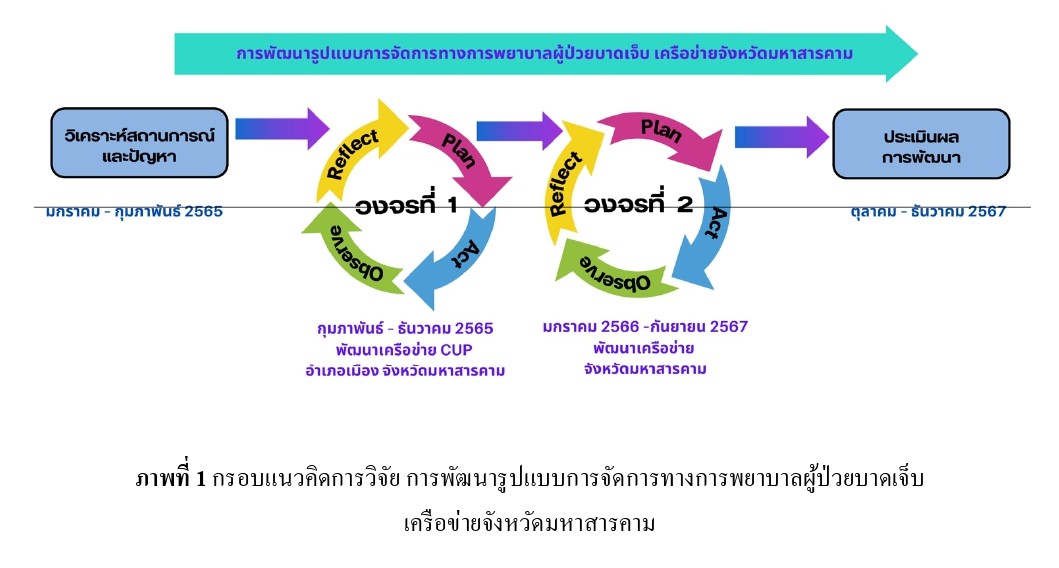
การวิจัยเชิงปฏิบัติการแบบมีส่วนร่วม เพื่อพัฒนารูปแบบการจัดการทางการพยาบาลผู้ป่วยบาดเจ็บ เครือข่ายจังหวัดมหาสารคาม แบ่งเป็น 3 ระยะ คือ 1) การวิเคราะห์สถานการณ์ปัญหา 2) การพัฒนารูปแบบการจัดการทางการพยาบาล และ3) การประเมินผลการใช้รูปแบบฯ ที่พัฒนาขึ้น
กลุ่มตัวอย่าง คือ ผู้ป่วยบาดเจ็บ ที่เข้ารับการรักษาที่โรงพยาบาล ในจังหวัดมหาสารคาม และมีคุณสมบัติที่กำหนด จำนวน 109 คน พยาบาลวิชาชีพที่ดูแลผู้ป่วยบาดเจ็บ จำนวน 157 คน และเจ้าหน้าที่หน่วย
ชุดปฏิบัติการกู้ชีพเบื้องต้น จำนวน 449 คน ทำการศึกษาระหว่าง เดือนมกราคม 2565 – ธันวาคม 2567 เครื่องมือการวิจัย ได้แก่ แนวทางสนทนากลุ่ม แบบสังเกตการปฏิบัติตามรูปแบบการจัดการทางการพยาบาล แบบบันทึกข้อมูลผู้ป่วยบาดเจ็บ แบบประเมินสมรรถนะของพยาบาลวิชาชีพ แบบประเมินสมรรถนะของเจ้าหน้าที่หน่วยชุดปฏิบัติการกู้ชีพเบื้องต้น และแบบสอบถามความคิดเห็นต่อรูปแบบการจัดการทางการพยาบาล วิเคราะห์ข้อมูลด้วยจำนวน ร้อยละ ค่าเฉลี่ยและการวิเคราะห์เชิงเนื้อหา
ผลการวิจัยพบว่า 1) การวิเคราะห์สถานการณ์ค้นหาปัญหา พบปัญหาการเข้าถึงระบบบริการของประชาชน การไม่มีรูปแบบการจัดการทางการพยาบาลผู้ป่วยบาดเจ็บ พบปัญหาที่เกี่ยวข้องกับสมรรถนะทางการพยาบาลและการช่วยเหลือผู้ป่วยบาดเจ็บ และขาดช่องทางการส่งต่อข้อมูล
ในเครือข่าย 2) ได้รูปแบบการจัดการทางการพยาบาลผู้ป่วยบาดเจ็บที่มีความเหมาะสมกับเครือข่ายจังหวัดมหาสารคาม และ3) การประเมินผล พบว่าผลลัพธ์ด้านการดูแลผู้ป่วยบาดเจ็บดีขึ้น พยาบาลวิชาชีพและเจ้าหน้าที่หน่วยชุดปฏิบัติการกู้ชีพเบื้องต้นมีสมรรถนะในการดูแลผู้ป่วยบาดเจ็บเพิ่มขึ้น และพยาบาลวิชาชีพมีความพึงพอใจในรูปแบบการจัดการทางการพยาบาลที่พัฒนาขึ้นในระดับมากที่สุด ร้อยละ 100 ดังนั้นจึงควรมีการนำรูปแบบการจัดการทางการพยาบาลที่พัฒนาขึ้นไปใช้ในเครือข่ายที่มีบริบทใกล้เคียง
เอกสารอ้างอิง
Accident Data Center of Thailand (2025, December 23). Statistics report: road accidents in Thailand from 2021 – 2022. https://www.thairsc.com/data-compare
Ahmed, S.K., Mohammed, M.G., Abdulqadir, S.O., El-Kader, R.G., El-Shall, N.A., Chandran, D., Rehman, M. E., & Dhama, K. (2023). Road traffic accidental injuries and deaths: A neglected global health issue. Health science reports, 6(5), e1240. https://doi.org/10.1002/hsr2.1240
Buasan R. (2008). Qualitative research in education. Khamsamai Publishing House.
Chokkatiwut, S. (2023). Results of the Emergency Medical Service Systems Development at Charoensin Hospital, Charoensin District, Sakon Nakhon Province. Journal of Sakon Nakhon Hospital, 26(1), 28 – 40. https://thaidj.org/index.php/jsnh/article/view/14480
Kemmis, S., & McTaggart, R. (1988). The Action Research Planner (3rd ed.). Deakin University Press.
Koomsuphan, W., Chitpakdee, B., & Abhicharttibutra, K. (2018). Development of a Registered Nurse Competency Framework, Emergency Department, Buddhachinaraj Phitsanulok Hospital. Nursing Journal CMU, 49(1), 138 – 147. https://he02.tci-thaijo.org/index.php/cmunursing/ article/view/255327/174949
Mahasarakham Hospital (2022). Annual Report 2022. Mahasarakham Hospital, Maha-sarakham Province.
National Institute for Emergency Medicine. (2022). Emergency Medical Principles Plan No.4, 2023 – 2027. https://online.fliphtml5.com/auukz/koew/#p=18
Nursing Division (2018). Protocol of The Development of The Quality of Nursing Service System: Service Plan. Suetawan.
Pintatham, K., Pensirinapa, N., & Kaladee, A. (2022). Factors Affecting Emergency Medical Service Operations according to the New Normal Standards in Chiang Rai Province. Chiangrai medical journal, 14(3), 57 – 70. https://he01.tci-thaijo.org/index.php/crmjournal/article/view/257295/ 175721
Pirunsuntorn, P., & Namprasert, S. (2024). A Development of Acute Trauma Referral Operation System from Northern Khon Kaen Hospitals under the Ministry of Public Health to a Srinagarind Hospital under Khon Kaen University. Journal of Emergency Medicial Services of Thailand,4(1), 73 - 86. https://he03.tci-thaijo.org/index.php/Jemst-01JHS/article/view/ 2347/2091
Sarapat, A. (2023). Effect of Nursing Care Model Development for Multiple Trauma Patients of Government Hospitals in Sisaket Province. Medical journal of srisaket surin buriram hospitals, 38(1), 175 – 185. https://he02.tci-thaijo.org/index.php/MJSSBH/article/view/262469/179182
Strategy and Planning Division (2018). Twenty-Year National Strategic Plan for Public Health
(2017 - 2036) 1st Revision 2018. https://spd.moph.go.th/wp-content/uploads/2022/09/ Ebookmoph20.pdf
Suwannaruk, U., Prachasantikul, P., Suwanrak, S., Chaiyakal, S., Somton, A., & Phumwiset, R. (2024). Development of the Emergency Medical Service System Model for Critically Emergency Patients to Access Services: Case Study of Suphanburi Province. Journal of Emergency Medicial Services of Thailand,4(2), 157 - 169. https://he03.tci-thaijo.org/index.php/Jemst-01JHS/article/view/2567/2629
Thailand Nursing and Midwifery Council. (2020). Nursing and midwifery outcome standard. https://www.tnmc.or.th/images/userfiles/files/A111.PDF
The Healthcare Accreditation Institute. (2022). Hospital and healthcare standards 5th edition. Author.
World Health Organization. (2010, May 13). Monitoring the buiding of health system: a handbook of indicators and their Measurement strategies. Geneva: World Health Organization. https://iris.who.int/bitstream/handle/10665/258734/9789241564052-eng.pdf
World Health Organization. (2023, April 30). Global status report on road safety 2023. https://www.who.int/publications/i/item/9789240086517
ดาวน์โหลด
เผยแพร่แล้ว
รูปแบบการอ้างอิง
ฉบับ
ประเภทบทความ
สัญญาอนุญาต
ลิขสิทธิ์ (c) 2025 วารสารมหาวิทยาลัยนราธิวาสราชนครินทร์

อนุญาตภายใต้เงื่อนไข Creative Commons Attribution-NonCommercial-NoDerivatives 4.0 International License.