
ปัจจัยที่ส่งผลต่อการยกระดับและพัฒนาคุณภาพการบริการของสถานประกอบการนวดไทยระดับพรีเมียมในจังหวัดอุตรดิตถ์
คำสำคัญ:
การนวดไทยระดับพรีเมียม, คุณภาพการบริการ, การท่องเที่ยวเชิงสุขภาพ, จังหวัดอุตรดิตถ์, การวิจัยแบบผสมผสานบทคัดย่อ
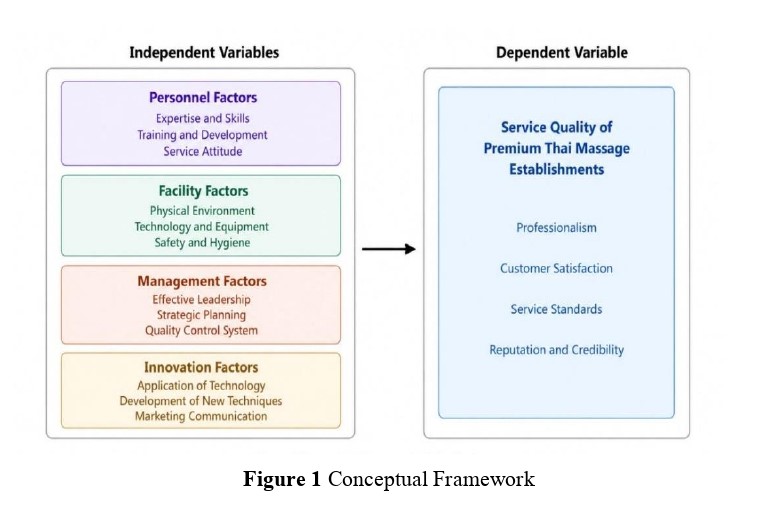
ความเป็นมาและวัตถุประสงค์ การนวดไทยระดับพรีเมียมมีศักยภาพในการส่งเสริมการท่องเที่ยวเชิงสุขภาพในจังหวัดเมืองรอง แต่ยังขาดหลักฐานเชิงประจักษ์ด้านกลไกการยกระดับคุณภาพบริการ การวิจัยนี้มุ่งวิเคราะห์อิทธิพลของปัจจัยด้านบุคลากร สิ่งอำนวยความสะดวก การจัดการ และนวัตกรรมต่อคุณภาพการบริการ และเสนอแนวทางพัฒนาแบบมีลำดับความสำคัญสำหรับสถานประกอบการนวดไทยระดับพรีเมียมในจังหวัดอุตรดิตถ์
วิธีการวิจัย ใช้รูปแบบผสมผสานชนิดอธิบายตามลำดับ (QUAN → qual) เก็บข้อมูลเชิงปริมาณจากกลุ่มตัวอย่างจำนวน 609 คน ได้แก่ ผู้ประกอบการ 45 คน บุคลากร 180 คน และลูกค้า 384 คน วิเคราะห์ด้วยสถิติพรรณนา สหสัมพันธ์เพียร์สัน การวิเคราะห์ถดถอยพหุคูณ และการวิเคราะห์แยกกลุ่ม ตรวจสอบ Common Method Bias ด้วย Harman's Single Factor Test (องค์ประกอบแรก = ร้อยละ 28.43 ต่ำกว่าเกณฑ์ร้อยละ 50) เก็บข้อมูลเชิงคุณภาพด้วยการสัมภาษณ์เชิงลึกผู้ให้ข้อมูลสำคัญ 20 คน วิเคราะห์ด้วยการวิเคราะห์เนื้อหา และตรวจสอบความน่าเชื่อถือตามเกณฑ์ Lincoln and Guba (1985) ด้วยการสร้างสามเส้าและ Member Checking
ผลการวิจัย ปัจจัยทั้ง 4 ด้านมีอิทธิพลต่อคุณภาพการบริการอย่างมีนัยสำคัญทางสถิติ (p < .01) และร่วมกันพยากรณ์คุณภาพการบริการได้ร้อยละ 68.40 (R² = .684) โดยปัจจัยด้านบุคลากรมีอิทธิพลสูงสุด (β = .342, f² = .224) รองลงมาคือการจัดการ (β = .276, f² = .128) สิ่งอำนวยความสะดวก (β = .198, f² = .079) และนวัตกรรม (β = .156, f² = .049) การวิเคราะห์แยกกลุ่มยืนยันความสอดคล้องของโมเดลในกลุ่มผู้ประกอบการ (R² = .621) บุคลากร (R² = .671) และลูกค้า (R² = .612) ลูกค้ามีความพึงพอใจในระดับสูง (M = 4.12) และร้อยละ 87.50 ตั้งใจใช้บริการซ้ำ ผลเชิงคุณภาพยืนยันว่าบุคลากรและการจัดการเป็นกลไกหลักในการยกระดับบริการ ขณะที่การรักษาบุคลากรฝีมือดีและการควบคุมต้นทุนเป็นข้อจำกัดสำคัญ
สรุปและข้อเสนอแนะ ควรยกระดับคุณภาพบริการตามลำดับความสำคัญ โดยเริ่มจากการพัฒนาทุนมนุษย์และระบบมาตรฐานการจัดการ (3 – 6 เดือน) ตามด้วยการปรับปรุงสิ่งอำนวยความสะดวก (6 – 12 เดือน) และการนำนวัตกรรมดิจิทัลมาใช้แบบค่อยเป็นค่อยไปในระยะยาว โดยอาศัยศักยภาพของจังหวัดในฐานะจุดผ่านของนักท่องเที่ยว 1,100,382 คนต่อปี ที่มีสัดส่วนการพักค้างคืนต่ำกว่าค่าเฉลี่ยของภาคเหนือ เพื่อพัฒนาอัตลักษณ์ Wellness Stopover ตามแนวคิด Stopover Tourism ที่ชี้ว่าเมืองรองสามารถสร้างมูลค่าจากการเป็นจุดผ่านทางได้อย่างยั่งยืน
เอกสารอ้างอิง
Bø, K. J. J., Tongtep, N., & Kamonmarttayakul, K. (2024). Customer insight analysis with sentiments and topic modeling from wellness centers in Phuket. In Proceedings of the 28th International Computer Science and Engineering Conference (ICSEC 2024), November 6–8, 2024, Khon Kaen, Thailand (pp. 1–6). IEEE. https://doi.org/10.1109/ICSEC62781.2024.10770722
Buttagat, V., Kluayhomthong, S., & Areeudomwong, P. (2024). The beneficial effects of traditional Thai massage on young patients with latent myofascial trigger points in the wrist extensor muscles: A randomized controlled trial. Journal of Bodywork and Movement Therapies, 40, 1201 – 1207. https://doi.org/10.1016/j.jbmt.2023.04.024
Chieochankitkan, A. (2013). Developing service quality for spa establishments in the active beach tourism cluster, Thailand [Master’s thesis]. Mahidol University.
Cochran, W. G. (1977). Sampling techniques (3rd ed.). John Wiley & Sons.
Cohen, J. (1988). Statistical power analysis for the behavioral sciences (2nd ed.). Lawrence Erlbaum Associates.
Global Wellness Institute. (2025). 2025 global wellness economy monitor. https://globalwellness institute.org/industry-research/2025-global-wellness-economy-monitor/
Janchai, N., Baxter, G., & Srisaeng, P. (2023). A study of Thai massage service quality effect on international tourist confidence. Academica Turistica, 16(3), 345 – 355. https://doi.org/10.26493/2335-4194.16.345-355
Kamalashiran, C., Muengtaweeponsa, S., Limudomoporn, M., Kaeokoket, Y., Eaimworawutthikul, W., Sriyakul, K., & Tungsukruthai, P. (2024). Traditional Thai massage steps development in acute ischemic stroke patients. MethodsX, 13, 102830. https://doi.org/10.1016/j.mex.2024.102830
Han, H., Kiatkawsin, K., Koo, B., & Kim, W. (2020). Thai wellness tourism and quality: Comparison between Chinese and American visitors' behaviors. Asia Pacific Journal of Tourism Research, 25(4), 424 – 440. https://doi.org/10.1080/10941665.2020.1737551
Kokfai, S., Pratoom, K., & Muenthaisong, D. K. (2016). Strategic entrepreneurial capability and service success: An empirical investigation of spa businesses in Thailand. AU-GSB e-JOURNAL, 8(2), 71 – 88. https://assumptionjournal.au.edu/index.php/AU-GSB/article/view/2226
Limprana, P., Chalaechorn, N., & Leecharoen, B. (2023). Factors of success of the Thai spa business. Journal of Rattana Bundit University, 18(1), 70 – 88. https://so03.tci-thaijo.org/index.php/rbac/article/view/267051
Lincoln, Y. S., & Guba, E. G. (1985). Naturalistic inquiry. SAGE Publications.
Maitland, R., & Newman, P. (Eds.). (2009). World tourism cities: Developing tourism off the beaten track. Routledge.
National Statistical Office. (2025). Table 17.1: Number of tourists accommodation, occupancy rate, total number of visitors and receipts from visitors by province: 2024. Author.
Nonsiri, P., & Choesawan, C. (2020). The potential of health tourism resources in the lower northern provincial cluster 1 (Tak, Sukhothai, Phitsanulok, Uttaradit, Phetchabun). Journal of Southern Technology, 13(1), 1 – 15. https://so04.tcithaijo.org/index.php/journal_sct/article/view/216193
Pattanapokinsakul, K., Sangthong, S., & Soonsan, N. (2025). Creating ‘wow factors’ in food service to enhance the Thai spa experience in Phuket, Thailand. IOP Conference Series: Earth and Environmental Science, 1570, 012004. https://doi.org/10.1088/17551315/1570/1/012004
Pattanapokinsakul, K., Wongmontha, S., Pongponrat Chieochan, K., & Pariwongkhuntorn, N. (2024). The readiness for development Phuket as a world-class wellness tourism destination. Journal of Arts Management, 8(1), 155 – 181. https://so02.tcithaijo.org/index.php/jam/article/view/268496
Podsakoff, P. M., MacKenzie, S. B., Lee, J.-Y., & Podsakoff, N. P. (2003). Common method biases in behavioral research: A critical review of the literature and recommended remedies. Journal of Applied Psychology, 88(5), 879 – 903. https://doi.org/10.1037/0021-9010.88.5.879
Sangpikul, A. (2022). Understanding the subjective and objective assessments of service quality through spa customers’ e-complaints in Bangkok. Journal of Quality Assurance in Hospitality & Tourism, 23(3), 569 – 596. https://doi.org/10.1080/1528008X.2021.1891598
Sangpikul, A. (2023). Understanding a conceptual framework of spa service quality: An overview approach. Academica Turistica, 16(3), 277 – 289. https://doi.org/10.26493/2335-4194.16.277-289
Sivapitak, S., & Sangpikul, A. (2024). Understanding the Relationship between service quality, service outcomes, and satisfaction in the spa industry. Tourism and Hospitality Management, 30(4), 597 – 606. https://doi.org/10.20867/thm.30.4.11
Sucharit, W., Roberts, N., Eungpinichpong, W., Hunsawong, T., & Chatchawan, U. (2023). Standardised 25-step traditional Thai massage (TTM) protocol for treating office syndrome (OS). International Journal of Environmental Research and Public Health, 20(12), 6159. https://doi.org/10.3390/ijerph20126159
Thipbharos, R., & Sangpikul, A. (2023). Understanding service outcomes in the spa industry. Tourism and Hospitality Management, 29(1), 147 – 151. https://doi.org/10.20867/thm.29.1.7
ดาวน์โหลด
เผยแพร่แล้ว
รูปแบบการอ้างอิง
ฉบับ
ประเภทบทความ
สัญญาอนุญาต
ลิขสิทธิ์ (c) 2026 วารสารมหาวิทยาลัยนราธิวาสราชนครินทร์

อนุญาตภายใต้เงื่อนไข Creative Commons Attribution-NonCommercial-NoDerivatives 4.0 International License.