
ผลกระทบของระบบสนับสนุนการตัดสินใจทางคลินิก (CDSS) ต่อการกำกับการใช้ยา Meropenem และ Tigecycline ในโรงพยาบาลระดับตติยภูมิ
คำสำคัญ:
ระบบสนับสนุนการตัดสินใจทางคลินิก (CDSS), การกำกับการใช้ยาต้านจุลชีพ (AMS), เชื้อดื้อยาต้านจุลชีพ, Meropenem, Tigecyclineบทคัดย่อ
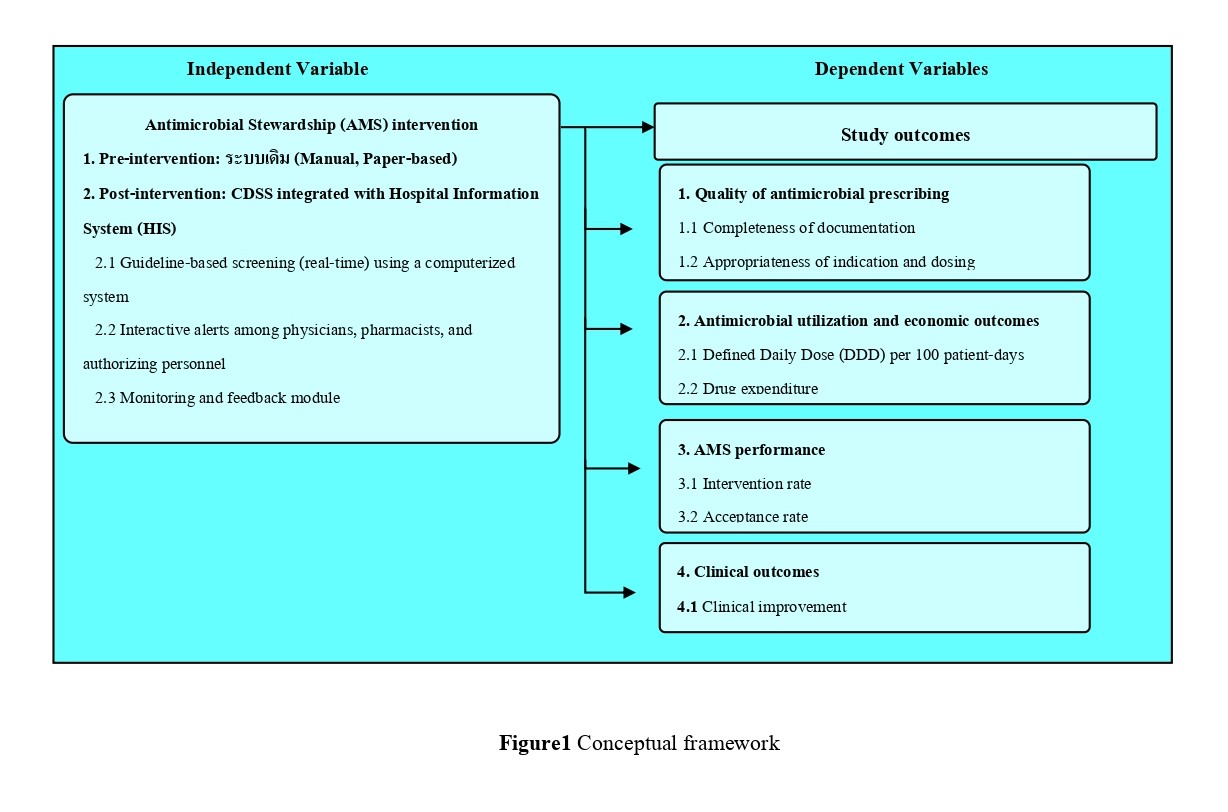
ความเป็นมาและวัตถุประสงค์ ปัญหาเชื้อดื้อยาต้านจุลชีพ (AMR) เป็นวิกฤตที่ส่งผลกระทบต่อผลลัพธ์การรักษาและภาระค่าใช้จ่าย โดยเฉพาะการใช้ยาควบคุมพิเศษ เช่น Meropenem และ Tigecycline การศึกษานี้มีวัตถุประสงค์เพื่อประเมินผลกระทบของระบบสนับสนุนการตัดสินใจทางคลินิกด้วยคอมพิวเตอร์ (CDSS) ต่อความเหมาะสมในการสั่งใช้ยา ปริมาณการใช้ยา และประสิทธิภาพในการกำกับการใช้ยาต้านจุลชีพ (AMS)
วิธีการวิจัย การศึกษาเชิงกึ่งทดลองก่อนและหลัง (Quasi-experimental study) เปรียบเทียบข้อมูล 12 เดือนก่อนใช้ระบบ (มกราคม – ธันวาคม 2565) และ 6 เดือนหลังเริ่มใช้ระบบ (มกราคม – มิถุนายน 2566) ณ โรงพยาบาลระดับตติยภูมิขนาด 1,188 เตียง เครื่องมือที่ใช้คือระบบ CDSS ที่บูรณาการเข้ากับระบบสารสนเทศโรงพยาบาล วิเคราะห์ข้อมูลความเหมาะสมในการสั่งใช้ยา ปริมาณการใช้ยา (DDD / 100 patient-days) ด้วยสถิติ Interrupted Time Series (ITS) และอัตราการยอมรับคำแนะนำจากระบบ ผลลัพธ์ทางคลินิกเบื้องต้น ได้แก่ อาการทางคลินิกดีระหว่างการรักษา เช่น อุณหภูมิร่างกายอยู่ในเกณฑ์ปกติ ภาวะไหลเวียนโลหิตคงที่ หรือไม่มีความจำเป็นต้องปรับเพิ่มหรือเปลี่ยนยาต้านจุลชีพเนื่องจากอาการแย่ลง
ผลการวิจัย หลังการนำระบบ CDSS มาใช้ พบว่าอัตราความเหมาะสมในการสั่งใช้ยาเพิ่มขึ้นอย่างมีนัยสำคัญจากร้อยละ 56.33 เป็นร้อยละ 94.08 และข้อมูลในใบขอใช้ยามีความครบถ้วน
ร้อยละ 100 ปริมาณการใช้ยา Tigecycline มีแนวโน้มลดลงอย่างมีนัยสำคัญทางสถิติ (p = 0.0067) โดยลดลง -512.545 DDD / 100 patient-days ต่อเดือน ในขณะที่ภาระงานการแทรกแซงซ้ำซ้อนของทีม AMS ลดลงจากร้อยละ 43.67 เหลือเพียงร้อยละ 5.92 นอกจากนี้ แพทย์ให้การยอมรับคำแนะนำจากระบบและเภสัชกรสูงถึงร้อยละ 100 นอกจากนี้ ผู้ป่วยในกลุ่มหลังใช้ระบบ CDSS มีอาการทางคลินิกดีขึ้นตามนิยามที่กำหนดร้อยละ 54.10
สรุปและข้อเสนอแนะ ระบบ CDSS เป็นเครื่องมือที่มีประสิทธิภาพในการส่งเสริมการใช้ยาต้านจุลชีพอย่างสมเหตุผล ช่วยลดปริมาณการใช้ยาและภาระงานของบุคลากรโดยไม่กระทบต่อผลลัพธ์ทางคลินิก ควรมีการขยายผลการใช้งานไปยังยากลุ่มควบคุมอื่น ๆ และพัฒนาระบบยาให้มีการใช้สมเหตุผลแบบเรียลไทม์ในโรงพยาบาลระดับต่าง ๆ ต่อไป
เอกสารอ้างอิง
Amor-García, M., Chamorro-de-Vega, E., Rodríguez-González, C.G., Iglesias-Peinado, I., & Moreno-Díaz, R. (2024). Effects of a Pharmacist-Designed Clinical Decision Support System on Antimicrobial Stewardship. Appl Clin Inform, 15(4), 679 - 688. http://doi.org/10.1055/a-2341-882
Antimicrobial Resistance Devision (2015). Global action plan on antimicrobial resistance. https://www.who.int/publications/i/item/9789241509763
Barlam, T.F., Cosgrove, S.E., Abbo, L.M., MacDougall, C., Schuetz, A.N., Septimus, E.J., Srinivasan, A., Dellit, T.H., Falck-Ytter, Y.T., Fishman, N.O., Hamilton, C.W., Jenkins, T.C., Lipsett, P.A., Malani, P.N., May, L.S., Moran, G.J., Neuhauser, M.M., Newland, J.G.,
Ohl, C.A., … Trivedi, K. K. (2016). Implementing an Antibiotic Stewardship Program: Guidelines by the Infectious Diseases Society of America and the Society for Healthcare Epidemiology of America. Clinical Infectious Diseases, 62(10), e51-e77.
http://doi.org/10.1093/cid/ciw118
Carracedo-Martinez, E., Gonzalez-Gonzalez, C., Teixeira-Rodrigues, A., Prego-Dominguez, J., Takkouche, B., Herdeiro, M. T., & Figueiras, A. (2019). Computerized Clinical Decision Support Systems and Antibiotic Prescribing: A Systematic Review and Meta-analysis. Clin Ther, 41(3), 552-581. http://doi.org/10.1016/j.clinthera.2019.01.018
Department of Disease Control (2022). Thailand Antimicrobial Resistance Containment and Prevention Report 2022. Author.
Giamarellou, H., Galani, L., Karavasilis, T., Ioannidis, K., & Karaiskos, I. (2023). Antimicrobial Stewardship in the Hospital Setting: A Narrative Review. Antibiotics (Basel), 12(10). http://doi.org/10.3390/antibiotics12101557
López-Viñau, T., Peñalva, G., García-Martínez, L., Castón, J.J., Muñoz-Rosa, M., Cano, Á.,
Recio, M., Cisneros, J.M., Pérez-Nadales, E., Aguirre, J.R., García-Martínez, E., Salcedo, I., Prado, J.R., Fuente, C.D., Martínez-Martínez, L., Gracia-Ahufinger, I., Torre-Cisneros, J. (2021). Impact of an Antimicrobial Stewardship Program on the Incidence of Carbapenem Resistant Gram-Negative Bacilli: An Interrupted Time-Series Analysis. Antibiotics (Basel), 10(5). http://doi.org/10.3390/antibiotics10050586
Murray, C.J., Ikuta, K.S., Sharara, F., Swetschinski, L., Robles Aguilar, G., Gray, A., Han, C., Bisignano, C., Rao, P., Wool, E., Johnson, S.C., Browne, A.J., Chipeta, M.G., Fell, F., Hackett, S., Haines-Woodhouse, G., Hamadani, B.H.K., Kumaran E.A.P., McManigal, B., Achalapong, S.,. . . Naghavi, M. (2022). Global burden of bacterial antimicrobial resistance in 2019: a systematic analysis. The Lancet, 399(10325), 629 - 655. http://doi.org/10.1016/S0140-6736(21)02724-0
O’Neill, J. (2016). Tackling Drug-Resistant Infections Globally: Final Report and Recommendations. Review on Antimicrobial Resistance. Wellcome Trust and HM Government. https://amr-review.org/sites/default/files/160525_Final%20paper_with%20cover.pdf
Phumart, P., Phodha, T., Thamlikitkul, V., Riewpaiboon, A., Prakongsai, P., & Limwattananon, S. (2012). Health and Economic Impacts of Antimicrobial Resistant Infections in Thailand : A Preliminary Study. Journal of Health Systems Research, 6, 352 - 360. https://he04.tci-thaijo.org/index.php/j_hsr/issue/archive/2
Rawson, T.M., Moore, L.S., Hernandez, B., Charani, E., Castro-Sanchez, E., Herrero P., Hayhoe, B., Hope, W., Georgiou, P., & Holmes, A. H. (2017). A systematic review of clinical decision support systems for antimicrobial management: are we failing to investigate these interventions appropriately? Clinical Microbiology and Infection, 23(8), 524 - 532. http://doi.org/10.1016/j.cmi.2017.02.028
Ritmann, B., & Stevens, M. P. (2019). Clinical Decision Support Systems and Their Role in Antibiotic Stewardship: a Systematic Review. Current Infectious Disease Reports, 21(8), 29. http://doi.org/10.1007/s11908-019-0683-8
Rungsitsathian, K., Wacharachaisurapol, N., Nakaranurack, C., Usayaporn, S., Sakares, W., Kawichai, S., Jantarabenjakul, W., Puthanakit, T., & Anugulruengkitt, S. (2021). Acceptance and outcome of interventions in a meropenem de-escalation antimicrobial stewardship program in pediatrics. Pediatr Int, 63(12), 1458 - 1465. http://doi.org/10.1111/ped.14703
Shields, M. R., Shah, S., Falcione, B.A., Potoski, B.A., Liu, L., Goshorn, E.S., Clarke, L., Viehman, A., Hadi, C., Kwak, E.J., Samanta, P., Khadem, T., Ryan, B.J., Yakemowicz, C., Simonick, C., Erwee, R., McCreary, E.K., Abdel-Massih, R., & Nguyen, M.H. (2022). Increased efficiency and impact of implementing ILUM insight within an antimicrobial stewardship program (ASP) at an academic medical center. Open Forum Infectious Diseases, 9 (Suppl 2), ofac492.761. https://doi.org/10.1093/ofid/ofac492.761
Van Dort, B. A., Penm, J., Ritchie, A., & Baysari, M. T. (2022). The impact of digital interventions on antimicrobial stewardship in hospitals: a qualitative synthesis of systematic reviews. Journal of Antimicrobial Chemotherapy, 77(7), 1828 - 1837. http://doi.org/10.1093/jac/ dkac112
Wangchinda, W., Srisompong, J., Chayangsu, S., Ruangkriengsin, D., Thamlikitkul, V., Koomanachai, P., Sirijatuphat, R., Rattanaumpawan, P. (2022). Impact of Antibiotic Authorisation at Three Provincial Hospitals in Thailand: Results from a Quasi-Experimental Study. Antibiotics (Basel), 11(3), 354. http://doi.org/10.3390/antibiotics11030354
World Health Organization. (2017). Thailand: National strategic plan on antimicrobial resistance 2017-2021. https://www.who.int/publications/m/item/thailand-national-strategic-plan-on-anti microbial-resistance-2017-2021
World Health Organization (2019). Antimicrobial stewardship programmes in health-care facilities in low- and middle-income countries. https://iris.who.int/server/api/core/bitstreams/e2e59ce4-c373-4066-9ff7-a0cce3e6ccdd/content
World Health Organization. (2023)(a). National Action Plan for Health Security (2023–2027). Author.
World Health Organization. (2023)(b). Tracking AMR Country Self-Assessment Survey (TrACSS). Global Database for Tracking Antimicrobial Resistance (AMR) Country Self- Assessment Survey (TrACSS). https://amrcountryprogress.org/compare/?global_data=true
ดาวน์โหลด
เผยแพร่แล้ว
รูปแบบการอ้างอิง
ฉบับ
ประเภทบทความ
สัญญาอนุญาต
ลิขสิทธิ์ (c) 2026 วารสารมหาวิทยาลัยนราธิวาสราชนครินทร์

อนุญาตภายใต้เงื่อนไข Creative Commons Attribution-NonCommercial-NoDerivatives 4.0 International License.