ผลของโปรแกรมการโค้ชการฉีดอินซูลินต่อความสามารถในการฉีดอินซูลินด้วยตนเองของผู้ป่วยเบาหวานชนิดที่ 2 ที่ควบคุมระดับน้ำตาลในเลือดไม่ได้
คำสำคัญ:
โปรแกรมการโค้ชการฉีดอินซูลิน, การฉีดอินซูลินด้วยตนเอง, ผู้ป่วยเบาหวานชนิดที่ 2, ความสามารถในการฉีดอินซูลินบทคัดย่อ
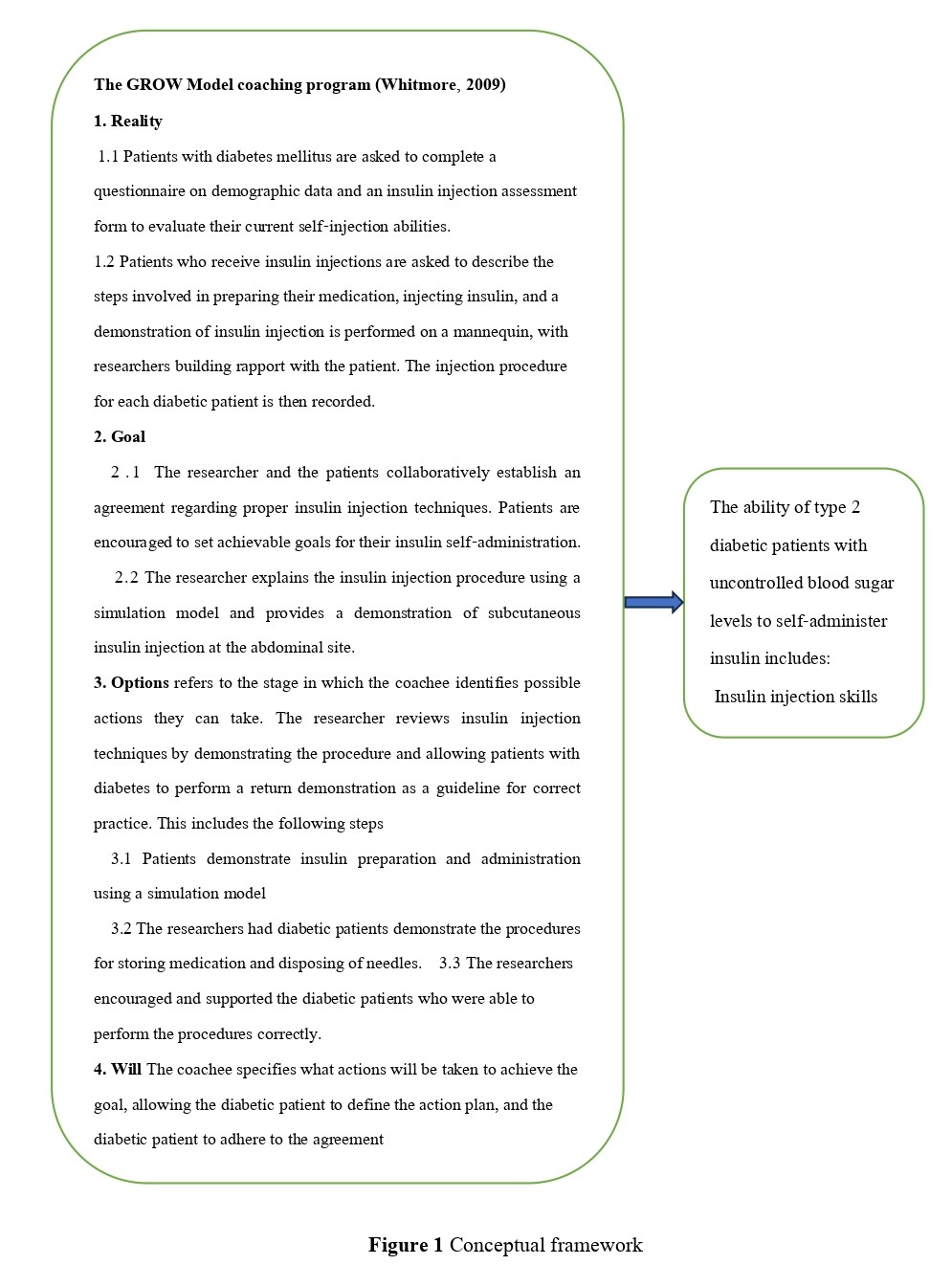
ความเป็นมาและวัตถุประสงค์ โรคเบาหวานชนิดที่ 2 เป็นภาวะเรื้อรังที่เกิดขึ้น เมื่อระดับน้ำตาลในเลือดสูงอย่างต่อเนื่องจากร่างกายไม่สามารถใช้อินซูลินได้อย่างเหมาะสม เป็นสาเหตุสำคัญทำให้มีนำไปสู่ภาวะแทรกซ้อนและความรุนแรงของโรค ทั้งในระยะเฉียบพลันเกิดการติดเชื้อในร่างกาย รวมถึงภาวะแทรกซ้อนระยะยาวต่อระบบต่าง ๆ ของร่างกาย เพื่อป้องกันหรือชะลอการเกิดภาวะแทรกซ้อนต่าง ๆ ให้ผู้ป่วยเบาหวานชนิดที่ 2 ที่รักษาด้วยการฉีดอินซูลินที่มีความสามารถการฉีดอินซูลินที่ถูกต้อง การโค้ช การฝึกทักษะการฉีดอินซูลินด้วยตัวเอง เป็นบทบาทสำคัญในการฝึกทักษะความสามารถเกี่ยวกับทักษะการฉีดอินซูลินและการจัดการตนเองที่เหมาะสม การวิจัยครั้งนี้มีวัตถุประสงค์เพื่อศึกษาผลของโปรแกรมการโค้ชการฉีดอินซูลินต่อความสามารถในการฉีดอินซูลินด้วยตนเองของผู้ป่วยเบาหวานชนิดที่ 2 ที่ควบคุมระดับน้ำตาลในเลือดไม่ได้
วิธีการวิจัย การวิจัยนี้เป็นการวิจัยกึ่งทดลอง กลุ่มตัวอย่างคือผู้ป่วยเบาหวานชนิดที่ 2 จำนวน 52 คน แบ่งเป็นกลุ่มทดลองและกลุ่มควบคุม กลุ่มละ 26 คน เครื่องมือที่ใช้ประกอบด้วย โปรแกรมการโค้ชการฉีดอินซูลินของผู้ป่วยเบาหวานชนิดที่ 2 ที่ควบคุมระดับน้ำตาลในเลือดไม่ได้ และเครื่องมือที่ใช้ในการเก็บรวบรวมข้อมูล ประกอบแบบสอบถามข้อมูลทั่วไป แบบสอบถามข้อมูลสุขภาพ แบบประเมินความสามารถในการฉีดอินซูลิน ได้ค่าความเที่ยงของครอนบาคแอลฟา 0.81 วิเคราะห์ข้อมูลโดยใช้สถิติเชิงพรรณนา สถิติทดสอบแบบทีคู่ ทีแบบอิสระ และไคสแควร์
ผลการวิจัย พบว่า กลุ่มทดลองมีค่าคะแนนเฉลี่ยความสามารถในการฉีดอินซูลินหลังการได้รับโปรแกรมการโค้ชการฉีดอินซูลิน (68.73, S.D. = 4.39) สูงกว่าก่อนการทดลอง (54.96, S.D. = 2.97) อย่างมีนัยสำคัญทางสถิติที่ระดับ .05 (t = 13.721, p < .05)
สรุปและข้อเสนอแนะ ผลการศึกษานี้แสดงให้เห็นว่า โปรแกรมนี้สามารถนำไปใช้เพื่อส่งเสริมทักษะความสามารถในการฉีดอินซูลินให้มีประสิทธิภาพมากขึ้น
เอกสารอ้างอิง
Ahmad, F., & Joshi, S. H. (2023). Self-care practices and their role in the control of diabetes: A narrative review. Cureus, 15(7), e41409. https://doi.org/10.7759/cureus.41409
Chen, R. Y., Yang, Y. S., Lin, C. L., & Shu, C.T. (2019). Effectiveness of short-term health coaching on diabetes self-management and HbA1c control. Frontiers in Public Health, 7, 314. https://doi.org/10.3389/fpubh.2019.00314
Chinnawoot, S., Sukjaroen, J., & Anutarakul, V. (2024). The Effect of a Transactional Program on Self-care Behavior and Blood Sugar Levels Among Uncontrolled Type 2 Diabetic Patients. Journal of Health and Nursing Education, 30(3), 143 – 147. https://he02.tci-thaijo.org/index. php/Jolbcnm/article/download/270657/185616
Cohen, J. (1988). Statistical power analysis for the behavioral sciences (2nd ed.). Lawrence Erlbaum Associates.
Comprehensive Research Group. (2025). Impact of nurse-led self-management education on type 2 diabetes mellitus: A clinical intervention study. Frontiers in Public Health, 13, 1622988. https://doi.org/10.3389/fpubh.2025.1622988
Department of Disease Control (2022). Non-Communicable Diseases Division / Risk Communication Bureau. Department of Disease Control, https://narathiwat.nso.go.th/images/provincecial staticalreport/2023/2023 narathiwatstreportcompress2.pdf
Diabetes Association of Thailand (2023) Clinical Practice Guideline for Diabetes. https://www.dmthai.org/new/index.php/sara-khwam-ru/sahrab-bukhkhl-thawpi/diabetes-book/ naewthang-wech-ptibati-sahrab-rokh-bea-hwan-2566
Gorska-Ciebiada, M., Masierek, M., & Ciebiada, M. (2020). Improved insulin injection technique, treatment satisfaction and glycemic control: Results from a large cohort education study. Journal of Clinical & Translational Endocrinology, 19, 100217. https://doi.org/10.1016/j.jcte.2020.100217
Gurvich, V., & Naumova, M. (2023). Critical issues with the Pearson’s chi-square test.arXiv.
Kidney Disease: Improving Global Outcomes (KDIGO) Diabetes Work Group. (2022). KDIGO 2022 clinical practice guideline for diabetes management in chronic kidney disease. Kidney International, 102(5S), S1–S127. https://doi.10.1016/j.kint.2022.06.008
Kongmaha, P., Tuicharoen, J., Koetchuen, K., & Wiboonchai, N. (2024). Effects of health coaching on glycated hemoglobin levels among patients with type 2 diabetes. Journal of Health Center 9, 18(3), 1152 – 1163. https://he02.tci-thaijo.org/
Liang, K., Xie, Q., Nie, J., & Deng, J. (2021). Study on the effect of education for insulin injection in diabetic patients with new simulation tools. Medicine, 100(14), e25424. https://doi.10.1097/MD.0000000000025424
Luksanaleka, K., Rattanagreethakul, S., & Janpraser, S. (2017). Effects of Coaching on Self-management Behaviors and Blood Sugar Level among Persons with Type 2 Diabetes Mellitus with Insulin Injection. Journal of Nursing Science Chulalongkorn University, 29(1), 67 - 80. https://buuir.buu.ac.th/bitstream/1234567890/6137/1/Fulltext.pdf
Phanthana, S. (2021). The effectiveness of an insulin injection teaching program for diabetes patients who treated with insulin injection at the diabetes mellitus clinic of Buengkan Hospital. Journal of Preventive Medicine Association of Thailand, 11(2), 332 – 344. https://he01.tci-thaijo.org/index.php/JPMAT/article/view/249680
Phromma, S. (2017). A development of coaching skills model for nurse leaders. Journal of Uttaradit Rajabhat University, 11(2), 354 – 368. https://so06.tci- thaijo.org/index.php/uruj/article/view/125552
Pitak, P., Thipyapong, T., & Phuongjantara, A. (2023). Supporting insulin self-titration among patients with type 2 diabetes. Journal of Health Systems Research, 17(4), 811 – 820. https://he04.tci-thaijo.org/index.php/j_hsr/article/view/2529
Printrakun, R., & Songthap, A. (2021). Factors affecting insulin injection behaviors among type 2 diabetic patients in Long Hospital, Long District, Phrae Province. Thai Journal of Pharmacy Practice, 13(2), 346 – 355. https://he01.tci-thaijo.org/index.php/TJPP/article/view/258321
Promchaisri, K., Lerkiatbundit, S., & Saengcharoen, W. (2019). Effect of Self-Efficacy Enhancing Program on Ability to Use Insulin-Penfill Injection among Patients with Diabetes Type 2: A Randomized Controlled Trial. Thai Pharmaceutical Journal, 11(3), 649 - 658. https://he01. tci-thaijo.org/index.php/TJPP/article/view/187552
Takaree, S., Changmai, S., & Hinjiranan, S. (2019). The outcomes of the nursing care through mutual goal setting in insulin self-injection of type 2 diabetic persons. Thai Journal of Nursing, 68(3), 48 – 55. https://he02.tci-thaijo.org/index.php/TJN/article/view/233360
Tippila, K., & Bunloet, A. (2022). Factors influencing denlal of insulin usage among type ll dlabetes patlents with indication for insulin usage in community hospital. Research and Development Health System Journa, 15(2), 269 - 283. https://he02.tci-thaijo.org/index.php/RDHSJ/article/view/256033
Trikhirhisthit, K. (2017). Acceptance of Insulin Injection After Comprehensive Education Program Compared with Routine Counselling in Type 2 Diabetes Refusing Insulin Injection. Thammasat Medical Journal, 18(3), 291 - 299. https://he02.tci-thaijo.org/index.php/tmj/ article/download/149723/109884
Urbinner. (2021, November 9). What is coaching? What is the process?. https://www.urbinner.com/ post/what-is-coaching
Whitmore, J. (2009). Coaching for performance: GROWing human potential and purpose—The principles and practice of coaching and leadership (4th ed.). Nicholas Brealey Publishing.
Yingyuen, K., Charoensri, S., & Pongchaiyakul, C. (2022). Effect of using Mobile Messenger for Insulin Injection Education for Glycemic Control: A Randomized Controlled Trial. Pacific Rim International Journal of Nursing Research, 26(3), 461 - 473. http://he02.tci-thaijo.org/index.php/PRIJNR/article/view/258070
Yingyuen, K., & Methakanchanasak, N. (2016). Innovation for self-management through telehealth service system among type 2 diabetes patients with dyslipidemia. Srinagarind Medical Journal, 31(6), 365 – 371. http://li01.tci-thaijo.org/index.php/SRIMEDJ/article/view/75274
ดาวน์โหลด
เผยแพร่แล้ว
รูปแบบการอ้างอิง
ฉบับ
ประเภทบทความ
สัญญาอนุญาต
ลิขสิทธิ์ (c) 2026 วารสารมหาวิทยาลัยนราธิวาสราชนครินทร์

อนุญาตภายใต้เงื่อนไข Creative Commons Attribution-NonCommercial-NoDerivatives 4.0 International License.