Results of Implementing the Online Reporting System for Oxygen Enrichment in Aquaculture Using Solar-Powered Energy for Cage Fish Farming
Article Sidebar
Main Article Content
Abstract
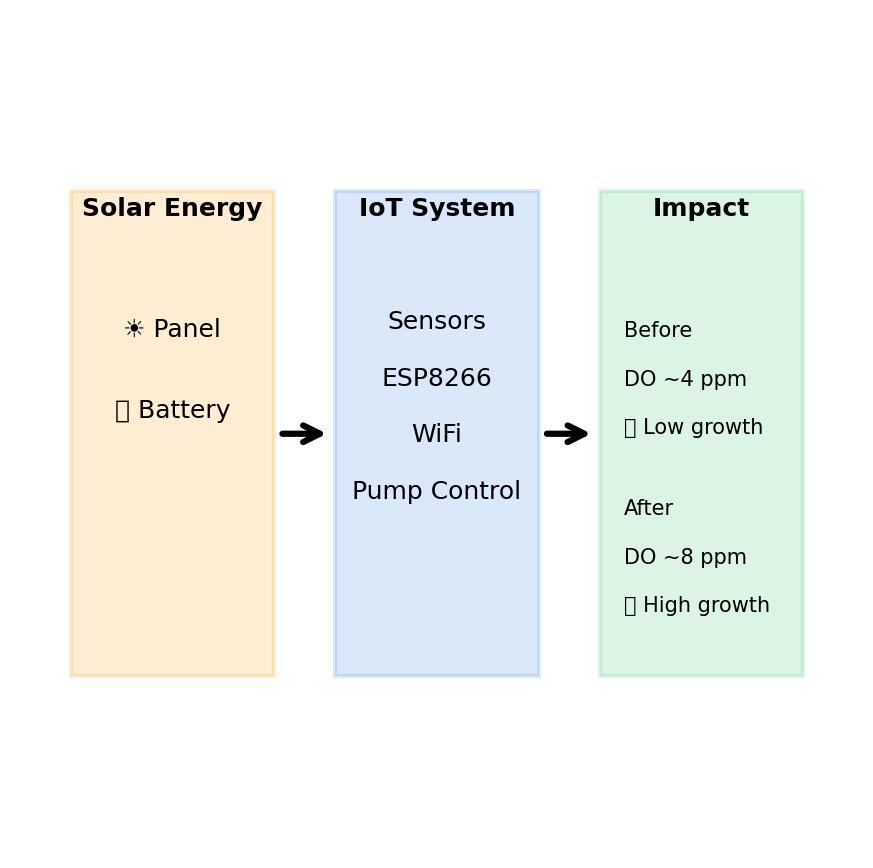
Fish farming in ponds is popular due to its effective environmental control, whereas cage farming in rivers and canals faces challenges due to unregulated flowing water. Despite this, many farmers prefer cage farming due to lower costs and the absence of pond space expenses. A major issue in cage farming is low oxygen levels at night, which can lead to oxygen deprivation, reduced growth, or even mortality. However, oxygen parameters are not the only factors influencing fish health and growth. Other elements, such as fish density, feed quality, disease management, and water temperature, also significantly impact fish performance. To address the issue of oxygen deficiency, an advanced oxygen enrichment system was developed, utilizing solar-powered electricity to maintain optimal oxygen levels. The system automatically activates when oxygen levels drop, releasing pressurized air to maintain stability. It is equipped with sensors for real-time monitoring and uses stored solar energy to operate continuously, reducing operational costs and ensuring sustainability. The system's main features include solar panels for energy generation, battery storage for nighttime operation, and automated oxygen release when levels fall below a set threshold. After one year of operation, the system maintained an average oxygen level of 8.2 ppm and proved reliable, average power output of 300 W. These results showed that the system provides a stable environment for fish growth, thereby improving efficiency and reducing the risk of oxygen deprivation. This approach offers a cost-effective, sustainable solution for river cage farming, enhancing fish health and overall productivity. Nonetheless, optimizing other factors like fish stocking density, nutritional input, and disease management practices are also essential for achieving the best outcomes in cage aquaculture.
Article Details

This work is licensed under a Creative Commons Attribution-NonCommercial-NoDerivatives 4.0 International License.
The content and information in the article published in Journal of Rajamangala University of Technology Srivijaya It is the opinion and responsibility of the author of the article. The editorial journals do not need to agree. Or share any responsibility.
References
Beveridge, M.C.M. 2004. Aquaculture and the Environment. Blackwell Publishing, Oxford, UK.
Boyd, C.E. and Tucker, C.S. 1998. Water Quality for Pond Aquaculture. Auburn University Press, Alabama, USA. DOI: https://doi.org/10.1007/978-1-4615-5407-3_4
Cordova-Rozas, M., Aucapuri-Lecarnaque, J. and Shiguihara-Juarez, P.N. 2019. A cloud monitoring system for aquaculture using IoT. IEEE Sciences and Humanities International Research Conference (SHIRCON), 1-4: 212645066. DOI: https://doi.org/10.1109/SHIRCON48091.2019.9024849
Jalil, M.M. and Hussain, S. 2020. Solar-powered oxygenation systems for sustainable aquaculture practices. Renewable Energy 149: 1234-1241.
Kramer, D.L. 1987. Dissolved oxygen and fish behavior. Environmental Biology of Fishes 18(2): 81-92. DOI: https://doi.org/10.1007/BF00002597
Liu, W., Yang, Y. and Zhou, Z. 2017. Effects of feed quantity and quality on the growth of fish in aquaculture systems. Aquaculture Nutrition 23(3): 609-620.
Mengistu, S.B., Mulder, H.A., Benzie, J.A.H. and Komen, H. 2019. A systematic literature review of the major factors causing yield gap by affecting growth, feed conversion ratio and survival in Nile tilapia (Oreochromis niloticus). Reviews in Aquaculture 12(2): 524-541. DOI: https://doi.org/10.1111/raq.12331
Nguyen, H.N., Phan, T.B., Nguyen, T.M., Nguyen, D., Pham, T.G. and Pham, T.T. 2023. Changes in basic water environmental parameters of the water intake of brackish water shrimp farming in Northern Vietnam period 2017-2021. Ministry of Science and Technology, Vietnam 65(12): 43-51. DOI: https://doi.org/10.31276/VJST.65(12).43-51
Opiyo, M.A., Marijani, E., Muendo, P., Odede, R., Leschen, W. and Charo-Karisa, H. 2018. A review of aquaculture production and health management practices of farmed fish in Kenya. International Journal of Veterinary Science and Medicine 6(2): 141-148. DOI: https://doi.org/10.1016/j.ijvsm.2018.07.001
Tacon, A.G.J. and Metian, M. 2008. Global overview on the use of fish meal and fish oil in the production of farmed fish. Aquatic Living Resources 21(4), 319-332.
