
Effects of Flour Type and Longan Addition on the Quality of Longan-Fortified Baked Crackers
Article Sidebar
Main Article Content
Abstract
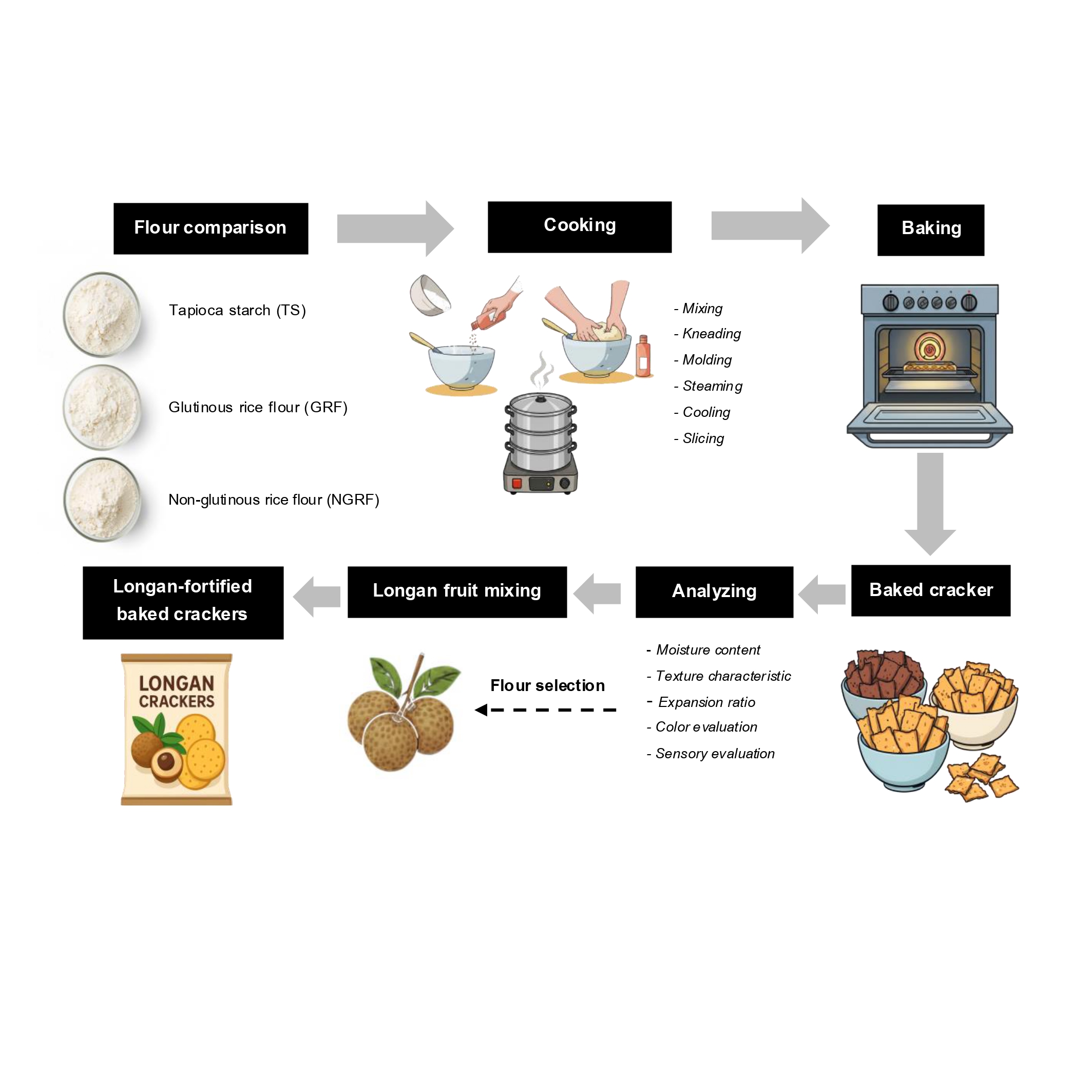
Khao Griab, a popular fried snack in Thailand, is typically made from deep-fried crackers. However, deep-fried foods are known for their high oil content, which is linked to metabolic disorders. This research aimed to develop a baked version of ‘Khao Griab’ as a healthier alternative by modifying the traditional production process, substituting baking for frying. Three types of commercial flour/starch were compared: tapioca starch (TS), glutinous rice flour (GRF), and non-glutinous rice flour (NGRF). The moisture content of the crackers ranged from 0.80% to 2.36%, with water activity values between 0.133 and 0.287. The expansion ratios of the three cracker samples ranged from 21.67% to 56.67%, with NGRF-based crackers showing the lowest expansion, followed by GRF and TS. Crackers made from NGRF were the least hard, while those made from TS were slightly harder, and GRF-based crackers exhibited the highest hardness. The TS-based crackers had the highest L* value and the lowest b* value, whereas NGRF-based crackers had the lowest L* value and the highest redness (+a*) and yellowness (+b*). Sensory evaluation indicated that TS-based crackers achieved higher scores across all attributes, establishing TS as the preferred base for fortification with 5–15% longan. Hardness increased with higher longan levels, and the 10% longan-fortified TS cracker was identified as the optimal formulation based on both sensory acceptance and nutritional improvement. A 30 g serving of longan-fortified baked crackers provides 120 kcal, with percent Daily Values (%DV) of 1% for fat and 2% for sodium—both lower than those of commercial products.
Article Details

This work is licensed under a Creative Commons Attribution-NonCommercial-NoDerivatives 4.0 International License.
The content and information in the article published in Journal of Rajamangala University of Technology Srivijaya It is the opinion and responsibility of the author of the article. The editorial journals do not need to agree. Or share any responsibility.
References
Akonor, P.T., Dziedzoave, N.T., Buckman, E.S., Essel, E.M., Lavoe, F. and Tomlins, K.I. 2017. Sensory optimization of crackers developed from high-quality cassava flour, starch, and prawn powder. Food Science & Nutrition 5: 564-569. DOI: https://doi.org/10.1002/fsn3.431
Almoraie, N.M., Saqaan, R., Alharthi, R., Alamoudi, A., Badh, L. and Shatwan, I.M. 2021. Snacking patterns throughout the life span: Potential implications on health. Nutrition Research 91: 81-94. DOI: https://doi.org/10.1016/j.nutres.2021.05.001
Association of Official Analytical Collaboration (AOAC). 2023. Official Methods of Analysis of the Association of Official Analytical Chemists: Official Methods of Analysis of AOAC International (22nd ed.). AOAC International, Oxford University Press, Oxford.
Association of Official Analytical Collaboration (AOAC). 2019. Official Methods of Analysis of the Association of Official Analytical Chemists: Official Methods of Analysis of AOAC International (21st ed.). AOAC International, Washington DC.
Changso, S. and Sanon, W. (2024). Enrichment of antioxidant activity in steamed cupcakes with concentrated dried longan juice. PKRU SciTech Journal 8(1): 83-95. (in Thai)
Cheow, C.S., Kyaw, Z.Y., Howell, N.K. and Dzulkifly, M.H. 2004. Relationship between physico-chemical properties of starches and expansion of fish cracker keropok. Journal of Food Quality 27: 1-12. DOI: https://doi.org/10.1111/j.1745-4557.2004.tb00633.x
Chobot, M., Kozłowska, M., Ignaczak, A. and Kowalska, H. 2024. Development of drying and roasting processes for the production of plant-based pro-healthy snacks in the light of nutritional trends and sustainable techniques. Trends in Food Science & Technology 149: 104553. DOI: https://doi.org/10.1016/j.tifs.2024.104553
Dogan, S.F. 2004. Effect of different batter formulations on quality of deep-fat fried chicken nuggets. Master of Science (Food Engineering), The Graduate School of Natural and Applied Sciences of Middle East Technical University.
Galal, W.K., Elfeky, W.Z. and Eman, S.M. 2023. Preparation and evaluation of high nutrition value crackers enriched with some leafy vegetables. Food Technology Research Journal 2(2): 111-122. DOI: https://doi.org/10.21608/ftrj.2023.334169
Glassner, D.L. 2018. The association between type of fat and the risk of developing cardiovascular diseases. The Science Journal of the Lander College of Arts and Sciences 12(1): 39-46.
Kim, J.S. and Koh, B.K. 2019. Rice varieties in relation to saltine rice cracker quality. International Journal of Food Properties 22(1): 1899-1909. DOI: https://doi.org/10.1080/10942912.2019.1691587
Kulchan, R., Boonsupthip, W. and Suppakul, P. 2010. Shelf life prediction of packaged cassava-flour-based baked product by using empirical models and activation energy for water vapor permeability of polyolefin films. Journal of Food Engineering 100: 461-467. DOI: https://doi.org/10.1016/j.jfoodeng.2010.04.031
Mahmoud, K.F., Shedeed, N.A. and Hussein, A.M.S. 2023. Production and quality evaluation of corn crackers fortified with freeze-dried banana peel and pulp. Food and Humanity 1: 1680-1690. DOI: https://doi.org/10.1016/j.foohum.2023.11.019
Nammakuna, N., Suwansri, S., Thanasukan, P. and Ratanatriwong, P. 2009. Effects of hydrocolloids on quality of rice crackers made with mixed-flour blend. Asian Journal of Food and Agro-Industry 2(4): 780-787.
Noranizan, M.A., Dzulkifly, M.H. and Russly, A.R. 2010. Effect of heat treatment on the physico-chemical properties of starch from different botanical sources. International Food Research Journal 17: 127-135.
Pichetnawin, T. 2004. Effect of modified starches in quality attributes of rice crackers. Master of Science (Food Technology), Silpakorn University.
Pereira, J., Hu, H., Xing, L., Zhang, W. and Zhou, G. 2020. Influence of rice flour, glutinous rice flour, and tapioca starch on the functional properties and quality of an emulsion-type cooked sausage. Foods 9(1): 9. DOI: https://doi.org/10.3390/foods9010009
Rani, L., Kumar, M., Kaushik, D., Kaur, J., Kumar, A., Oz, F., Proestos, C. and Oz, E. 2023. A review on the frying process: Methods, models and their mechanism and application in the food industry. Food Research International 172: 113176. DOI: https://doi.org/10.1016/j.foodres.2023.113176
Saeleaw, M. and Schleining, G. 2010. Effect of blending cassava starch, rice, waxy rice and wheat flour on physico-chemical properties of flour mixtures and mechanical and sound emission properties of cassava crackers. Journal of Food Engineering 100: 12-24. DOI: https://doi.org/10.1016/j.jfoodeng.2010.03.020
Saha, S. 2020. IMF: To enhance the shelf-life of food. International Journal for Modern Trends in Science and Technology 6(10): 103-108. DOI: https://doi.org/10.46501/IJMTST061018
Say, M., Fuangpaiboon, N., Hirunsorn, P. and Tangwongchai, R. 2022. Composite flour cracker enriched with banana flour: Formulation optimization and properties. Asia-Pacific Journal of Science and Technology 27(3): 1-12.
Silva, K.D.R.R. and Sirasa, M.S.F. 2018. Antioxidant properties of selected fruit cultivars grown in Sri Lanka. Food Chemistry 238: 203–208. DOI: https://doi.org/10.1016/j.foodchem.2016.08.102
Thai Industrial Standards Institute (TISI). 2011. Thai Community Products Standards 107/2554: Crispy Snack, Khaogriab., Ministry of Industry, Bangkok. (in Thai)
Thi, T.T.T., Le, H.N.N., Thi, H.N.L., Nu, M.N.T., Thi, T.L. and Van, V.M.L. 2024. High-fiber crackers supplemented with asparagus hard-stem: Impacts of supplementation ratios and water amounts in cracker recipe on the product quality polish. Journal of Food and Nutrition Sciences 74(2): 162–168. DOI: https://doi.org/10.31883/pjfns/188110
Timic, J.B., Kotur-Stevuljevic, J., Boeing, H., Krajnovic, D., Djordjevic, B. and Sobajic, S. 2020. A cross-sectional survey of salty snack consumption among Serbian urban-living students and their contribution to salt intake. Nutrients 12(11): 3290. DOI: https://doi.org/10.3390/nu12113290
Trade Policy and Strategy Office. 2024. Commerce reveals consumption of healthy snack products continues to grow. It is expected that this will be a good opportunity for Thai entrepreneurs. Ministry of Commerce, Thailand. Available Source: https://tpso.go.th/news/2404-0000000006, November 4, 2024. (in Thai)
Tuta, S. and Palazoğl, T.K. 2017. Effect of baking and frying methods on quality characteristics of potato chips. GIDA the Journal of Food 42(1): 43-49. DOI: https://doi.org/10.15237/gida.GD16050
Wang, Y.J., Yeh, T.L., Shih, M.C., Tu, Y.K. and Chien, K.L. 2020. Dietary sodium intake and risk of cardiovascular disease: A systematic review and dose-response meta-analysis. Nutrients 12(10): 2934. DOI: https://doi.org/10.3390/nu12102934
Widjajaseputra, A.I. 2012. Relation of moisture distribution and texture of rice-based foods – A perspective. International Food Research Journal 19(3): 1275-1278.
Yayah, F., Yusof, N.N.M. and Chen, C.K. 2017. Effect of varying ratios of oyster mushroom powder to tapioca flour on the physicochemical properties and sensory acceptability of fried mushroom crackers. Malaysian Society of Applied Biology 46(1): 57-62.
Zhang, X., Guo, S., Ho, C. and Bai, N. (2020). Phytochemical constituents and biological activities of longan (Dimocarpus longan Lour.) fruit: A review. Food Science and Human Wellness 9(2): 95–102. DOI: https://doi.org/10.1016/j.fshw.2020.03.001
