Influence of Garlic Marinade on Maillard Reaction and Polycyclic Aromatic Hydrocarbon Formation in Grilled Chicken
Article Sidebar
Main Article Content
Abstract
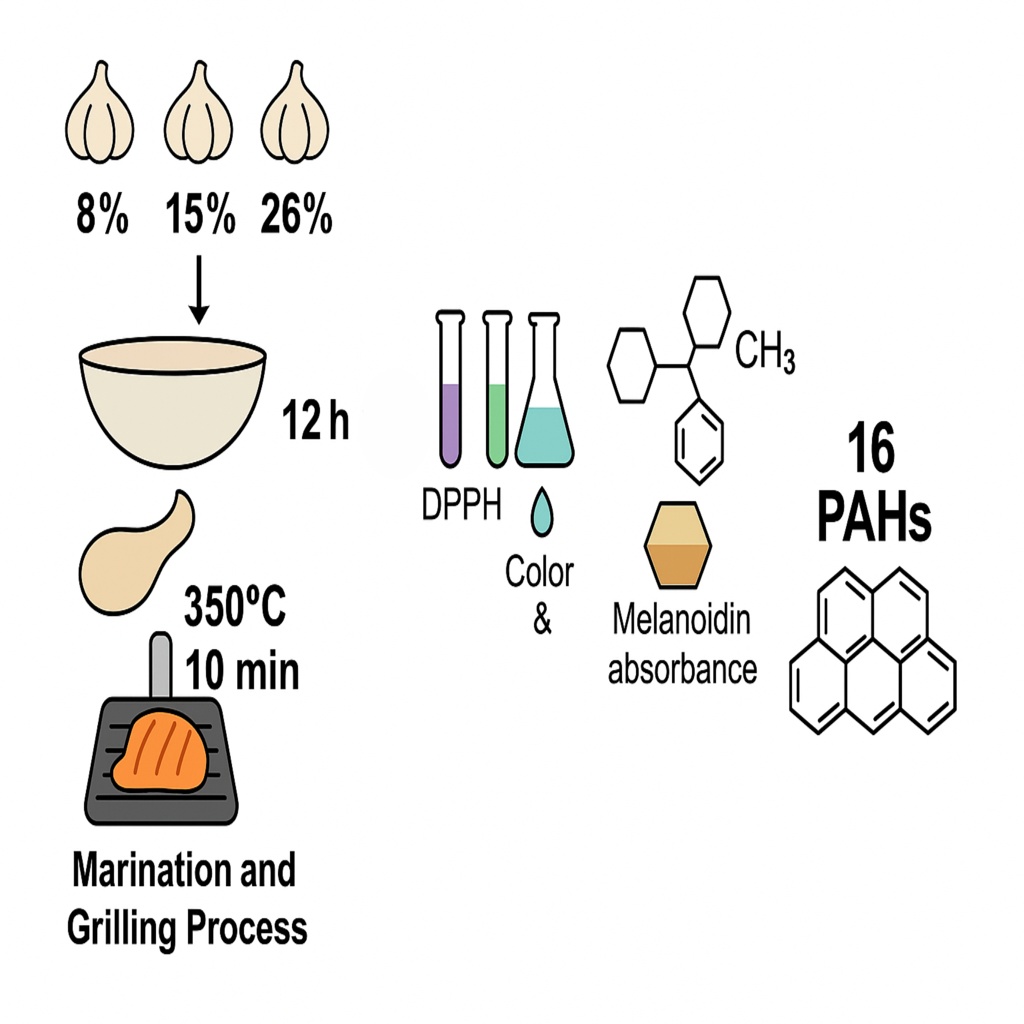
Garlic, a common ingredient in Thai cuisine, is a natural source of antioxidants and may influence chemical reactions during cooking, such as the Maillard reaction and the formation of polycyclic aromatic hydrocarbons (PAHs), which are potential carcinogens. This study investigated the effect of garlic-containing marinades on these processes in grilled chicken. Marinades with 8%, 15%, and 26% garlic were prepared, and chicken breasts were marinated for 12 hours. A non-marinated sample served as the control. All samples were grilled on a hotplate at 350 °C for 10 minutes. Antioxidant activity of the marinades and marinated chicken was assessed using DPPH assay (2,2-diphenyl-1-picrylhydrazyl) and ABTS assay (2,2'-azino-bis(3-ethylbenzothiazoline-6-sulfonic acid), and total phenolic content was measured. The Maillard reaction was evaluated through color change and melanoidin absorbance, while 16 PAHs were quantified using Gas Chromatography–Mass Spectrometry. The results showed that higher garlic concentrations enhanced the antioxidant activity of the marinades but did not significantly affect Maillard reaction markers or PAH formation. The limited PAH levels observed are likely due to the grilling method—specifically, the use of a hotplate heat source, its temperature, and the cooking duration—which may not induce substantial PAH production. These findings suggest that garlic enhances antioxidant properties in marinades but may have limited impact on PAH mitigation under the cooking conditions used.
Article Details

This work is licensed under a Creative Commons Attribution-NonCommercial-NoDerivatives 4.0 International License.
The content and information in the article published in Journal of Rajamangala University of Technology Srivijaya It is the opinion and responsibility of the author of the article. The editorial journals do not need to agree. Or share any responsibility.
References
Alomirah, H., Al-Zenki, S., Al-Hooti, S., Zaghloul, S., Sawaya, W., Ahmed, N. and Kannan, K. 2011. Concentrations and dietary exposure to polycyclic aromatic hydrocarbons (PAHs) from grilled and smoked foods. Food Control 22(12): 2028–2035. DOI: https://doi.org/10.1016/j.foodcont.2011.05.024
Alshahrani, S.M., Alotibi, R.E., Al-Zahrani, H.S. and Al-Zahrani, S.A. 2021. Influence of grilling methods and flame orientation on PAH levels in meat products. Journal of Food Composition and Analysis 97: 103754.
Alvarado, C.Z. and McKee, S.R. 2007. Marination to improve functional properties and safety of poultry meat. Journal of Applied Poultry Research 16(1): 113–120. DOI: https://doi.org/10.1093/japr/16.1.113
Andrade, C.D., Seiquer, I., Haro, A., Castellano, R. and Navarro, M.P. 2010. Development of the Maillard reaction in foods cooked by different techniques: Intake of Maillard-derived compounds. Food Chemistry 122: 145–153. DOI: https://doi.org/10.1016/j.foodchem.2010.02.031
Banerjee, S., Panda, A., Das, A. and Dey, S. 2022. Garlic-derived bioactive sulfur compounds: Recent developments in their antioxidant and health-promoting activities. Current Nutrition & Food Science 18(2): 182–193.
Batiha, G.E., Beshbishy, A.M., Wasef, L.G., Elewa, Y.H., Al-Sagan, A.A., Abd El-Hack, M.E., Taha, A.E., Abd-Elhakim, M.Y. and Hetta, H.F. 2020. Chemical constituents and pharmacological activities of garlic (Allium sativum L.): A review. Nutrients 12(3): 872-890. DOI: https://doi.org/10.3390/nu12030872
Chaemsai, S., Kunanopparat, T., Srichumpuang, J., Nopharatana, M., Tangduangdee, C. and Siriwattanayotin, S. 2016. Reduction of the polycyclic aromatic hydrocarbon (PAH) content of charcoal smoke during grilling by charcoal preparation using high carbonisation and a preheating step. Food Additives and Contaminants: Part A 33(3): 385–390. DOI: https://doi.org/10.1080/19440049.2016.1143124
Chen, B.H., and Lin, Y.S. 1997. Formation of polycyclic aromatic hydrocarbons during processing of duck meat. Journal of Agricultural and Food Chemistry 45: 1394–1403. DOI: https://doi.org/10.1021/jf9606363
Farhadian, A., Jinap, S., Abas, F. and Sakar, Z.I. 2010. Determination of polycyclic aromatic hydrocarbons in grilled meat. Food Control 21(5): 606–610. DOI: https://doi.org/10.1016/j.foodcont.2009.09.002
Farhadian, A., Jinap, S., Hanifah, H.N. and Zaidul, I.S. 2011. Effects of meat preheating and wrapping on the levels of polycyclic aromatic hydrocarbons in charcoal-grilled meat. Food Chemistry 124: 141–146. DOI: https://doi.org/10.1016/j.foodchem.2010.05.116
Gibis, M. 2007. Effect of oil marinades with garlic, onion, and lemon juice on the formation of heterocyclic aromatic amines in fried beef patties. Journal of Agricultural and Food Chemistry 55: 10240–10247. DOI: https://doi.org/10.1021/jf071720t
Hossen, M.J., Kim, M.Y., Cho, J.Y. and Kim, J.H. 2020. Therapeutic potential of garlic and its bioactive compounds in age-related neurological disorders. Aging and Disease 11(6): 1444–1457.
Hu, G., Cai, K., Li, Y., Hui, T., Wang, Z., Chen, C., Xu, B. and Zhang, D. (2021). Significant inhibition of garlic essential oil on benzo[a]pyrene formation in charcoal-grilled pork sausages relates to sulfide compounds. Food Research International 141: 110127-110137. DOI: https://doi.org/10.1016/j.foodres.2021.110127
International Agency for Research on Cancer. 1993. Some naturally occurring substances: Food items and constituents, heterocyclic aromatic amines and mycotoxins. IARC Monographs on the Evaluation of Carcinogenic Risks to Humans 56. Lyon: IARC.
Janoszka, B. 2020. PAHs and heterocyclic aromatic amines in meat–Formation, occurrence, and exposure. Food Chemistry 325: 126787-126800.
Lee, J.G., Kim, S.Y., Moon, J.S., Kim, S.H., Kang, D.H. and Yoon, H.J. 2016. Effects of grilling procedure on levels of polycyclic aromatic hydrocarbons in grilled meats. Food Chemistry 199: 632–638. DOI: https://doi.org/10.1016/j.foodchem.2015.12.017
Lu, F., Kuhnle, K., Gunter, M. and Cheng, Q. 2018. The effect of common spices and meat type on the formation of heterocyclic amines and polycyclic aromatic hydrocarbons in deep-fried meatballs. Food Control 92: 399–411. DOI: https://doi.org/10.1016/j.foodcont.2018.05.018
Malarut, N. and Oonsivilai, A. 2022. Grilling techniques and their effects on PAH formation in meat: A case study in Thai cuisine. Environmental Science and Pollution Research 29: 62390–62398.
Mellado-García, P., Maisanaba, S., Puerto, M., Llana-Ruiz-Cabello, M., Prieto, A.I., Marcos, R. and Cameán, A.M. 2015. Genotoxicity assessment of propyl thiosulfinate oxide, an organosulfur compound from Allium extract, intended for food active packaging. Food and Chemical Toxicology 86: 365–373. DOI: https://doi.org/10.1016/j.fct.2015.11.011
Min, S., Patra, J.K. and Shin, H.S. 2018. Factors influencing inhibition of eight polycyclic aromatic hydrocarbons in heated meat model system. Food Chemistry 239: 993–1000. DOI: https://doi.org/10.1016/j.foodchem.2017.07.020
Ni, Z., Lin, H., Zhang, Y. and Lin, Q. 2021. Formation of PAHs in grilled pork and the effect of different grilling methods. Meat Science 181: 108703-108718.
Park, K.C., Pyo, H.S., Kim, W.S. and Yoon, K.S. 2017. Effects of cooking methods and tea marinades on the formation of benzo[a]pyrene in grilled pork belly (Samgyeopsal). Meat Science 129: 1–8. DOI: https://doi.org/10.1016/j.meatsci.2017.02.012
Phillips, D.H. 1999. Polycyclic aromatic hydrocarbons in the diet. Mutation Research 443: 139–147. DOI: https://doi.org/10.1016/S1383-5742(99)00016-2
Prathomtong, W., Suthivarakom, K. and Chaiseri, S. 2016. Effect of grilling temperature and time on the formation of polycyclic aromatic hydrocarbons in chicken meat. Kasetsart Journal - Natural Science 50(5): 698–705.
Ramos, S., Alía, M., Bravo, L. and Goya, L. 2019. Comparative study of PAH formation in meat cooked by various household methods. Food Additives & Contaminants: Part A 36(3): 431–440.
Santonicola, S., Albrizio, S., Murru, N. and Mercogliano, R. 2021. Polycyclic aromatic hydrocarbons (PAHs) in grilled meat: A risk analysis study related to fat content. Foods 10(6): 1275-1289.
Serpen, A., Gökmen, V. and Fogliano, V. 2012. Total antioxidant capacities of raw and cooked meats. Meat Science 90: 60–65. DOI: https://doi.org/10.1016/j.meatsci.2011.05.027
Shahraki, A.H., Rezapour-Firouzi, S. and Golbabaei, F. 2024. Strategies for mitigation of PAHs in grilled meat products: Recent trends and future prospects. Trends in Food Science & Technology 139: 585–594.
Tsai, T.H., Tsai, P.J., and Ho, S.C. 2005. Antioxidant and anti-inflammatory activities of several commonly used spices. Journal of Food Science 70: 93–97. DOI: https://doi.org/10.1111/j.1365-2621.2005.tb09028.x
Wongmaneepratip, W. and Vangnai, K. 2017. Effects of oil types and pH on carcinogenic polycyclic aromatic hydrocarbons (PAHs) in grilled chicken. Food Control 79(9): 119–125. DOI: https://doi.org/10.1016/j.foodcont.2017.03.029
Yurchenko, S. and Mölder, U. 2021. PAH content in grilled meat products under different cooking conditions. Environmental Science and Pollution Research 28(6): 7110–7118.
Zelinkova, Z. and Wenzl, T. 2015. The occurrence of polycyclic aromatic hydrocarbons (PAHs) in food and the dietary exposure of European populations. Comprehensive Reviews in Food Science and Food Safety 14(1): 1–17.
Zhang, Y., Deng, Y. and Li, M. 2022. Effect of antioxidant-rich marinades on PAH reduction in grilled beef. Journal of Agricultural and Food Chemistry 70(15): 4567–4574.
